Construction Technology & Innovation
/
Mar 24, 2026
How to Review Electrical Submittals: A Step-by-Step Guide
Not sure where to start with electrical submittal reviews? This guide walks through exactly what to check, where most rejections come from, and how to build a repeatable review process your whole team can follow.

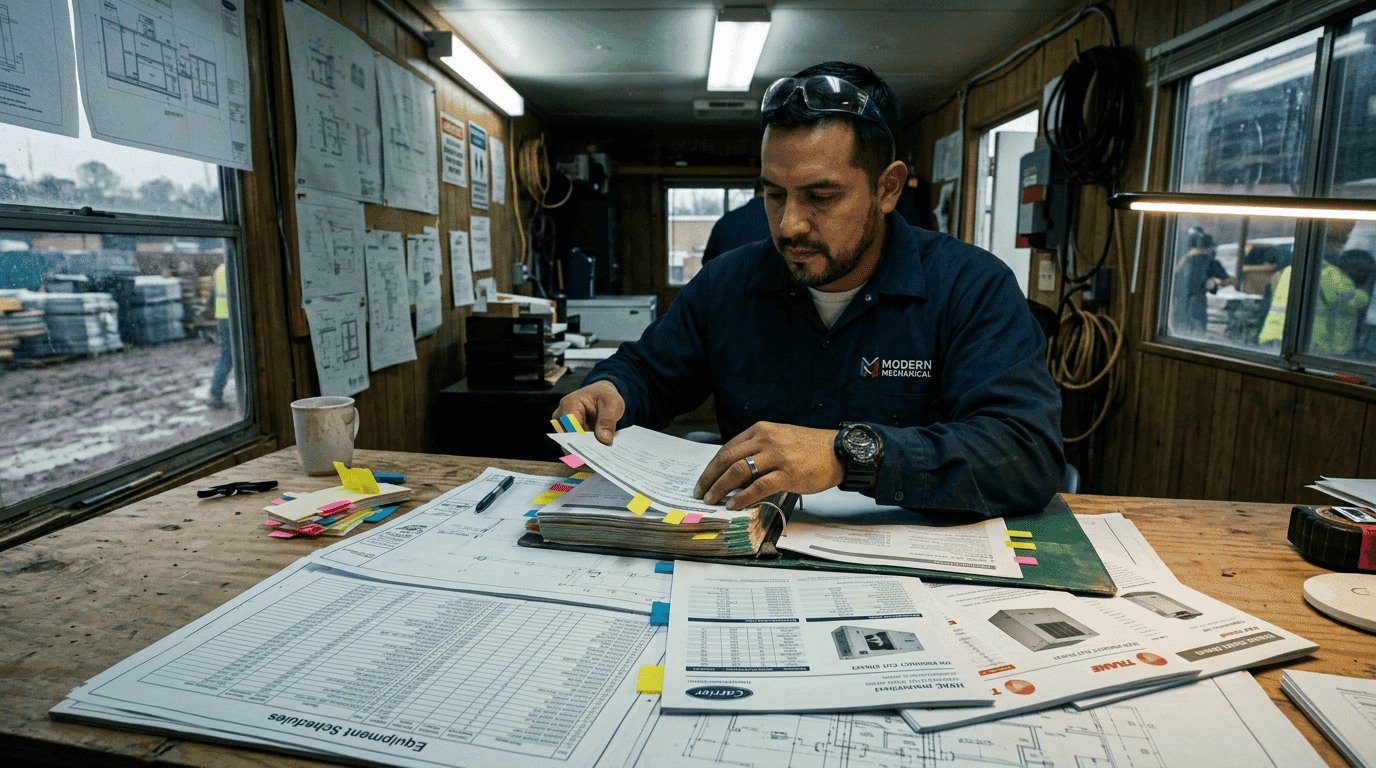
Ask most construction professionals which submittal type causes the most headaches on a busy construction project and the answer is almost always lighting fixtures.
Not because any single fixture is particularly complicated, but because there are so many of them. Knowing how to review electrical submittals effectively isn't just about catching one bad cut sheet - it's about building a submittal review process that holds up when you're staring down a fixture schedule with 80 different types across a school, a hospital wing, or a commercial office fit-out.
That volume is what makes Division 26 structurally different from mechanical. The structural difference traces back to how the MasterFormat divisions separate electrical scope from mechanical, with Division 26 covering everything from switchgear and distribution to branch circuits and fixture connections.
A single air handler submittal might involve 30 or 40 technical characteristics to verify. An electrical submittal review covering a mid-size construction project can involve 60 to 100 individual fixture types, each requiring its own compliance pass.
Understanding the construction submittal review process helps explain why rejection rates across the construction industry hold at roughly 35%. It's a problem BuildSync tracks closely, and one that comes up in nearly every conversation with GCs and electrical subs.
Electrical submittals contribute disproportionately to that figure because the volume of individual verification points creates more surface area for things to slip through. Every rejection adds weeks to the project schedule - and the general contractor, the design team, and the subcontractor all absorb that cost.
What's Actually in a Construction Submittal Package
Before the submittal process starts, the general contractor's construction manager needs a clear picture of scope. An electrical submittal package under Division 26 covers a wide range of equipment, and not all of it demands the same review depth.
Product data submittals for lighting fixtures sit at one end of the complexity scale; switchgear and generator packages with full test reports and manufacturer specifications sit at the other.
Understanding that range before the first construction submittal lands is how the general contractor's project team allocates review time correctly.
Equipment Type | Review Complexity |
Lighting fixtures (luminaires) | High - large quantity, fixture-specific characteristics, DLC and energy code compliance |
Panelboards | Medium-High - bus ratings, AIC, circuit schedules, manufacturer specifications |
Switchgear / switchboards | High - interrupting capacity, bus coordination, contract documents review |
Dry-type transformers | Medium - efficiency class, kVA, voltage, enclosure type |
Generators | High - kW rating, fuel system type, transfer switch coordination, compliance documentation |
Low-voltage systems (fire alarm, data, AV) | Medium - device listings, system compatibility, product data submittals |
Wiring devices, conduit, wire/cable | Low - UL listing, spec compliance, material certifications |
Shop drawings - which cover system layout and installation details - run on a parallel track and require their own submittal process. Shop drawings are not product data submittals, and the construction manager needs to track them separately on the submittal schedule.
This guide covers the product data side of Division 26: the cut sheets, manufacturer specifications, and test reports that move through the construction process from the electrical sub to the design team for technical compliance review.
Want to see how BuildSync breaks down a Division 26 submittal package automatically? Book a demo.
The Review Process: What to Check at Each Stage
The equipment types above each require a different review approach. The steps below cover what to check for the highest-rejection categories first - lighting fixtures and power distribution equipment - before moving into certifications and how to handle ambiguous characteristics.
Step 1: Submittal Preparation - What the General Contractor Verifies First
The submittal process starts well before anyone opens a cut sheet. Before the construction manager reviews anything, the general contractor's project team needs to confirm that the submitted products match the right equipment tags, locations, and applications on the drawings - and that the submittal package is complete.
On a busy construction project, this check gets skipped because it feels obvious. It's also where the most avoidable rejections originate. A responsible contractor treats this alignment step as a formal quality gate, not a formality.
The general contractor's construction manager reviews submittals for completeness before anything moves forward - checking that every piece of the package is present and that each submittal carries a completed transmittal form referencing the correct spec section, project name, revision number, and submission date.
Check the following before any submittal moves to the design team:
Fixture type designations on the luminaire schedule match what's been submitted - SK4, TYP-A, TYP-B - and every tag in the submittal documents has a corresponding entry
Equipment tags on the drawings align with every product being proposed, with no gaps
Products submitted match the right application - wet location fixtures where wet ratings are required, hazardous-location equipment where called for by the architect or engineer, tamper-resistant devices where occupancy type requires them
Every substitution is flagged as a substitution and supported by equivalency documentation that preserves design intent - not assumed to be an acceptable alternate without review
Each submittal references the correct spec section, project name, and revision number
Every rejection the general contractor catches during submittal preparation costs an afternoon. The same rejection caught during design team review costs 2 to 4 weeks on the project schedule. That's the math that makes thorough review at this stage worth the time.
Step 2: What to Check on Lighting Fixture Submittals
Lighting submittals are where volume pressure hits hardest in the submittal review process. The construction manager and the general contractor's project team have to run a separate review for each fixture type - there is no shortcut. Volume is the defining challenge of Division 26. Physical examples of rejected submittals from past projects are the fastest way to train a project team on what to look for.
On a large construction project, one non-compliant submittal hiding inside a 60-fixture schedule can trigger a revise and resubmit from the design team that delays the project schedule by weeks. Product data submittals for lighting are the highest-frequency review task in Division 26, and the submittal review process for them cannot be rushed.
For each fixture type in the package, the submittal review should verify:
Lumen output: Product data must match the actual product configuration being submitted, not a generic catalog entry. Submitted lumens need to meet or exceed the designed footcandle levels.
Color temperature (CCT): 3000K, 3500K, and 4000K are not interchangeable. Project requirements frequently call for a specific CCT range by space type, and this is a technical requirement that slips through under time pressure.
Color Rendering Index (CRI): Healthcare, retail, and high-end office specs commonly require CRI 90+. A fixture that's CRI 80 when CRI 90 is specified is a submittal the design team will reject.
Mounting type and configuration: Recessed, surface, pendant, track - and within those categories, trim type, aperture size, and ceiling compatibility all determine whether the submittal complies with design intent.
Lens and diffuser selection: A frosted polycarbonate lens may be called out in the project requirements, but if the sub hasn't selected that option on the submittal form, it won't be what ships. This is one of the most common sources of non-compliant submittals the design team flags, and it reflects a pre-submission error, not an equipment problem.
Dimming compatibility: 0-10V, TRIAC, DALI, or proprietary - the driver in the manufacturer specifications must match the control system specified by the architect or engineer, especially on construction projects with building automation integration.
Wattage vs. Lighting Power Density: The technical requirements under ASHRAE 90.1 and IECC energy codes set wattage limits per square foot by space type. A higher-wattage alternate can push a zone over the LPD limit when the architect or engineer reviews the engineering calculations for LPD compliance. This is easy to miss when reviewing lighting at volume.
DLC listing status: Many project requirements specify DLC Premium, not just DLC Listed. These are different tiers with different efficacy thresholds. The submittal complies only when it meets the specific tier called out in the specifications.
The Documentation Version Mismatch Problem
The most common reason lighting fixture submittals get rejected by the design team isn't that the fixture is wrong - it's that the documentation doesn't match the product being submitted.
An LM-79 photometric test report might reference a different driver model than the cut sheet. A UL certification falls outside a jurisdiction's validity window. Manufacturer specifications from an older product version show different performance data than what's currently sold.
Proper documentation means every document in the submittal package is internally consistent - the same model number, the same configuration, the same revision date across the cut sheet, test reports, and certifications.
Cross-check that test reports and certifications reference the same model number and configuration as the cut sheet. The National Electrical Contractors Association (NECA) publishes installation standards that give submittal reviewers a benchmark for what complete, consistent submittal documents should look like on a commercial construction project.
If the documents don't align internally, resolve it before the submittal reaches the design team. This is one of the failure patterns that BuildSync surfaces automatically during review.
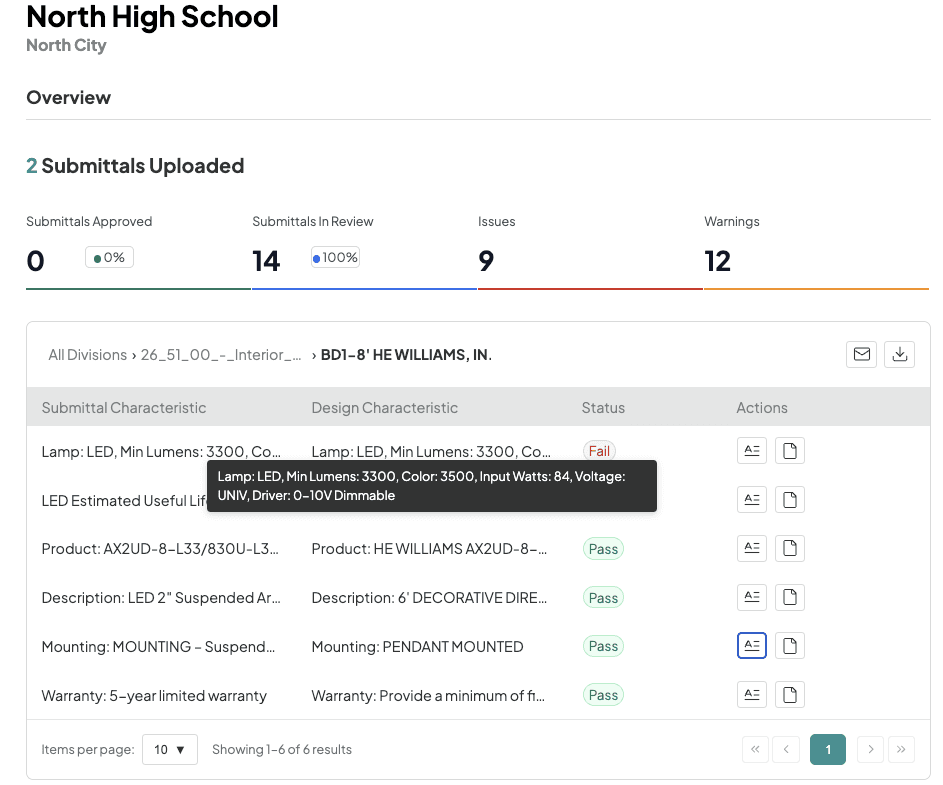
When asked about why lighting fixture submittals are often considered one of the most frustrating across divisions - Tom Port, the co-founder of BuildSync, says:
It’s funny - we tend to love lighting fixtures, while our customers usually don’t. The issues we see aren’t major, obvious mistakes; they’re small, repetitive ones that add up quickly.
Things like incorrect CCT values or the wrong DLC tier slipping through at scale, or documentation that doesn’t perfectly match the specified fixture configuration. Individually, these might seem minor, but when they’re repeated across 50 or 100 fixtures, that’s when rejection cycles start to build.
Step 3: What to Check on Power Distribution Equipment
Panelboards, switchgear, transformers, and generators require a different approach from the general contractor's construction manager. The fixture count problem disappears, but technical compliance per item becomes more demanding - and the consequences of a missed technical requirement are more severe. These are long-lead items: switchgear commonly runs 26 to 40 weeks from order to delivery on a commercial construction project.
A submittal rejected by the design team for a long-lead power distribution item can push back procurement by 4 to 6 weeks, compressing the project schedule in ways the entire project team absorbs through schedule delays.
For panelboards and switchgear, the submittal review should verify:
Bus and breaker ratings: The main bus ampacity must match the feeder schedule in the contract documents. Individual breaker trip ratings and frame sizes need to align with the panel schedule. This is a check the construction manager can run directly against the drawings.
Interrupting capacity (AIC rating): Must meet or exceed available fault current at the point of installation. Under-rated equipment is a code violation. A structural engineer or electrical engineer of record will flag this immediately during design team review.
Voltage and phase configuration: 120/208V 3-phase 4-wire vs. 277/480V - wrong voltage is a full rejection from the design team, no exceptions. This is the kind of technical compliance failure that has downstream schedule impacts across the entire project.
Enclosure type and NEMA rating: NEMA 1 indoor general purpose isn't acceptable where the architect or engineer specifies NEMA 3R or NEMA 4. Mechanical rooms, rooftop installations, and wet areas carry specific project requirements tied to design intent.
UL listing: The UL listing in the manufacturer specifications must match the installation environment and intended application.
For dry-type transformers, also verify during the submittal review:
Efficiency class: DOE 2016 standards set minimum thresholds, but some project requirements and contract documents specify higher efficiency. Verify against the drawings - not just the kVA figure in the specification sheet.
Temperature rise rating: 80°C vs. 115°C affects sizing in confined spaces and enclosures. This technical requirement is easy to overlook when reviewing submittal packages under pressure.
kVA rating and voltage taps: Must match the transformer schedule in the contract documents exactly. Confirm primary and secondary voltages and tap configurations - run the engineering calculations to catch any mismatch before the order is placed. Risk management here means catching a mismatch before the order is placed, not after the equipment arrives on the construction project.
![BuildSync 'fail' example showing a panelboard or transformer submittal with submitted value vs. spec value side-by-side]](https://framerusercontent.com/images/rza3CLgImNQvGSDLpLFgNGqZkU.png)
Step 4: Certifications and Listings - The Quality Control Checkpoint Before Design Team Review
Certifications are technical compliance requirements, not administrative paperwork. A missing or misapplied certification is the clearest quality control failure in the entire submittal review - either the proper documentation is present, or the submittal fails. There is no gray area.
The construction manager's role in the approval process is to run this quality control process before the design team ever sees the package. Anyone who lets certification gaps through to the design team approval process adds weeks to the project schedule for issues that take minutes to catch.
Certification / Listing | When It's Required |
UL Listing | Effectively all electrical equipment - panelboards, switchgear, fixtures, devices |
DLC Listed / DLC Premium | Lighting on construction projects requiring rebate eligibility or energy code compliance; Premium tier when specified |
ETL Listing | Acceptable alternative to UL for many products - verify the contract documents don't exclusively require UL |
Energy Star | Specified for residential-type products, some commercial lighting |
NFPA 110 compliance | Emergency and standby power systems, generators |
NEMA certification | Enclosure type for motors, panels, and equipment in specific environments |
One detail that catches many construction professionals off guard: DLC certification is not permanent. Products are removed from the DLC Qualified Products List when new technical requirements take effect and the product hasn't been re-certified. A submittal with a DLC listing from two years ago may no longer be valid.
Check the live list before the submittal moves forward - not just the cut sheet. This quality assurance step takes five minutes and prevents a risk management failure that can cost weeks on the project schedule. The general contractor's construction manager should build this check into the standard submittal review on every construction project.
Step 5: How to Handle Unknowns in the Construction Submittal Process
Not every characteristic in a submittal review is a clean pass or fail. Some land in ambiguous territory - the spec calls for a corrosion-resistant coating to protect design intent, and the product data just says "coated." Or the construction submittal process surfaces a project requirement that references a specific NFPA section, and the manufacturer specifications don't address it.
These unknowns are a real part of the review and approval process, and how the general contractor's construction manager handles them determines whether the submittal moves forward or stalls.
Unknowns in the submittal process fall into three categories:
The technical data is missing from the submittal documents entirely - needs to be requested from the sub or manufacturer in a timely manner before the package moves to the design team
The submittal addresses a project requirement in general terms without the specific technical data needed to confirm compliance - needs a supplemental manufacturer specifications sheet in a timely manner
The spec and the submittal use different terminology for what appears to be the same characteristic - needs written confirmation from the manufacturer to resolve the ambiguity against the contract documents
The general contractor's job in the submittal review process is to resolve unknowns before anything reaches the design team. Sending a package to the architect or engineer with unresolved ambiguities invites rejection - or a long back-and-forth that adds schedule delays the construction manager and the entire project team absorb.
Resolving those unknowns is faster than any revise and resubmit cycle. Issue an RFI if the project specifications are unclear on a point. Request supplemental technical data from the manufacturer in a timely manner. Front-loading that resolution is risk management.
The GC and design team both lose when the same unknowns bounce back and forth when they could have been resolved at the construction manager level.
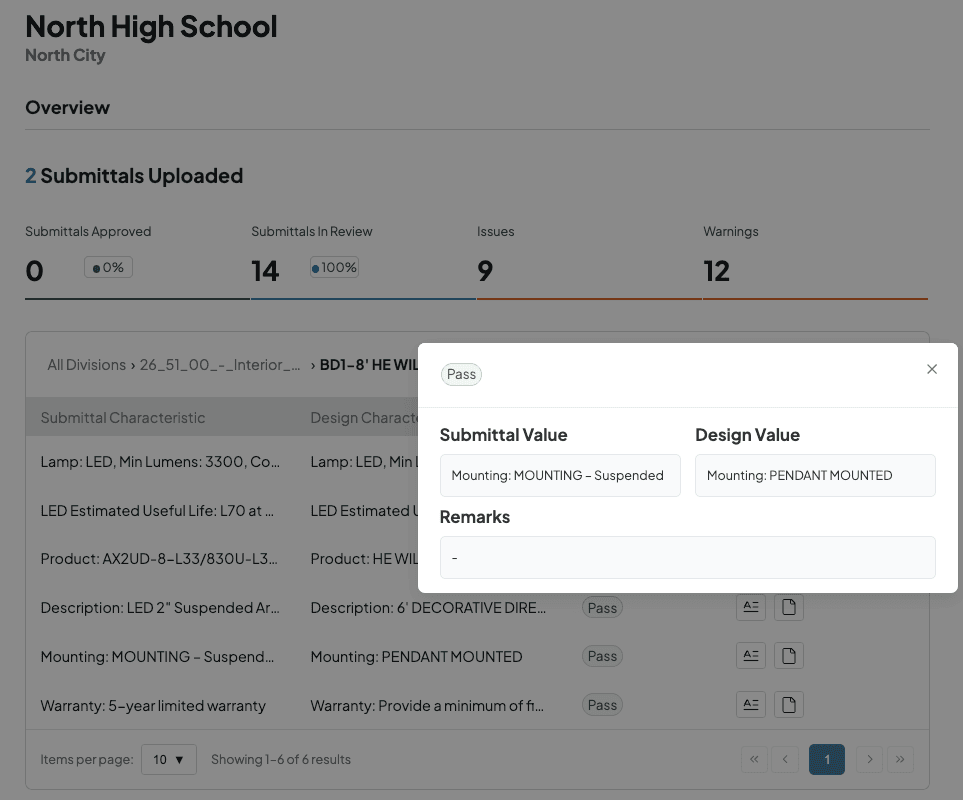
Building a Repeatable Submittal Review Workflow for the General Contractor
A single thorough review doesn't fix a systemic problem. Construction professionals with consistently low rejection rates have built a submittal review process that doesn't depend on any one person's institutional knowledge or their workload on a given week.
When the general contractor's construction manager and project team follow the same submittal process on every construction project, the results become predictable - and the design team receives cleaner submittals.
Build equipment-specific checklists before the first submittal arrives
A checklist built from Section 26 50 00 of your actual project specifications is a working tool. Pull every verifiable requirement, note its source page, and distribute it to the entire project team before the first submittal arrives. This is how a responsible contractor keeps non-compliant submittals out of the queue and ensures every review meets the same standard.
A project engineer working from a spec-based checklist catches the same technical requirements a senior construction manager would catch - because the checklist does the institutional memory work.
A working lighting fixture checklist should cover:
Lumens
CCT
CRI
Mounting type
Lens/diffuser selection
Dimming protocol
DLC tier
Wattage vs. LPD limit
Test reports alignment
UL listing
Warranty terms
That's eleven checkpoints minimum - your project specifications will add more. The same approach applies to shop drawings: the general contractor should build a shop drawings review checklist before they arrive, not after the first one comes back. A team working from the same checklist rarely loses weeks to avoidable rejections.
Establish what 'complete' means before the submittal process starts
Run a submittal kickoff with your electrical sub early in the construction project. Define exactly what manufacturer specifications, certifications, installation instructions, and documentation are required for each equipment type.
Use a Procore-based submittal workflow to track the submittal schedule and submission status, but don't let the submittal workflow tool substitute for the conversation. Getting the owner and design team - and the entire project team - on the same page at the start of the construction submittal process is what prevents rejected submittals from stacking up later.
Approved submittals don't happen by accident; they happen because the submittal process was defined clearly before the first package landed.
Train project engineers on what to look for, not just how to look
A first-year engineer conducting their first independent review of a lighting submittal doesn't know that DLC Premium and DLC Listed are different tiers, or that the lens configuration needs to match the specific fixture designation - not just the fixture family.
The construction manager's job isn't just to review submittals - it's to develop the project team so the submittal process scales. Pair checklists with annotated examples of non-compliant submittals from past construction projects. That combination accelerates technical development across the board.
Common Submittal Challenges: When the Submittal Process Isn't Keeping Up
There's a point on every large construction project where the volume of project submittals outpaces the construction manager's capacity for thorough review. It happens during the first few months when everything arrives at once - lighting packages, panel schedules, switchgear submittals, shop drawings, low-voltage systems - all competing for attention on the same submittal schedule while the construction schedule keeps moving.
Why the process breaks down at volume
Managing construction submittal reviews at scale is where things most commonly go sideways. Incomplete packages, documentation mismatches, and missed certifications slip through when the review process is compressed under pressure. These are the same patterns that drive submittals back from the design team week after week.
This isn't a people problem. A construction manager handling 15 open submittals simultaneously can't give every one the same depth of attention. The reviews that suffer most are the complex, high-volume ones - lighting packages, A/V documentation, anything where compliance detail lives inside dozens of individual line items. When non-compliant submittals reach the design team, it erodes the GC-design team relationship and puts the project schedule at risk.
How Monteith Construction handled it
Monteith Construction's project team ran into exactly this on a school construction project. Project Engineer Jacob Delargy described a 530-page A/V submittal as the kind that would normally consume days of a PE's time before anything moved to the design team. Their solution was to use BuildSync to handle technical compliance review first - surfacing which submittals needed the construction manager's attention and which were already clean.
PM Daniel Recktenwald described the practical outcome: the submittal process went from dominating the entire week to being part of the day. That shift happens when the technical extraction burden is removed from manual review. More submittals move through on the first pass. The construction manager stays in control of final approval. The project schedule holds.
The closeout benefit
As-built drawings at project closeout also benefit from a cleaner submittal process. When approved submittals are documented accurately throughout the project - with clear records of what was reviewed, what passed, and what was revised - the as-builts reflect what was actually installed.
That matters for quality assurance and future work on the same site. A searchable audit trail makes the entire process traceable and gives the construction manager and project owner a defensible closeout record.
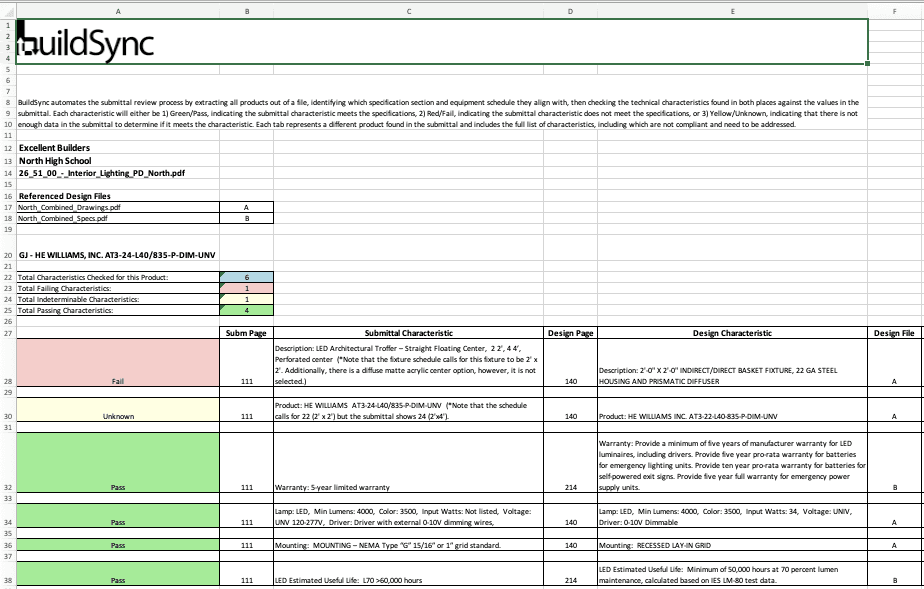
The approach isn't about removing the construction manager or project engineer from the review and approval process. Construction submittal reviews still require human judgment - BuildSync just handles the technical extraction first.
BuildSync handles the systematic technical comparison - extracting characteristics from the submittal and checking them against project specifications - and the project team reviews the output, resolves unknowns, and decides what moves to the design team. The design review stays with the humans responsible for it. The project schedule benefits because the submittal review process no longer stalls the construction project at its most critical moments.
Want to see how BuildSync handles electrical submittal reviews at scale?
Frequently Asked Questions
What is the difference between DLC Listed and DLC Premium for lighting fixture submittals?
DLC Listed and DLC Premium are two separate certification tiers with different efficacy requirements. DLC Premium requires higher lumens-per-watt performance than standard DLC Listed, and most utility rebate programs require Premium status for rebate eligibility. If project requirements specify DLC Premium and the submitted product data is only DLC Listed, the submittal fails regardless of everything else in the package. Always check the spec language and verify the product's current DLC tier against the DLC Qualified Products List, not just the cut sheet. This is one of the most avoidable causes of rejection in the entire submittal process - catching it takes two minutes and protects the project schedule.
Do electrical submittals need to be organized by spec section or can they be bundled?
Who is responsible for reviewing electrical submittals - the general contractor or the electrical sub?
How do drawing revisions affect already-submitted electrical equipment?
What happens if a submittal is approved but the wrong product gets installed?
Related reads for you
Discover more articles that align with your interests and keep exploring.


