Industry Insights
/
Sep 24, 2026
Product Data Submittals: Examples, Forms, and Requirements
A product data submittal is the manufacturer documentation proving a product meets spec. See what it includes, a real example, and the forms GCs expect.


A product data submittal is the manufacturer documentation a contractor submits to prove proposed materials and equipment meet the project specifications before anything gets ordered and installed. Cut sheets, performance characteristics, certifications, and technical documentation, all assembled against a specific spec section. That part is straightforward.
Here's the part the construction industry rarely puts in the definition. In the construction submittal process, a large share of product data submittals that come back marked "revise and resubmit" had the correct product in them the whole time.
The product was fine. The documentation didn't prove it.
What Does a Product Data Submittal Include?
Every product data submittal is built from the project requirements written into the spec section governing that scope of work, usually in PART 1 of the section under CSI's SectionFormat structure.
What the section asks for is what belongs in the submittal package.
Component | What it proves | Where the requirement originates |
Manufacturer cut sheet | The proposed product exists as described, with the model number on the submittal | PART 1 submittal article of the spec section |
Performance and technical data | Ratings meet the numeric thresholds the specs set | PART 2 of the spec section, plus equipment schedules on the drawings |
Certifications and listings | The product meets referenced standards | Spec references to UL, AHRI, ASTM, or NEMA |
Installation instructions | The product meets the installation requirements as detailed | PART 3 of the spec section |
Warranty documentation | Coverage term matches the contract requirements, and the document carries into project closeout | Spec section or the project manual, Division 01 |
Anything beyond that list is padding. Anything missing from it is a reason for a reviewer to stop reading.
A Product Data Submittal Example, Characteristic-by-Characteristic
This product data submittal example uses a rooftop unit on a commercial construction project. The submittal documents arrive as a 70-page package covering one piece of equipment. A project manager or project engineer working through it isn't reading 70 pages.
They're pulling perhaps 60 discrete technical characteristics off those pages and comparing each against the specs and the mechanical schedule.
Three of those comparisons decide the outcome:
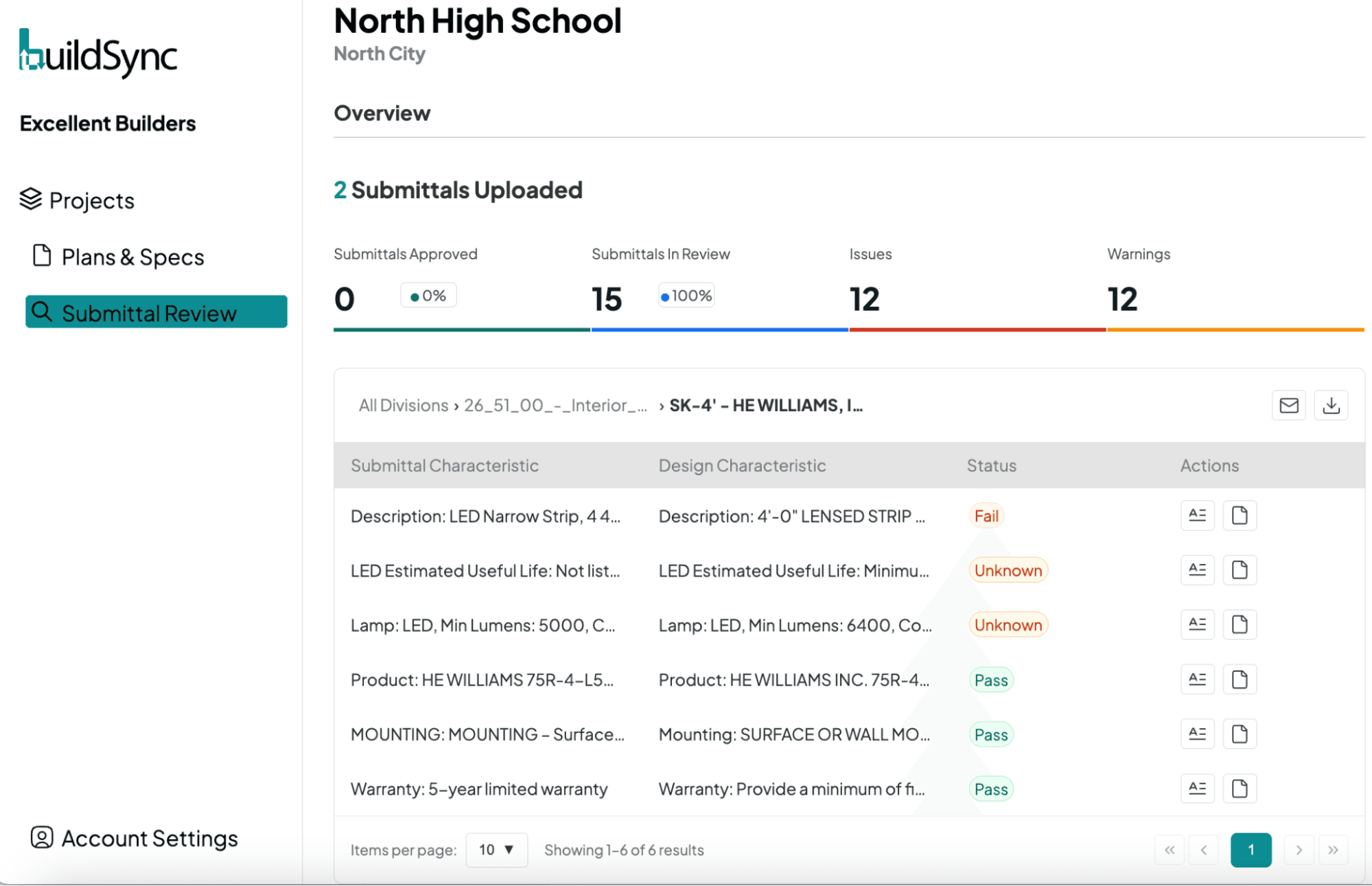
Characteristic | Submittal value | Spec requirement | Status |
Refrigerant type | R-454B | R-410A | Fail |
Filter rating | MERV 8 | MERV 13 (Division 23) | Fail |
Extra materials | Not listed | Spare fan belts required | Unknown |
The first two are visible to anyone comparing values side by side. The refrigerant is an outright mismatch, and the filter rating is the same category answered differently. The third one is invisible unless the reviewer is reading the spec section looking for what should be there, which is a different and slower kind of reading.
Three Ways a Construction Submittal for Product Data Gets Rejected
Grouping rejections by cause makes the pattern clearer than grouping them by trade.
The data doesn't match the project specifications
The straightforward case. A glazing submittal names a manufacturer that isn't on the spec's approved list. A light transmittance value reads 33% against a 42% minimum. The submitted product and the specified product are different things, and the architect and design team return it accordingly.
These are the rejections everyone pictures. They're also the minority.
The right product with the wrong option selected
More common and harder to see. Consider a lighting submittal covering fixture type SK4. The luminaire schedule calls for a frosted polycarbonate lens. The manufacturer's data sheet shows every lens option the fixture supports, and the sub submitted that sheet without circling the frosted option.
Nothing on the page is wrong. The product line is correct, the fixture is correct, the sheet is authentic. What's absent is proof that the specified configuration is the one being purchased. The reviewer has no way to confirm which lens shows up on site, so the submittal goes back and the project schedule absorbs another cycle.
The requirement the data sheet never answers
The third category is silence. The specs require a 10-year warranty from substantial completion and the submittal never mentions warranty terms. Or the specs require corrosion-resistant coil coating for a coastal site, the data sheet confirms a coating is applied, and it never says whether that coating is corrosion resistant.
This is the category that produces the most frustrating approval delays, because both parties are technically reading the same document and arriving at different conclusions. The sub sees a complete cut sheet. The design team sees an unanswered contract requirement.
When asked which of the three failure modes appears most often across the submittals BuildSync has processed, and why silent omissions are more likely to slip past experienced reviewers than outright mismatches, Tom Port, the co-founder of BuildSync, says:
“What we see most often isn’t necessarily the completely wrong product; it’s a product that’s broadly correct, but the package doesn’t prove that the exact required option, configuration, or accessory was selected.
Silent omissions are especially easy to miss because there’s no obvious bad value to catch. If the spec requires a 10-year warranty and the submittal says nothing about warranty, the reviewer has to know to look for that absence. An outright mismatch puts two conflicting values in front of you. An omission asks you to notice something that isn’t there, and that’s much harder when you’re reviewing hundreds of characteristics.”
Try BuildSync free on a few of your most complex submittals.
What Goes on a Product Data Submittal Form?
The form is the transmittal and cover sheet that carries the package. It tells a reviewer what they're holding before they read a single technical page. Six fields belong on the product data submittal form:
Spec section number
Submittal number, with a revision suffix on resubmittals
Product and manufacturer
Responsible contractor
Submittal type
Action being requested
It also carries the general contractor's review stamp, the project's front line of quality control. Under AIA A201 §3.12, the architect's review checks conformance with the design concept rather than the accuracy of every finite detail, which leaves technical verification with the contractor and makes that stamp a contractual act rather than a formality.
Any deviation from the specs belongs on the form explicitly, listed and labeled, rather than buried on page 40 where the design team gets to discover it. A well-built submittal cover sheet does more for approval timelines than most construction teams expect.
How Product Data Differs from Shop Drawings and Material Samples
Three submittal types cover most of what moves through review, and they differ by who creates the document.
Submittal type | What it is | Who produces it |
Product data | Manufacturer literature for a proposed product | Manufacturer |
Shop drawings | Fabrication and assembly detail specific to the project | Fabricator or subcontractor |
Material samples | Physical examples of finishes and different materials | Manufacturer or supplier |
A201 defines product data as manufacturer-furnished illustrations, schedules, performance charts, instructions, brochures, and diagrams that illustrate materials or equipment for a portion of the work.
The distinction that matters in practice: product data comes off the shelf, so the contractor has to mark it up to show which model, options, and finishes were selected. All three demonstrate how the contractor intends to conform to the project's design intent, and none of them are contract documents themselves under the construction contract between the project owner and the contractor.
Subs submit shop drawings for fabricated assemblies, while product data covers catalog equipment. Product data is the highest-volume of the types of submittals on most construction projects, which is why it drives the majority of the review load.
What the Design Team Checks Before Final Approval
Design teams review submittals by checking each specified value against the package, tag by tag, and they move faster when the package anticipates them. Teams that work this way get submittals approved on the first pass more often. Three practices reliably shorten the review and approval cycle.
Reviewers verify specified values one at a time, so mark those values directly on the cut sheet where they can ensure compliance at a glance. If the specs require an MCA of 42 amps, highlight the MCA on the page. Every value a reviewer has to hunt for is a place the submittal can stall and the project timeline can slip.
Reviewers check each tag separately, which is why shared documents need to be broken down to the tag level. One data sheet covering VAV 1-1 through 2-9 is a trap. Confirm the sheet covers each tag and shows the required options selected for each one.
Reviewers work from the spec section rather than the cut sheet, so include a compliance matrix mapping every spec requirement to its page in the technical data. This is the single highest-leverage page in the package, and it's the closest thing to doing the reviewer's job for them. A project team building a repeatable version of this can work from a construction submittal review checklist rather than rebuilding it inside each construction management workflow.
When the Submittal Process Outgrows Manual Review
The practices above work. In real construction project management, though, a project engineer rarely has the hours to apply them to every package once a third concurrent project lands.
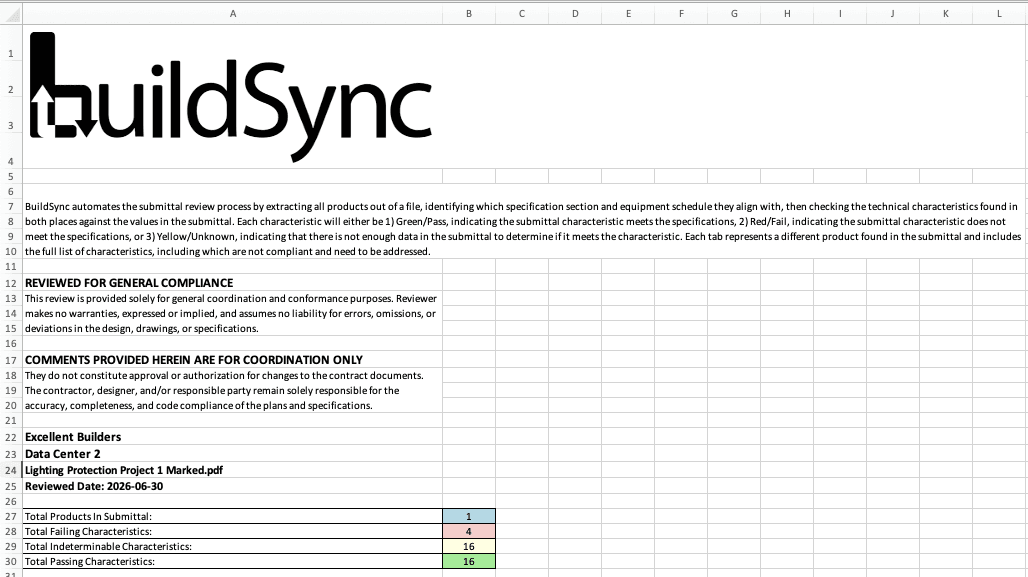
That's where AI-powered submittal review earns its place across the entire submittal process. BuildSync performs deep technical analysis on each submittal: it separates the individual products, extracts every technical characteristic from the product data, and compares each one against the plans and specs to ensure compliance line by line, returning a status and a reason for each.
The unknowns get their own category precisely because silence is a distinct problem from mismatch. Submittal software that only routes documents through an approval workflow doesn't reach this layer.
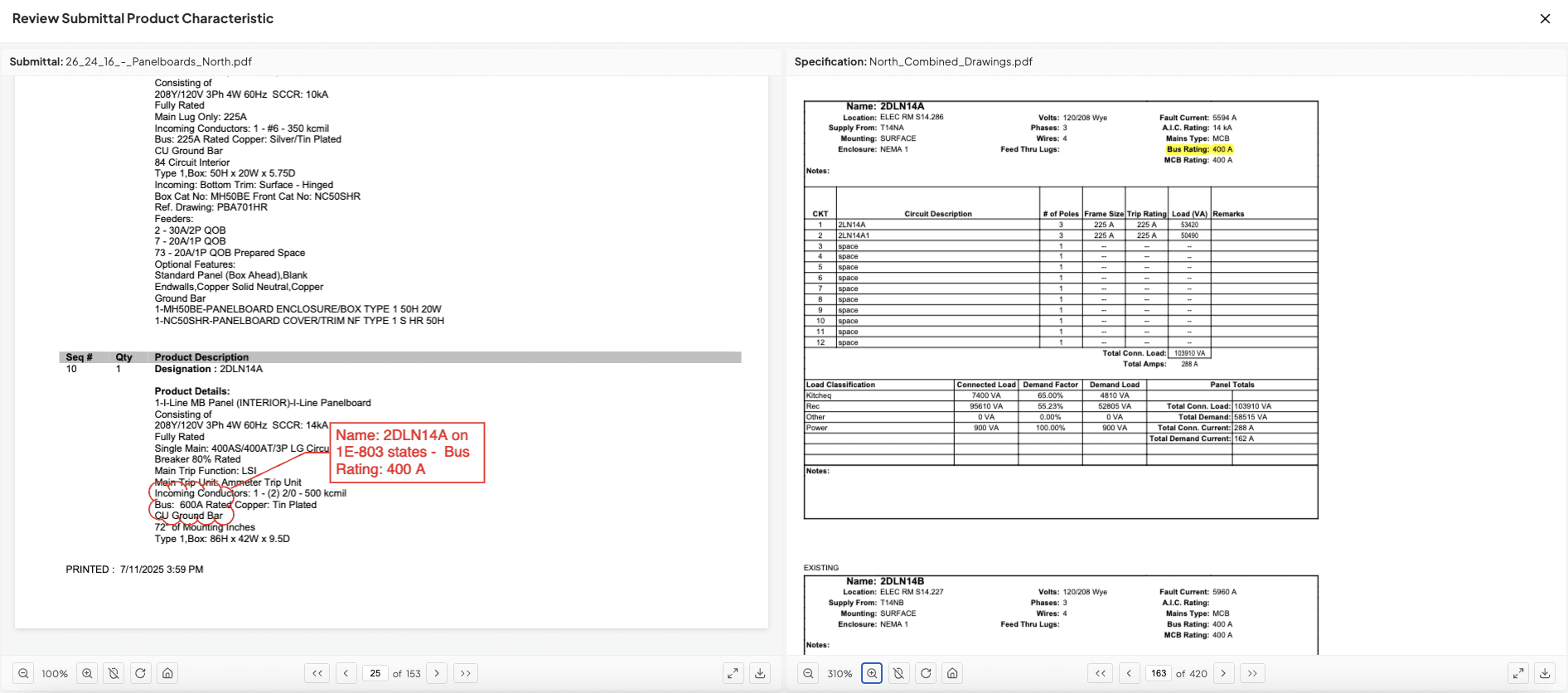
Skepticism among construction professionals about AI reading technical documents is reasonable, given what's riding on the review. The answer BuildSync built for it is verification. Click any characteristic and the original source documents open side by side, submittal page on the left with the value highlighted, spec page on the right with the requirement. Trust but verify, on every line.
The results show up in review capacity and in quality assurance consistency. At Fountain Electric, Shared Services Manager Patrick Bloodsworth reported spending 2 to 3 hours on submittals instead of 2 to 3 days, with the architect returning one approved as noted.
At Monteith Construction, Project Engineer Jacob Delargy reviewed a 530-page submittal against multiple specs, noting it caught references he would not have thought to check in his own review process.
When asked how PEs typically react when BuildSync first flags a characteristic as “unknown” instead of pass or fail, and what that category is actually intended for, Tom Port, the co-founder of BuildSync, says:
Sometimes we hear, ‘Why didn’t it just make a decision?’ But that’s exactly what the unknown category is for. It means the information needed to make a defensible pass-or-fail call isn’t actually in the submittal or the spec. The way to think about the unknowns is that it is really a prompt for the PE to get clarification from the sub, vendor, or design team before that uncertainty turns into a field issue.
See BuildSync in action. Book a demo.
Product Data Submittal FAQs
Who prepares the product data submittal, the subcontractor or the general contractor?
The subcontractor prepares it and the general contractor or construction manager reviews and stamps it before forwarding to the design team. Preparing submittals falls to the sub, which means gathering the necessary documentation for the products in their scope. The GC verifies compliance against the contract documents, which is where most catchable problems should be caught. A single package can pass through multiple stakeholders before it reaches final approval.
How long does the review and approval process take?
Can a product data submittal propose an "or equal" substitution?
What's the difference between "approved as noted" and "revise and resubmit"?
Does every product data submittal appear on the submittal register?
Related reads for you
Discover more articles that align with your interests and keep exploring.