Industry Insights
/
Sep 23, 2026
What Is a Technical Submittal in Construction?
A technical submittal is the documentation a sub provides to prove a product meets spec. See what's included, who reviews it, and where rejections start.


A technical submittal in construction is the package of manufacturer product data a subcontractor provides to prove that a proposed product meets the project specifications before it gets ordered, fabricated, or installed.
It's a formal document set carrying technical data, performance ratings, material data, certifications, and warranty terms, and it moves through the same approval process as every other submittal on the job.
That definition takes about 30 seconds to learn and explains almost nothing about why these packages keep coming back marked revise and resubmit. The rejection rarely traces to a missing document. It traces to one characteristic buried on page 43 that nobody had time to check against the spec.
What a Technical Submittal in Construction Actually Contains
A technical submittal is a stack of claims. Every one of the submittal documents inside it exists to prove one specific thing about the proposed materials, and the design team reviews it claim by claim.
Component | The claim it makes |
Product data sheets | This is the exact model, from a manufacturer the spec approves |
Performance and technical data | Capacities, efficiencies, and ratings meet the numbers written into the spec section |
Dimensional data and installation instructions | It fits the space and installs the way the design intends |
Certifications and test reports | Third-party listings the spec requires (UL, ASTM, ASHRAE) are in hand |
Material data and finishes | The different materials of construction, coatings, and finishes match what was specified |
Warranty documentation | Duration, coverage, and start date basis match the requirement |
Spare parts and attic stock | Closeout commitments are captured now instead of at punch list |
Where material samples and detailed shop drawings fit
Material samples, mock-ups, and detailed shop drawings are different types of submittals with a different job, and each one gets reviewed a different way.
Submittal type | What it is | How it gets reviewed |
Technical submittal (product data) | Manufacturer specifications for an existing product | Characteristic-by-characteristic comparison against the spec |
Material samples | Physical examples of color, texture, or finish | Visual approval against design intent |
Mock-ups | A built prototype or assembly, put up on site | Judged as a standard the finished work has to match |
Detailed shop drawings | Drawings prepared for this project showing fabrication and installation | Engineering interpretation, not data comparison |
Treating all four as one undifferentiated line on the construction submittal log is a small habit that creates real friction later, because each one needs a different kind of thorough review.
Why "Technical Submittal" is not a Term in Your Construction Documents
Search your contract for the phrase and you won't find it. AIA A201-2017 §3.12 names three things: Shop Drawings, Product Data, and Samples. AIA Contract Documents notes that "submittal" is a widely used word that lacks a single definition, and that what qualifies varies by scope, project type, and who's performing the work.
"Technical submittal" is jobsite shorthand the construction industry adopted without ever defining. On most construction projects it maps to product data, but that mapping is assumed rather than agreed.
So the sub builds what they think the package is, the general contractor reviews against what they think it should be, and the architect and design team return it for something neither party had on their list.
Assumed scope is returned scope, and some of the most costly mistakes on a job start as a vocabulary problem that surfaces in the rejection log as an incomplete submission.
When asked what GCs and subcontractors are usually really disagreeing about when they differ on whether a technical submittal is complete, whether it is missing documentation or a different interpretation of the specification, Tom Port, the co-founder of BuildSync, says:
“Most of the time, they’re not arguing about whether a PDF is physically missing. They’re arguing about what the spec actually required the submittal to prove. The sub may look at Part 1 and say, ‘We included every document you asked for,’ while the GC is looking at Part 2 and saying, ‘Yes, but the data you submitted doesn’t demonstrate compliance with the technical requirements.’ That difference in interpretation is where a lot of the friction starts. A package can be complete from a document standpoint and still be incomplete from a compliance standpoint.”
What the Project Specifications Require the Submittal to Prove
The submittal requirements are written down, and they live in two places inside the same spec section. Part 1 lists the necessary documentation the contractor must provide. Part 2 defines the technical requirements those documents have to satisfy.
CSI's SectionFormat standardizes that arrangement across the project manual, which is why the structure holds on every commercial job regardless of who wrote the specs.
Division 01 governs how submittals move: transmittal formats, review windows, resubmittal procedure. The technical section governs what has to be in them. Reviewers who know the Division 01 process cold can still miss failures, because the failures live in the technical section they didn't open.
A complete submittal package satisfies Part 1's list. To ensure compliance, an approved one also has to prove Part 2's numbers. Teams that only work the first half of that sentence end up with a package that contains every required document and still fails.
For a deeper read on how construction specifications are structured and how the three specification types change what verification looks like, that guide covers it in full.
Who reviews construction submittals, and what the design team checks
Three parties review submittals on the same package and each one asks a different question.
Reviewer | The question they're asking |
Subcontractor preparing the package | Is everything the spec section listed in the file? |
GC project manager or project engineer | Does the submitted technical data match the project requirements, line by line? |
Architect and design team | Does this conform to design intent and the contract documents? |
That middle stage is where the contractual weight sits, and where the technical submittal stops being paperwork and becomes quality assurance.
Under A201, the responsible contractor who submits product data is representing to the owner and architect that the submittal has been reviewed and coordinated against the requirements of the work. It is also where the most catchable failures should die, and where project complexity most often wins.
Where the Construction Submittal Process Breaks Down: Incomplete Submissions and Unchecked Characteristics
The construction submittal process fails on arithmetic more often than on carelessness. A technical submittal isn't reviewed as a document. It's reviewed as a list of individual comparisons, and the list is longer than most reviewers realize.
A single air handling unit submittal can carry 60 or more technical characteristics. A lighting fixture yields six to 12 each, and one cut sheet routinely covers dozens of tagged fixture types across an entire floor.
Jacob Delargy, a project engineer at Monteith Construction, worked a 530-page submittal on a school project. The reviewer who signs that package is making hundreds of discrete calls against the project specifications while also fielding RFIs, chasing material availability, and updating the submittal schedule.
The characteristics that slip are consistent and unglamorous:
A refrigerant type submitted as R-454B where the spec calls for 410A
Light transmittance at 33% against a 42% minimum in the glazing section
A frosted lens offered as an option on the cut sheet, never selected for the tag that required it
Spare fan belts called for in the spec and simply absent from the package
None of those are exotic. Each of these technical details costs the same two-week submittal revision cycle, and the project delays compound from there.
When asked which single characteristic type fails most often across the submittals BuildSync has processed, and why it keeps slipping past otherwise careful reviewers, Tom Port, the co-founder of BuildSync, says:
It's very rarely one thing; it’s the small technical characteristics buried inside the spec, refrigerant type, finish, coating, light transmittance, spare parts, things like that.
They keep slipping past good reviewers because the problem is volume. A reviewer might be making hundreds of individual comparisons across a large package while also managing the rest of the job. The miss usually isn’t from lack of care; it’s that one seemingly minor requirement gets buried in the noise.
See what a full characteristic-level review looks like on one of your own submittals. Book a demo.
How to Protect the Construction Schedule with a First-Pass Technical Submittal
Construction teams that hit high first-time acceptance tend to do the same handful of things when preparing submittals, and the compounding effect on successful project delivery is the whole reason the habits stick.
Organize by tag, not by document. If one product data sheet covers 40 fixtures, the reviewer needs to see 40 compliance checks, not one PDF.
Select every option explicitly. A catalogue page that lists a lens, coating, or finish as available proves nothing about what was ordered.
Pull closeout items forward. Warranty terms, spare parts, and closeout submittal requirements belong in the review now, not in a retention dispute at project completion.
Resolve conflicts before submitting. When drawings and specs disagree, issue the RFI first rather than letting the design team find it for you.
Check against a fixed list. A repeatable construction submittal review checklist keeps quality control consistent across reviewers and projects.
What Construction Software Changes for Construction Management Teams
Every item above is achievable. Doing all of it, on every submittal, during the startup phase of a live job is where it falls apart.
Skepticism about AI reviewing technical documents is reasonable, and it should be. The stakes are equipment orders and schedule.
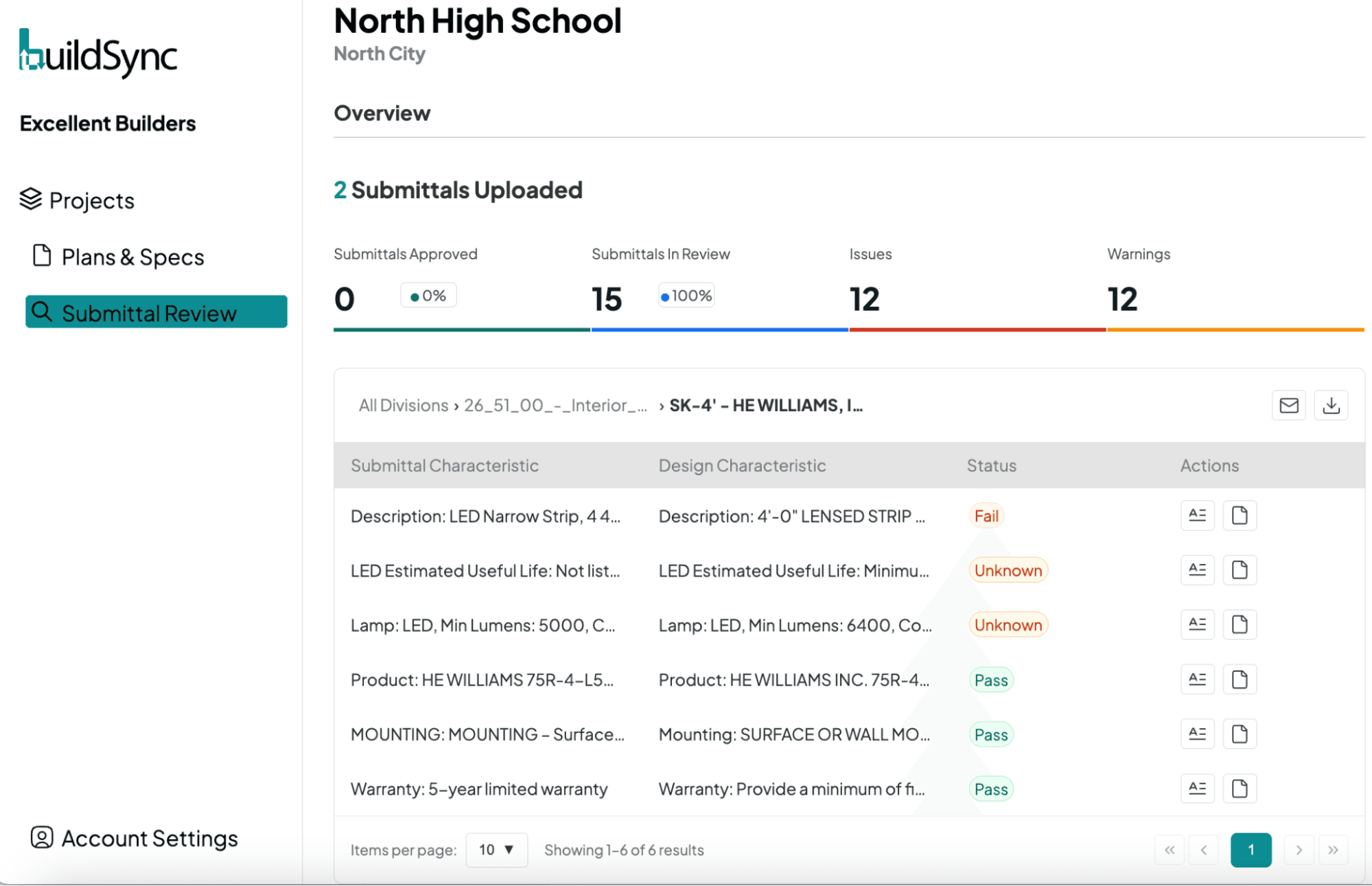
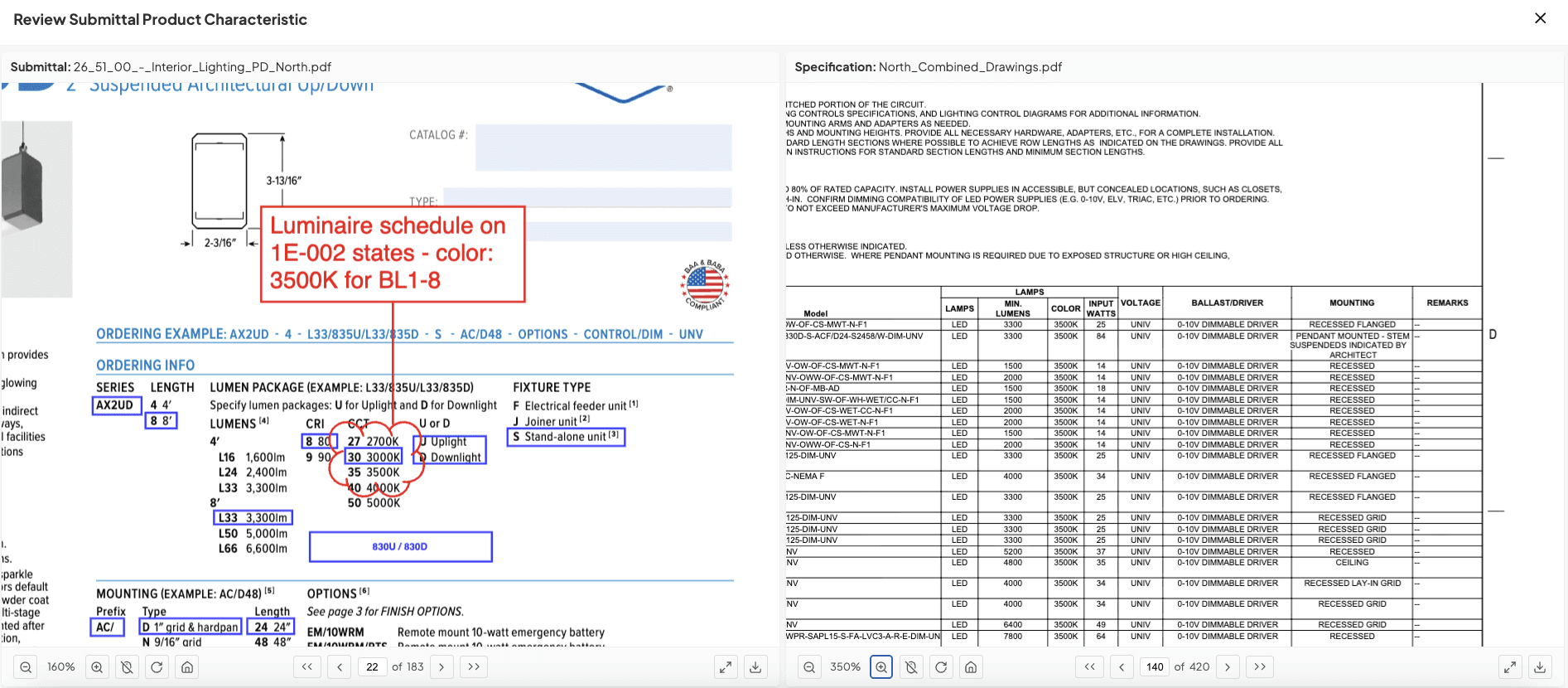
What deep technical analysis does to the submittal review process is narrow: it breaks a submittal package down to the product level, extracts every technical characteristic, compares each one against the plans and specs, and returns a status with the reason behind it. Fountain Electric cut its submittal rejection rate from 40% to 20% working this way, and reviewed a 500-page lighting submittal in hours rather than days.
What a construction company actually gets back
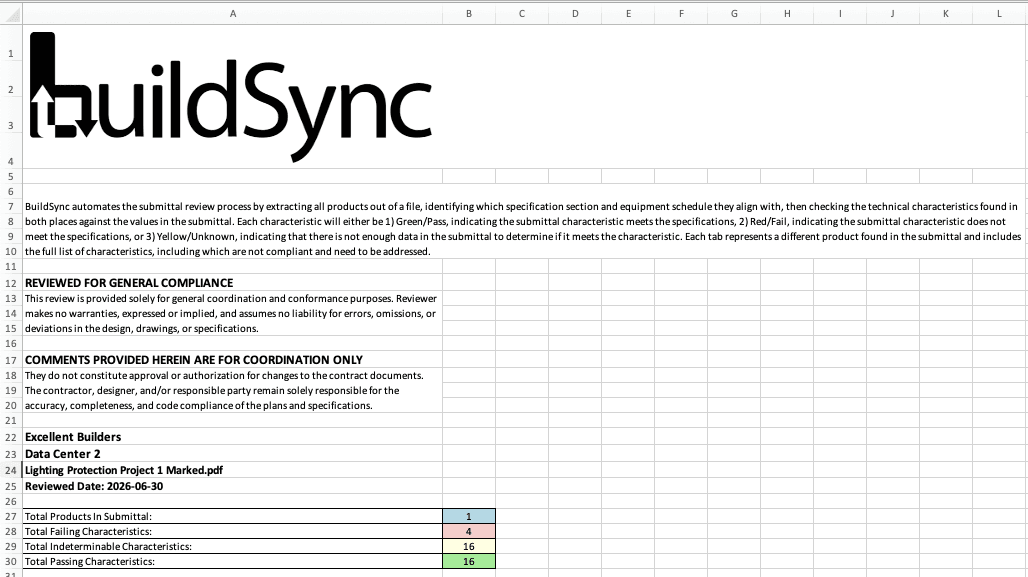
A marked-up copy of the submittal showing every failure in place, and a compliance report the project team can send straight to a sub, a vendor, or the design team. Every finding links to its source page in both documents, so reviewers verify in seconds instead of combing 80-page specs. Trust, then verify.
The project efficiency gain isn't in the software doing the review. It's in the reviewer reaching a defensible answer in minutes, which is time that goes back into project management work that actually needs a person.
Shop drawings stay with the engineer. The final approval call stays with the project engineer, who owns the judgment, and unknowns exist precisely because some determinations need a human with project context. Rejections drop, but no review process takes them to zero.
When asked how reviewing the submittal and specification pages side by side changes a reviewer’s workflow, and what PEs start doing differently after using it for two or three weeks, Tom Port, the co-founder of BuildSync, says:
Try BuildSync free on your most complex technical submittal, or book a demo to see it run against your own specs.
Frequently Asked Questions About Technical Submittals
Is a technical submittal the same as a shop drawing?
No. A technical submittal presents manufacturer product data for a product that already exists, while shop drawings are detailed drawings prepared specifically for the project to show how the contractor will fabricate and install the work. They're reviewed differently because one is a data comparison and the other requires engineering interpretation.
What does "approved as noted" mean on a returned technical submittal?
When should technical submittals be issued relative to procurement?
If the design team approves a non-compliant technical submittal, who carries the risk?
Related reads for you
Discover more articles that align with your interests and keep exploring.