Construction Technology & Innovation
/
Feb 26, 2026
How to Use AI to Review Construction Submittals
Discover how AI-powered submittal review works: automated data extraction, spec compliance checking, and detailed markups in hours instead of weeks. A practical guide for construction teams.


You're on your third submittal rejection this month. Each one pushes your timeline out 2+ weeks. Your project engineers are drowning in 70-page cut sheets, trying to cross-reference every dimension and spec against project requirements. Sound familiar?
If you're wondering how you can use AI to review submittals, you're asking the right question. The construction industry has quietly normalized a 30% rejection rate for construction submittals - but AI-powered submittal review is changing that reality.
Before chasing that number down, it helps to know what a good submittal rejection rate actually is for a team like yours, since the industry average and the realistic target aren't the same thing.
This guide walks you through exactly how AI reviews construction submittals, how to implement it in your submittal process, and what results you can expect for project success.
What Is AI Submittal Review and How Does It Fit Into the Construction Submittal Process?
AI submittal review uses artificial intelligence to analyze product data against contract documents and project specifications, extracting technical characteristics and verifying compliance automatically.
Unlike workflow management tools that simply move documents through the review and approval process, AI performs deep technical analysis - the same work a structural engineer or project engineer would do manually, but in hours instead of days.
How AI Analyzes Construction Submittals and Contract Documents (The Technical Review Process)
When you upload construction submittals for AI review, the system performs four distinct steps in the submittal review process:
Step 1: Document Ingestion and Product Identification
The AI reads through your submittal and identifies each individual product or piece of equipment. A lighting fixture submittal might contain 14 different fixtures. An HVAC system's submittal might include multiple air handlers, each with different specifications. The AI breaks these down into separate products for individual quality control analysis. That per-fixture breakdown is especially valuable for electrical submittal review, where a single package can contain 60 to 100 fixture types and each one needs its own compliance pass against the spec.
Step 2: Technical Characteristics and Product Data Extraction
For each product, the AI extracts every technical characteristic - dimensions, ratings, materials, certifications, performance criteria. A rooftop unit might have 60+ distinct characteristics. The AI pulls all of them, including installation instructions and performance criteria buried on page 47 that a manual reviewer might miss during an inadequate review.
Step 3: Specification Requirement Mapping Against Contract Documents
The AI reads your project specifications and contract documents, identifying every requirement that applies to each product. It then maps submittal characteristics to specification requirements, ensuring thorough review and maintaining design intent.
Step 4: Compliance Checking and Quality Assurance Reporting
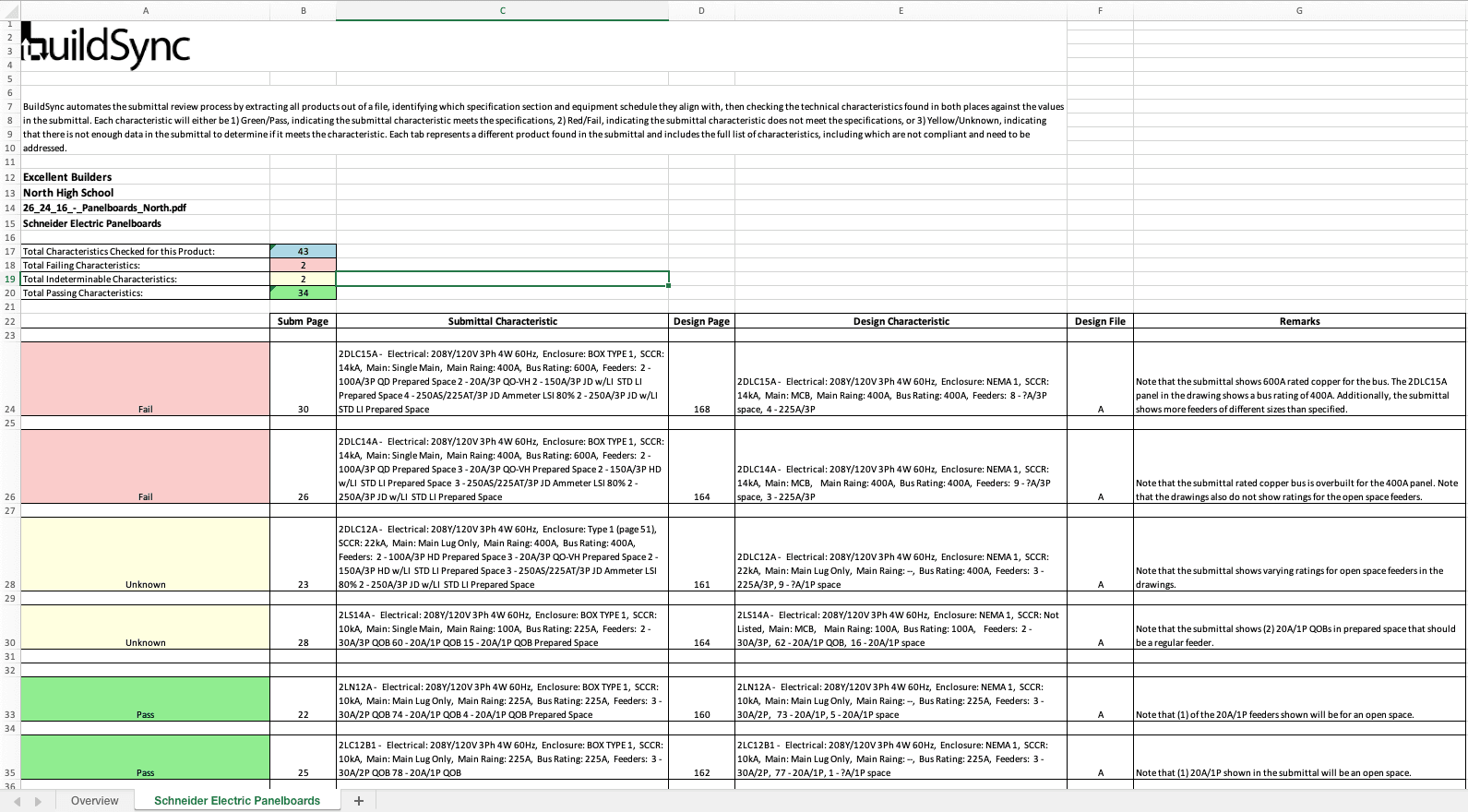
Finally, the AI verifies compliance for each characteristic against project specifications. The result: detailed reports showing what passes, what fails, and what's unknown - requiring professional responsibility and human judgment from the structural engineer or project manager.
According to McKinsey research on AI in construction, AI-driven tools can increase productivity by up to 20% while reducing costs by up to 15% - precisely because they automate these time-intensive technical analysis tasks critical to successful projects.
How to Review Submittals Using AI: Step-by-Step Submittal Procedures
Initial Setup: Upload Contract Documents and Project Specifications
First, upload your construction documents - drawings and project specifications - into the AI platform. This establishes the baseline for all compliance checking and quality control. BuildSync processes these contract documents in minutes, extracting submittal requirements automatically.
Processing Your First Construction Submittal
Upload project submittals just as you would to any submittal log system. If you're using Procore, many AI tools (including BuildSync) integrate directly - construction submittals uploaded to Procore automatically route through AI review without changes to your submittal procedures.
The AI processes the submittal, typically within hours for standard product data and within a day for complex submittals with extensive documentation.
Reviewing AI-Generated Reports for Quality Assurance
The AI returns a detailed compliance report showing:
Total products reviewed against contract documents
Characteristics that pass the specification requirements
Characteristics that fail and require” revise and resubmit” action
Unknown characteristics requiring a structural engineer's judgment
Trust But Verify: Ensuring Thorough Review
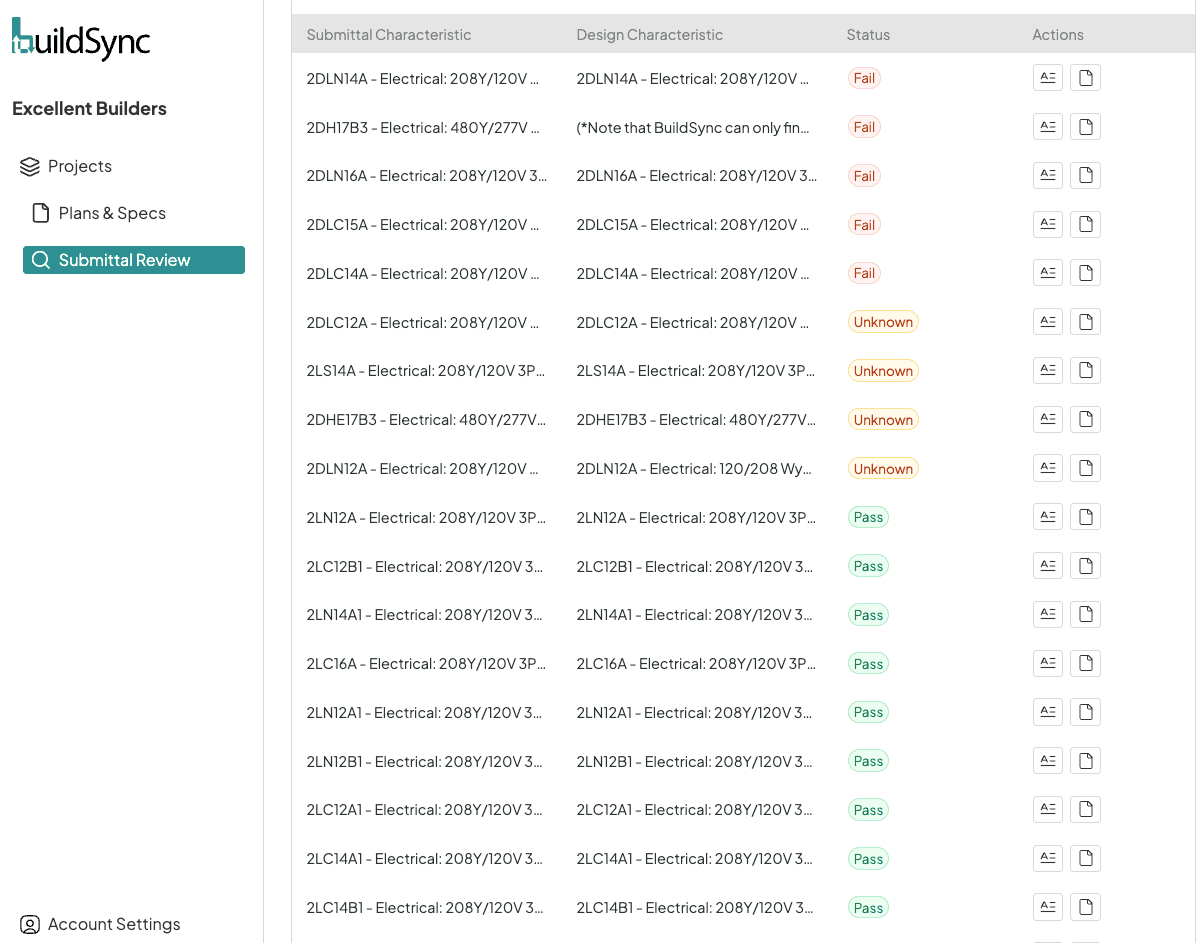
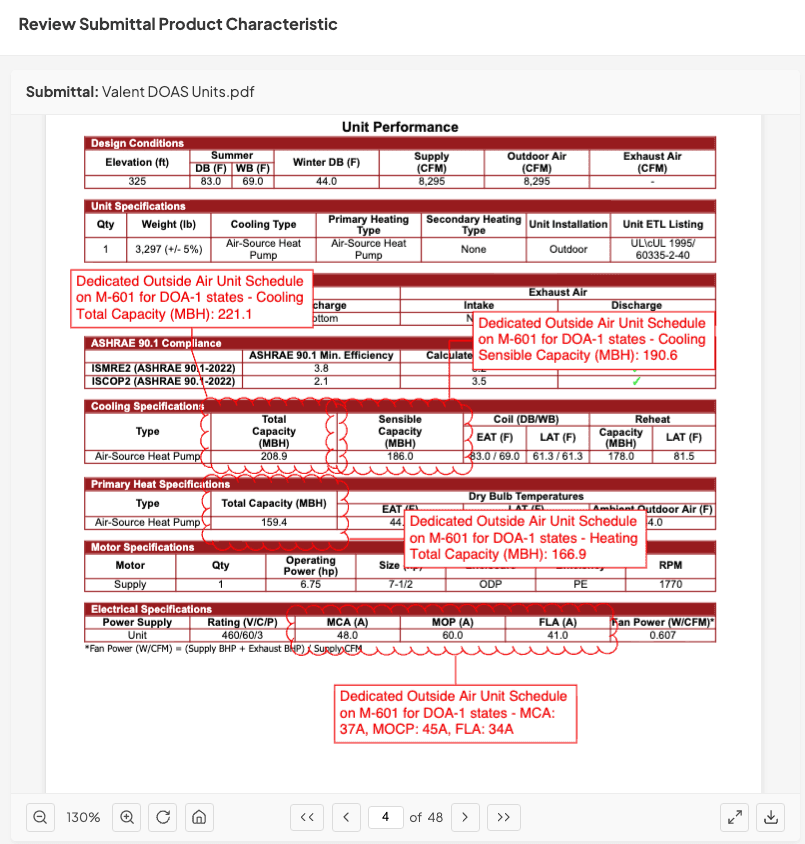
Here's where AI differs from workflow automation: you can verify every finding. Click on any characteristic, and the AI shows you the original construction documents - both the submittal and project specifications - with relevant text highlighted. No hunting through 70 pages to find where that refrigerant type was listed.
This transparency supports quality control when adopting the technology.
Jacob Delargy, Project Engineer at Monteith Construction, explains:
"BuildSync is the first stop a submittal makes in our workflow once it is turned in by a subcontractor. The report helps our reviewer navigate through the submittal as they perform their own review prior to sending to the architect for architect's review."
Making Final Approval Decisions for the Architect's Approval
The AI doesn't replace professional responsibility - it augments it. The project manager reviews findings, makes determinations on unknown items (where contextual knowledge applies), and decides whether to secure the architect's approval or revise and resubmit.
Integrating AI Submittal Review Into Your Construction Process
For General Contractors Using Procore and Managing the Submittal Process
If you're using Procore for the construction submittal process, integration is straightforward. AI platforms built for construction submittal review, like BuildSync, act as actors within your Procore workflow. Construction submittals automatically route through AI review, and detailed reports populate directly in Procore - no changes to submittal procedures required.
Setup typically takes minutes: add the AI tool to your submittal log workflow, grant access to contract documents and project specifications, and you're operational.
For Standalone Usage in the Submittal Review Process
If you're not using Procore or prefer standalone operation, the construction process is simple: upload contract documents and construction documents once per construction project, then upload project submittals as needed. Most teams report being fully operational within 24 hours.
Team Training and Adoption Across Construction Projects
With the BuildSync AI submittal review tool, the learning curve is minimal. Most project engineers are reviewing their first AI-analyzed submittal within an hour. The interface feels familiar - you're still conducting a consultant's review, just with 80% of the extraction and comparison work supporting quality assurance already complete.
See how BuildSync integrates with your existing submittal process.
Can AI Really Provide Adequate Review of Construction Submittals Against Contract Documents?
Let's address the skepticism: Can AI really check complex specifications reliably and prevent project delays?
The answer is yes - when it's purpose-built for the construction submittal process. Generic AI adapted for construction won't provide thorough review. Purpose-built AI submittal review systems, such as BuildSync, achieve 95%+ accuracy on technical compliance checking of product data.
When asked about the skepticism around AI's ability to review complex submittals, Tom Port, the co-founder of BuildSync, says:
Skepticsm is healthy, and construction professionals should be skeptical before adopting any new technology. My response is simple: don’t take our word for it. Try BuildSync for free on a real project. Run it against your specs and compare the results to your own review.
Trust in AI doesn’t come from a demo, it comes from seeing it catch things you might have missed.
Here’s a table of what AI excels at, what requires, and what still requires professional responsibility from structural engineers:
AI Capabilities | Human Expertise Required |
Extracting all technical data from 70+ page cut sheets | Contextual decisions about project-specific conditions |
Cross-referencing 60+ characteristics against specs | Judgment calls on equivalent products or substitutions |
Identifying non-compliant items buried in documentation | Coordination decisions with other trades |
Standardizing review quality across all submittals | Owner preferences not in specifications |
Flagging missing performance criteria | Design intent interpretation |
Checking installation instructions against requirements | Site-specific safety considerations |
Understanding Unknowns in the Review Process and Construction Means
AI flags items as "unknown" when ambiguous information requires a structural engineer's judgment. This happens when:
Performance criteria are specified but not listed on product data
Context exists outside construction documents
Design intent suggests equivalent products might satisfy contractual obligations
Construction project-specific conditions apply
For example, if project specifications call for "corrosion-resistant coated coils for salt fog environments" and the submittal states "coil coating provided" without specifying corrosion resistance, the AI flags this as unknown - preventing incomplete submissions.
It can't make assumptions. This transparency ensures quality assurance, and these types of ambiguities are among the common submittal requirements that cause confusion during the review process
Jacob Delargy, Project Engineer at Monteith Construction, found BuildSync AI particularly valuable:
"BuildSync has helped us review multiple submittals against multiple specs that I would not have thought to reference during my own review process."
For junior project engineers, seeing which contract documents the AI references for each characteristic accelerates learning about submittal requirements and professional responsibility.
That's the real question worth asking about whether AI actually erodes that learning or just moves it, and the honest answer depends entirely on how the tool is used.
Time Savings in the Submittal Review Process: From Days to Hours
The impact on the construction process is immediate. Monteith Construction achieved 70% faster submittal reviews after implementing AI on construction projects ranging from $5M to $30M - significantly reducing project delays.
Manual review process timeframes:
Standard product data (rooftop unit, pump): 2-4 hours
Complex equipment with detailed shop drawings (air handler, switchgear): 6-8 hours
Multi-product submittal (lighting with 20+ fixtures): Full day or more
BuildSync AI-powered review and approval process timeframes:
Standard equipment: 1-2 hours (including AI processing and consultants review)
Complex equipment: 2-3 hours
Multi-product submittal: 3-4 hours
The difference compounds across construction projects. On a particularly challenging 530-page audiovisual submittal - the kind that would normally require extensive structural engineer time and delay the construction process - AI processed it systematically while Monteith's team focused on coordination.
Reducing Project Delays Through Better Quality Control
The construction industry averages 30-40% rejection rates on construction submittals. Each revise and resubmit cycle adds 2+ weeks of project delays - the time for the rejected submittal to bounce back, get corrected through manual data entry, resubmitted, and sent for the architect's review again.
AI catches incomplete submissions and non-compliant items before consultants review them. By performing a thorough review of every characteristic against contract documents, AI identifies failures that cause project delays when manual reviewers miss them.
Beyond time savings, fewer project delays mean:
More predictable construction project timelines and successful projects
Better relationships with consultants for architect's approval
Less rework affecting the job site
Reduced risk of installing equipment that violates specified standards
Consider real-world project complexity: a rooftop unit submittal specifying R-454B refrigerant per project specifications, but submitted with R-410A. It's buried in a 70-page cut sheet. Miss it during consultants review, and project delays become the least concern - you're facing equipment replacement costs of $75,000-$150,000 plus 4-6 months of schedule impact that compromise project success.
According to Deloitte's 2025 construction industry outlook, AI and analytics can unlock 10-15% cost savings and reduce schedule overruns by 10-20% - largely through risk management that prevents these costly mistakes in the construction process.
How to Review Construction Submittals More Effectively With AI
Prioritize Complex Construction Submittals for AI Review
Start with your most complex, time-intensive project submittals - those with extensive product data and detailed shop drawings that would take 6-8 hours of manual review. These deliver immediate ROI and demonstrate value to structural engineers and project managers quickly.
Get a Free Trial of BuildSync AI Submittal Review Tool.
Create Feedback Loops With Subcontractors to Prevent Incomplete Submissions
Use detailed AI reports to educate subcontractors on submittal requirements. Share reports showing exactly which characteristics against specified standards failed and why. Over time, subs improve quality control and submit higher-quality packages that streamline the review and approval process.
Use AI Reports to Train Junior Team Members on Submittal Procedures
Junior project engineers learn faster when they can see which project specifications apply to each characteristic. The AI shows them where to look in contract documents and what performance criteria to check - supporting professional responsibility development.
Standardize Quality Assurance Across Construction Projects
AI applies the same thorough review to every construction submittal, regardless of project complexity or who's reviewing. This consistency improves quality control across your entire construction project portfolio and contributes to successful projects.
Check out our in-depth guide on how to improve your construction submittal review process.
Common Mistakes in the Construction Submittal Process When Adopting AI
Over-Relying on AI Without Adequate Review
During pilots, verify AI findings against construction documents. Click through to source materials. Build confidence before relying completely - maintaining professional responsibility.
Under-Utilizing Detailed Analysis of Product Data
AI extracts more characteristics than most manual reviews catch. Don't just review failures - check passes too for quality assurance. You might discover gaps in your traditional submittal procedures.
Failing to Integrate With Existing Review Process
If the AI tool disrupts your construction submittal process, adoption fails. Choose platforms that integrate with existing submittal log systems (Procore, Autodesk Construction Cloud) and maintain current submittal procedures.
Not Training on How to Interpret Results for Architect's Approval
Schedule training showing teams how to read AI reports, verify findings against contract documents, and make determinations before sending for architect's review. The technology supports quality control, but intentional training accelerates adoption.
How to Pilot AI Submittal Review on Your Construction Project
Select the Right Construction Submittals for Initial Pilot
Choose 3-5 complex submittals with extensive product data and detailed shop drawings that would normally take significant structural engineer time. Include a mix - perhaps an HVAC system, a lighting package, and custom equipment. Avoid overly simple submittals that wouldn't demonstrate impact on project success.
Set Clear Success Criteria for the Submittal Review Process
Define success before starting:
Time saved in review and approval process
Accuracy of AI findings verified by structural engineer
Completeness of characteristic extraction from product data
Usability of reports for consultants review
Measure Results Against Your Construction Process
Compare pilot results to manual review:
How long did the AI take vs. the traditional review process time?
Did the AI catch items causing potential project delays you missed?
How many characteristics did it extract vs. what structural engineers would check?
Most construction teams find AI more thorough - identifying characteristics in construction documents that would have been overlooked, supporting risk management and quality assurance.
Scale Across Construction Projects
Once you've validated results and confirmed adequate review standards, scale gradually. Start with one construction project, then expand as confidence in the submittal process builds.
Ready to pilot AI submittal review? Try BuildSync on your most complex submittals for free.
What to Look for in AI Review Tools for Construction Submittals
Deep Technical Analysis of Contract Documents vs. Workflow Management
Verify the platform performs actual analysis of product data - extracting characteristics, comparing against project specifications and contract documents, identifying compliance issues.
The same split runs through the wider market, and how AI construction tools compare across the workflow is worth knowing before you shortlist anything.
Many "AI" tools are workflow automation with AI marketing that don't provide thorough review.
Integration Capabilities for Your Submittal Process
If you use Procore or Autodesk Construction Cloud for your construction submittal process, native integration is critical. The platform should support your existing submittal procedures without disrupting the review and approval process.
Accuracy Verification Features for Quality Control
Look for platforms that let structural engineers verify findings by showing construction documents. You should click any characteristic and see exactly where it was extracted from product data and project specifications - ensuring professional responsibility.
Support for Implementation Across Construction Projects
Implementation support matters for successful projects. Look for platforms with dedicated customer success teams and comprehensive training on submittal procedures.
Tom Port on what differentiates AI solutions that actually work in construction from those that don't:
It's simple: does it work on a real job?
A lot of AI tools look polished in controlled demos, but in construction, specs conflict, drawings change, and submittals are messy.
AI that actually works is built around real project workflows, checks requirements characteristic-by-characteristic, and proves itself on live projects. If it can’t survive the messiness of construction, it’s just a demo.
The Future of the Construction Submittal Process
AI isn't replacing structural engineers - it's freeing them from tedious manual data entry so they focus on coordination, risk management, and higher-value activities. Teams adopting AI now gain competitive advantages: faster construction project timelines, better quality assurance, stronger relationships for architect's approval.
The question isn't whether to adopt AI for the submittal review process - it's when. Construction teams that wait will compete against firms processing submittals in hours while spending days on inadequate review that causes project delays.
See how BuildSync's AI-powered submittal review works on your actual projects - schedule a demo.
Frequently Asked Questions About the Construction Submittal Process
How long does AI take to review construction submittals?
Processing times vary by project complexity. Standard product data (rooftop units, pumps) processes within 1-2 hours. Complex equipment with detailed shop drawings (air handlers, switchgear) may take 2-4 hours. Very large construction submittals with multiple products can take up to 24 hours. The system processes project submittals sequentially, so uploading multiple construction submittals simultaneously extends the total time. However, even 24-hour turnaround improves dramatically over manual review process times of days or weeks that cause project delays.
Can AI review detailed shop drawings or only product data?
What happens if the AI marks something incorrectly in the review process?
Do I need to change my current submittal procedures to use AI?
How much does AI submittal review software cost compared to manual review that causes project delays?
Related reads for you
Discover more articles that align with your interests and keep exploring.


