Industry Insights
/
Aug 17, 2026
Will AI Submittal Review Tools Prevent PEs From Learning?
AI submittal review doesn't remove PE learning; it changes where the learning happens. Here's the case, backed by what teams using it report.


AI submittal review tools shift where a project engineer's learning happens, moving it away from manual data entry and toward the judgment calls that actually build a career.
That distinction matters, because when people ask whether AI will take over construction jobs, submittal review is one of the first places worth looking for a real answer.
In the construction industry, the jobs most exposed to automation are the repetitive tasks inside a role, not the role itself, and submittal review has already moved from pilot to daily use across the industry.
The Real Fear Behind the Question
The concern is not really "will construction jobs be replaced by AI" or whether construction companies are quietly planning to shrink PE headcount. Most experienced construction managers already know AI is not here to replace jobs outright.
The fear that AI is going to take construction jobs is real, but the concern that actually holds up is narrower: if AI handles the grinding, detail-level comparison work, do junior staff still develop the technical skills that used to come from doing it by hand?
That is a fair question, and it deserves a real answer instead of reassurance. Research on AI adoption across knowledge work backs up part of the worry. A 2026 AEI analysis of AI's effect on the knowledge economy found that basic, routine construction tasks handled by junior staff are among the first automated, while demand shifts toward human workers who can supervise and interpret AI output rather than produce it manually.
A separate 2026 Anthropic study on skill formation found that novice workers who fully delegated a new technical task to AI showed impaired conceptual understanding and debugging ability afterward, without any measurable efficiency gain over doing the work by hand, the same trade-off that shows up whenever technological advancements replace manual work faster than they replace judgment.
Left unmanaged, that gap is real. Manual work gave junior engineers repetition. Repetition built pattern recognition and the technical skills that separate skilled workers from PEs still finding their footing. Remove the repetition without replacing it, and the pattern recognition never fully forms.
What Submittal Review Actually Teaches a PE
Before assessing the risk, it helps to name what a PE is supposed to learn during manual submittal review. It is not just administrative processing. Reviewing a submittal by hand against 30 to 80 pages of specifications teaches a PE to cross-reference technical requirements, spot which characteristics matter for a piece of equipment, and recognize how building systems fail compliance in predictable, learnable patterns.
That knowledge compounds. A PE who has manually reviewed 200 mechanical submittals develops an instinct for where a technoclass mismatch or a light transmittance gap is likely to hide. This is the technical skill the industry worries about losing, and it is worth taking seriously.
Does Using AI Tools on Submittals Create the Deskilling Pattern Researchers Describe?
Sometimes, yes, if a team uses AI passively. The deskilling pattern researchers describe shows up when a worker stops engaging with a task and simply approves whatever an automated system outputs.
Applied to submittal review, that failure mode looks like a PE glancing at a pass or fail flag and moving on without seeing why a characteristic failed. That is automation bias in construction terms, and a genuine risk of adopting AI carelessly, not a hypothetical one.
But the pattern is not automatic. It depends entirely on how the tool is built and used. A tool designed to hide its reasoning invites automation bias. A tool designed to show its work invites the opposite.
Where the Learning Moves, Not Disappears
This is where BuildSync's approach diverges from a workflow tool that just routes documents through approval stages.
Workflow tool | BuildSync | |
What a PE sees | Pass/fail status | Characteristic, spec requirement, and source page for both |
What happens on unknown | Often skipped or defaulted | Flagged for the PE to find missing context |
What it teaches over time | Little, since comparison is hidden | The cross-referencing instinct manual review builds |
A PE reviewing a failed characteristic in BuildSync sees the same comparison an experienced reviewer would make manually, assembled instead of hunted down page by page, still carrying the human touch of a real judgment call at the end.
That "trust but verify" structure is deliberate, and it is the difference between a tool that erodes technical skills and one that accelerates how they form. When BuildSync flags a characteristic as unknown rather than guessing, it forces a PE to go find the missing context themselves, the same habit a good mentor would insist on.
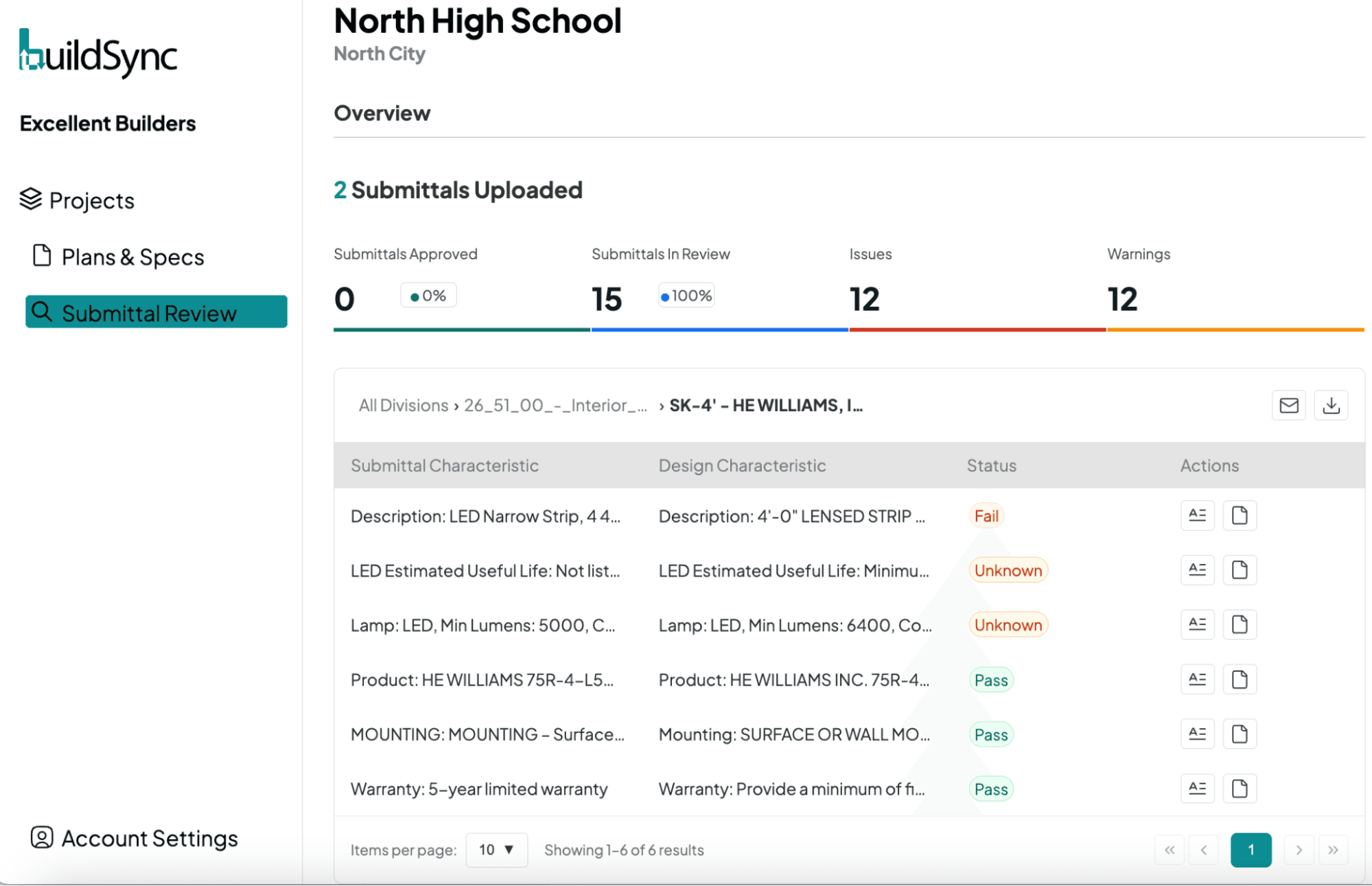
When asked how BuildSync's reports change the speed at which junior PEs begin catching issues that senior reviewers would typically identify, Tom Port, the co-founder of BuildSync, says:
The biggest difference we see is that they start understanding why something matters. A senior PM might understand the innate complexities of a piece of mechanical equipment, but a junior PE might not. With PEs who are motivated to learn, we consistently see them take the insights BuildSync has surfaced, understand why they matter, and then relay that information to the relevant stakeholders, catching issues before they can impact schedules.
What the Data From Actual Projects Shows
This shows up in real project data, not just design intent. On the Monteith Construction school project covered in BuildSync's case study on building schools smarter, project engineer Jacob Delargy reported that the tool surfaced spec cross-references he would not have thought to check on his own during manual review. That is a PE describing the pattern recognition submittal review is supposed to teach, arriving faster because the tool pointed him toward it instead of leaving him to stumble into it over time.
Construction companies adopting AI thoughtfully tend to see similar results elsewhere. As BuildSync co-founder Luke Paulo has put it when discussing what a rejected submittal actually costs a project, AI tools are still just tools that require proper training, and only increase efficiency when used correctly.
Teams that treat AI-generated reports as a training layer, not a rubber stamp, see PEs reach review competency faster and improve human efficiency across future projects. Firms that get this right end up with an efficient bench of PEs instead of a bottleneck.
What PEs and Construction Firms Should Actually Do
Keeping the reasoning visible, at a manageable cost to onboarding time, is what protects the learning. A few habits make the difference:
Review the reason behind every fail and unknown, not just the status column, before signing off on a submittal.
Treat unknowns as an assignment to go find missing context, not a flag to dismiss.
Have junior PEs walk senior staff through why BuildSync flagged something, not just what it flagged.
Track which characteristics come up as failures across multiple construction projects to build a personal pattern library faster than manual review alone would allow.
When asked what specific product decision prevents PEs from simply clicking approve without engaging with the review, Tom Port, the co-founder of BuildSync, says:
Everything in the product is built around encouraging the PE to engage with the submittal before they approve it. We make it incredibly easy to check our findings against the design documents by surfacing the document type, page number, and section where the requirement came from. When we watch customers use BuildSync, we regularly see them dig into the failures, review the evidence, and even take screenshots of our markups to send back to a subcontractor or vendor for clarification.
Construction firms that build this expectation into how they roll out AI technology get PEs who develop technical skills and new skills faster, and stay ahead of firms still reviewing everything by hand.
Firms that treat the tool as a black box get the automation bias the research warns about. The outcome depends on the habit built around it, and that habit is what helps a PE improve efficiency without losing the judgment the role depends on.
Will AI Take Over Construction Jobs More Broadly?
No, not in the sense of eliminating the roles, though it is reshaping what those roles demand. Labor statistics on AI adoption across industries point to a consistent pattern:
AI-exposed roles are compressing rather than disappearing, with entry-level positions expected to show judgment and oversight skills once reserved for senior workers.
Construction workers on the trade side and construction managers on the project delivery side are not being replaced by AI powered machines, and replacing workers wholesale is not what adopting AI in this industry looks like in practice.
The job market is shifting toward people who can direct and check automated output in real time, opening new job opportunities for PEs who can operate at that level.
For PEs specifically, the path to high demand and stronger hiring prospects runs through knowing how to interrogate an AI tool's findings, not avoiding the tool altogether.
Construction technology will make the PEs who never learned to engage critically with it far less competitive, and it is likely to open new roles built around directing AI output rather than replacing the review function entirely.
When Self-Directed Learning Isn't Enough
Not every firm has the mentorship bandwidth to walk every junior PE through every submittal by hand, and that gap often just piles more work onto reviews that already get done poorly or not at all.
When BuildSync's reports become the shared reference point between a junior PE and a senior reviewer, the tool does some of the coaching that a stretched-thin team cannot always provide, helping construction firms work smarter without adding headcount.
Mentorship still matters most, but the reports keep the learning happening, stay competitive on talent development, and reduce costs tied to onboarding, even when the mentorship time is not there.
When asked how BuildSync's reports help firms with limited senior staff give junior PEs the guidance they need, Tom Port, the co-founder of BuildSync, says:
BuildSync obviously isn’t a replacement for mentorship, but the reality is that a lot of firms are running lean and senior PMs don’t have the time to walk a junior PE through every submittal.
Our reports can get that PE 80% of the way there, showing them what was identified, why it was flagged, and where to go in the design documents to understand it further. The remaining 20% is where their own initiative and experience, really come into play.
See how BuildSync's construction submittal review software surfaces the reasoning behind every finding. Book a demo and bring your team's most complex submittal to try it on directly.
More Articles Worth Reading
For a deeper look at how the review process itself works, see BuildSync's guide on how long construction submittals should take to review, which covers turnaround expectations for teams adopting AI in construction for the first time.
For a wider view of where automation is landing across the industry, our breakdown of the AI construction tools teams are actually using in 2026 covers what each one replaces.
Frequently Asked Questions
Which roles in construction are most exposed to AI, and where do PEs fall?
Industry research on AI exposure by occupation has found that roles requiring specialist skill and high responsibility, including construction managers, civil engineers, and electricians, are among the least likely to be displaced, while narrower trade roles score higher on exposure. PEs sit closer to the low-exposure end, since the judgment and coordination the role requires are exactly what AI struggles to replace.
Does BuildSync review shop drawings the same way it reviews submittals?
How long does it take a new PE to get comfortable reading BuildSync's reports?
Does BuildSync's approach differ for junior versus senior PEs?
Related reads for you
Discover more articles that align with your interests and keep exploring.


