Construction Technology & Innovation
/
Mar 24, 2026
How Long Should Construction Submittals Take to Review?
Most teams spend 4–8 hours per submittal. Learn the industry benchmarks for submittal review time, where the hours go, and proven strategies to cut review time by up to 80%


Ask ten project managers how long submittal review time should take, and you'll get ten different answers.
Some will say a few hours. Others will say days. A few will just laugh.
The honest answer is: it depends - but that's not actually helpful when you're staring down a submittal schedule with 400 line items and a construction schedule that doesn't have room to slip.
What the industry rarely talks about is that "submittal review time" isn't one number. It's at least two very different timelines being conflated into one frustrating conversation. Getting clear on the difference - and knowing what realistic benchmarks look like for each - is the first step toward actually controlling this part of your construction project and your submittal schedule.
This guide breaks down what realistic submittal review time looks like by complexity, where the hours actually go inside a manual review, what costly delays cost your construction schedule, and what construction teams are doing to cut review time without cutting corners.
For a deeper look at the full review process from start to finish, the construction submittal review process guide covers each stage in detail.
The Two Timelines General Contractors and Design Teams Confuse
There are two distinct clocks running during every construction submittal review, and they get mixed together constantly.
The first is the design team turnaround - how long the architect or engineer of record takes to return a submittal after the general contractor submits it. Contracts typically address this timeline, though often vaguely. The AIA standard language calls for review "with such reasonable promptness as to cause no delay to the Work," which courts have interpreted anywhere from 14 days to 12 weeks.
According to Construction Specifications Institute guidance on submittal review timeliness, some design teams have documented average response times of 42 or more days - which is well beyond what most project schedules can absorb.
The second timeline - and the one almost nobody benchmarks - is the GC preliminary review: how long your own team spends to review submittals before they ever reach the design team.
This is where the real time drain lives. This is also where most rejections originate, because submittals that arrive at the design team with compliance issues still in them come straight back - adding another full rejection cycle to the clock. The design team's job is to verify design intent against what the contractor has proposed. When that verification keeps surfacing compliance failures, it signals a breakdown in the GC review that's costing everyone time.
The focus here is on that second timeline. That's the one you can actually control, and it's the one where meaningful submittal review time savings are possible.
Industry Benchmarks for Construction Submittal Review Time
There's no single industry standard that prescribes how long a general contractor preliminary review should take, because submittal complexity varies too much. But based on what construction teams and project managers consistently report, a reasonable benchmark framework by complexity looks like this:
Complexity Level | Submittal Types | Typical Review Time | Key Notes |
Simple | Hardware, paint, sealants, standard building materials | 30 min - 1.5 hrs | Product data is clear; few characteristics to cross-reference. Shop drawings for standard items are typically straightforward. |
Mid-complexity | Pumps, VAV boxes, fan coil units, light fixtures, basic electrical gear | 2 - 4 hrs | Multiple technical characteristics to verify independently. Shop drawings often accompany cut sheets; design team expects both to align. |
High-complexity | AHUs, chillers, custom switchgear, rooftop units, audiovisual systems | 4 - 8+ hrs | 60+ characteristics per submittal. Shop drawings for custom items require careful review against contract documents. Critical path items carry the highest cost of error. |
Project managers and project engineers at GCs commonly spend 20+ hours per week on manual reviews during heavy submittal periods. Each time one arrives, it competes with everything else the PE is already managing.
That means, on a busy week, one PE might complete three to five complex submittals - or spend the entire week on two particularly dense ones - with little time left for coordination, RFI management, or anything else on their plate.
When asked about how long submittal reviews actually take. Tom Port, the co-founder of BuildSync says:
When you press PMs and PEs on it, they’ll usually say somewhere between two and six hours. But when you ask what that includes, it’s everything, searching specs, digging through 70-page cut sheets, resolving contradictions, and then writing it all up.
Very little of that time is actually spent making decisions it’s spent getting to the point where you can.
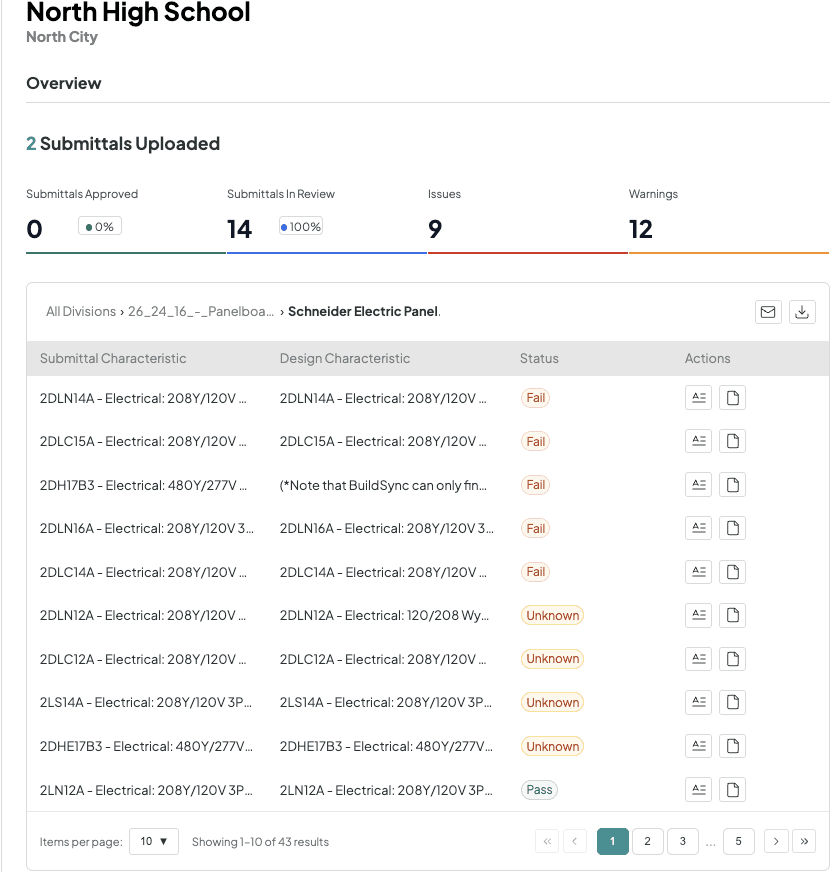
Where the Hours Go: Product Data, Shop Drawings, and What a Detailed Review Actually Involves
Here's something that gets missed in most conversations about submittal review time: the time isn't being wasted. It's being spent on genuinely difficult work. Understanding exactly where those hours go changes how you think about solving the problem.
A thorough manual review of a complex construction submittal breaks down into roughly four phases, each with its own time cost.
Locating the Right Specification Section
Before you can check anything, you need to find where the project specification addresses this particular piece of equipment. On a large construction project, specifications can run 200 pages or more across dozens of sections. Knowing the MasterFormat division structure helps reviewers jump to the right spec section faster, but even experienced PEs lose time when a single piece of equipment spans requirements in two or three divisions. If a submittal covers equipment that touches multiple spec sections - which MEP equipment frequently does - this alone can take 30 minutes to an hour.
Extracting Technical Characteristics from the Manufacturer's Cut Sheets
Once you know what the spec requires, you need to find where those characteristics appear in the submittal. A 70-page cut sheet package from a manufacturer is not organized around your specification structure. You're hunting for refrigerant type, airflow capacity, efficiency ratings, certifications, and warranty language across a document designed to market the product - not to make your job easier. This is where most of the time goes.
Interpreting Ambiguous or Contradictory Information
Contract documents are written by humans and sometimes contradict themselves, or reference requirements that aren't explicitly addressed in the construction submittal. When that happens, a reviewer has to make a judgment call about what the spec actually requires, what level of documentation is sufficient, and whether an RFI is warranted. That judgment takes time, and it takes experience.
Documenting Findings in a Shareable Format
A careful review that lives only in the reviewer's head isn't a review - it's a liability. Findings need to be documented so they can be communicated to the contractor, tracked for resubmittal, and referenced if the submittal gets disputed later. The design team will need that documentation if they have questions about the review rationale. Creating that documentation manually adds another layer of time to every submittal - whether it's product data, shop drawings, or material samples.
The scale of this problem becomes concrete when you look at real construction projects.
Monteith Construction processed a 530-page audiovisual submittal - the kind of document that would normally consume days of a PE's time working through page by page. That volume is not unusual on complex commercial projects, and it illustrates why even experienced, diligent reviewers can't keep pace with a high-volume submittal schedule using manual processes alone.
According to Construction Executive's Gold Standard Review framework, a thorough GC preliminary review involves five distinct levels of verification, from conformance to design intent through construction schedule coordination.
That depth is appropriate - the stakes justify it - but it's a significant time commitment on every submittal that arrives on your desk. The design team depends on the GC to complete that level of review before submittals reach them, which is the foundation of a functional submittal approval process.
What Construction Submittal Delays Actually Cost Your Project Schedule
Slow reviews are expensive. Not just in PE time, but in direct project costs across construction projects of every size.
BuildSync's research with more than 6,000 construction professionals found that each rejected submittal costs an average of $805 in direct administrative costs. That doesn't include the schedule impact, which is where the real damage happens.
Every rejection cycle adds 2 to 4 weeks to that submittal's timeline. For standard equipment, that's painful. For long-lead items - chillers, custom air handlers, large electrical gear, specialty glazing systems - it can be catastrophic.
Consider a rooftop HVAC unit where the contractor submitted product data showing R-410A refrigerant and the specification requires R-454B. That's a single line item buried in a 70-page cut sheet. If it's missed at the GC review stage and the design team catches it and rejects it, the rejection cycle starts over.
The design team issues a revise-and-resubmit. The approval that was supposed to unlock procurement never arrives. A compliant unit gets ordered with a 16 to 20 week manufacturing lead time. The installation window closes. Downstream mechanical and controls work gets pushed. The project's critical path shifts by months.
The math compounds quickly on projects with significant submittal volume. A mid-sized project processing 500 submittals at a 30% rejection rate - the industry average - generates more than $120,000 in direct rejection costs alone, plus project timeline impacts that can trigger liquidated damages or contractor delay claims.
Timely reviews aren't just a quality assurance measure - they're a risk management practice that protects the entire project team from costly delays that compound through the schedule.
The best place to break that cycle is at the general contractor preliminary review stage, before anything reaches the design team. Strong submittal management at the GC level means the design team spends their review time confirming compliance - not discovering it.
Use BuildSync's ROI calculator to run the numbers on what your current rejection rate is actually costing your projects.
Why Construction Submittal Review Times Vary So Much Across Projects
If you've ever tried to benchmark your team's review time against another company's and found the numbers don't match at all, there are a few good reasons for that.
Submittal Volume and Timing
On most commercial construction projects, the bulk of reviews hit in the first three to six months. A project team that's processing 50 packages a week during that window is working in a fundamentally different environment than the same team processing 10 a week later in the project.
Submittal progress tends to fall behind when volume peaks - not because the team is less capable, but because the bandwidth just isn't there. Submittal status tracking also becomes harder to maintain accurately when the team is overwhelmed, which creates its own cascading problems.
Reviewer Experience Level
A senior PE with ten years of mechanical systems experience can review an AHU submittal in two hours. A junior PE in their first year might spend six hours on the same submittal and still not be confident they caught everything. The specification language that immediately signals a compliance issue to an experienced reviewer can look like background noise to someone newer to the role.
Package Quality from the Contractor
A well-organized submittal package with marked technical data sheets, a compliance matrix, and all required certifications included can be reviewed in half the time of an incomplete package where the reviewer has to go hunting for basic information. The quality of what the contractor delivers has a direct and significant impact on how long the GC review takes. Similar submittals from a contractor who packages their product data consistently will always review faster than packages that arrive in inconsistent formats.
Specification Complexity and Contradictions
Some spec sections are 5 pages long with clear, unambiguous requirements. Others are 50 pages with multiple addenda, referenced standards, and language that seems to conflict with the drawings. Shop drawings for complex systems compound this further - when the shop drawings don't align with the specification, the design team has to reconcile both before they can approve anything.
The more interpretation a specification requires, the more time an honest, careful review takes - and the more likely it is that the design team will flag issues the GC thought were resolved.
5 Proven Ways for Project Managers to Reduce Submittal Review Time
Getting submittal review time under control doesn't require a complete process overhaul. These five approaches deliver consistent results and can be implemented without disrupting existing workflows.
1. Set Clear Expectations Before the First Submittal Arrives
The pre-construction kickoff meeting focused on submittals is one of the most underused tools in construction management. Use it to define exactly what a complete package looks like: marked cut sheets, specific certifications required by spec section, compliance matrices for complex equipment, and equipment tag references. Adequate time spent here, before submittals arrive, pays dividends throughout the project.
2. Prioritize by CriticalPath, Not by Arrival Order
Not all submittals are equal. Long-lead equipment on the project's critical path - chillers, switchgear, custom AHUs, specialty glazing - needs to move through review first, because procurement can't start until an approved submittal is in hand. Reviewing packages in the order they arrive means critical path items might sit behind standard hardware. Build a prioritization system that flags long-lead equipment at intake and moves it to the front of the queue.
The project schedule depends on approved shop drawings and equipment arriving in time to meet fabrication and delivery windows - that sequence needs to drive your review order, not the accident of which contractor submitted first.
When the design team receives shop drawings for critical path equipment, their clock starts. Every day of delay before that submittal arrives is a day subtracted from the overall float.
3. Build a Cross-reference System for Recurring Spec Sections
On most commercial construction projects, certain specification sections appear again and again across the review queue. MEP specs for refrigerants, efficiency ratings, and certifications don't change from package to package - only the product being submitted changes.
Creating a spec section summary that captures the key project requirements once means reviewers aren't re-reading the same 30 pages every time a mechanical package arrives.
It also means that when teams review submittals for similar equipment types, they're working from a consistent baseline rather than starting fresh every time. This supports timely reviews when the team is under pressure, and it gives the design team a more consistent package to work with on their end.
4. Use Rejection Documentation as a Teaching Tool
When a submittal goes back for revision, the feedback quality matters. Vague notes like "does not meet spec" require the contractor to guess and resubmit, adding another rejection cycle and delaying the approved submittal the design team is waiting for.
Specific, documented feedback that references the exact spec requirement and the exact page in the submittal where the non-compliance was found gives contractors what they need to fix it right the first time.
5. Use AI-powered Review to Handle the Technical Extraction
The most time-consuming part of manual review - locating and extracting technical characteristics from dense cut sheets and cross-referencing them against project specifications - is exactly what AI-assisted review is built to handle. Teams that use AI to review construction submittals are able to process the same volume in a fraction of the time, without sacrificing the depth of analysis the design team expects.
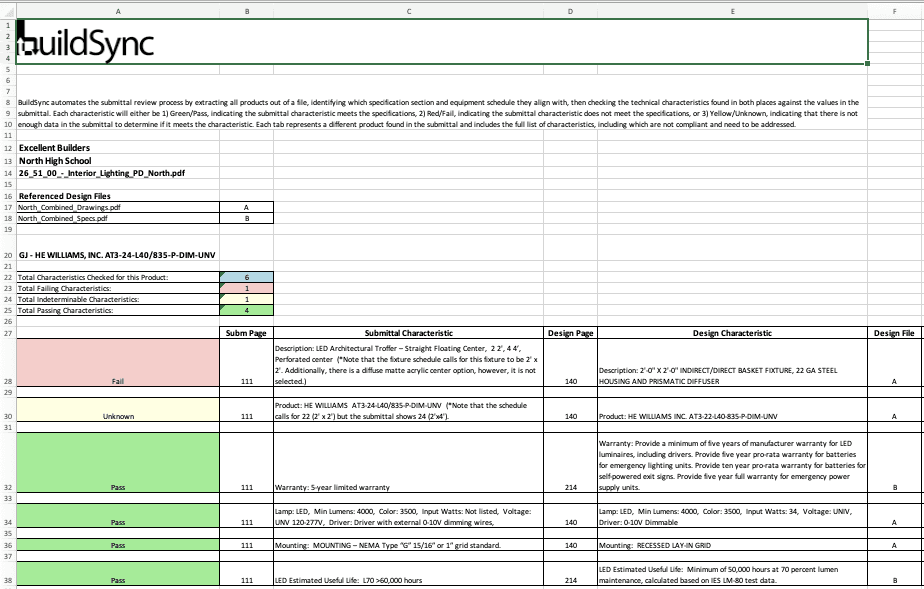
BuildSync's automated submittal review processes each submittal by extracting every technical characteristic, comparing each one against the project specifications, and returning a detailed report showing what passes, what fails, and what needs clarification - with direct links to the source documents in both the submittal and the specs.
These automated workflows significantly reduce the manual effort required from project managers and project engineers at every stage of the review process. The result is that reviewers spend their time on judgment and decisions, not on data extraction.
When asked about what separate teams that consistently get submittals approved on first pass, Tom Port, the co-founder of BuildSync says:
The difference is rarely effort; it’s clarity. Teams that get first-pass approvals are submitting clean, well-structured packages with clear traceability back to the spec. Teams stuck in rejection cycles usually leave gaps, miss requirements, have unclear documentation, or force the design team to do the interpretation for them.
What Good Submittal Management Looks Like: Automated Workflows and AI Review
The benchmarks above describe what manual review typically takes. Teams using AI-assisted review are operating in a different range entirely, with submittal management that runs on a fundamentally different schedule. The design team sees the difference too - in fewer revision requests, faster approvals on critical path items, and cleaner shop drawings packages that don't need to go back for more information.
Monteith Construction, a general contractor working on healthcare and education construction projects ranging from $5M to $30M, implemented BuildSync across their review workflow.
The result was 70% faster reviews across all types.
Faster approvals, fewer rejection cycles, and a submittal schedule that no longer threatened the construction timeline. Daniel Recktenwald, Project Manager at Monteith, described the change directly:
Before BuildSync we were moving through submittals like quicksand, often overwhelmed and missing problems. After BuildSync, submittals have become something that is part of your day and not your whole week.
That shift matters at a practical level. A submittal that previously required four to six hours of a PE's time can be processed in under an hour when AI handles the technical data extraction and the PE focuses on reviewing the findings and making determinations on ambiguous items. On a project with 500 items to review - including shop drawings, product data, and equipment packages that all need to reach the design team on time - that adds up to hundreds of hours returned to the project team.
Jacob Delargy, Project Engineer at Monteith, noted another benefit that goes beyond raw time savings:
BuildSync has helped us review multiple submittals against multiple specs that I would not have thought to reference during my own review process.
For junior PEs, AI-assisted review acts as a guide - surfacing the design intent requirements and contract documents that an experienced reviewer would know to check, and providing visibility into source documents that makes the review process itself a learning experience.
The "trust but verify" principle applies throughout. AI review doesn't replace the PE's judgment - it surfaces the technical detail so the PE can apply that judgment to actual findings rather than to manual data extraction. Every characteristic flagged is linked to its source in both the submittal and the specification, so reviewers can verify any finding in seconds rather than hunting through documents themselves.
This supports both design intent verification and the kind of document traceability that protects the team if a submittal decision is ever challenged. For construction management teams overseeing multiple active projects, that consistency is one of the most underappreciated benefits of automated submittal review.
The Time You Spend on Reviews Is a Choice
Not in a judgmental way - in a practical one. Manual submittal review at the scale of modern commercial construction is genuinely hard, and the project managers and engineers doing it carefully are providing real value to their construction projects. But the hours those reviews consume are not fixed. They're a function of process, tools, and how technical extraction work gets handled.
Teams that have gotten submittal review time under control haven't done it by rushing reviews or lowering standards. They've done it by taking the technical extraction work off their PEs' plates, giving reviewers better information faster, and turning a submittal process that used to take a week into something that fits into a day.
The general contractor who builds that capacity - through smarter submittal management, clearer contractor expectations, and automated workflows that handle the heavy lifting - creates a competitive advantage that shows up in every project schedule and every client relationship. The design team notices. Critical path equipment gets approved faster. Drawings come back cleaner. And the overall submittal process stops being the bottleneck.
Project success in commercial construction depends on dozens of moving parts - but submittal review is one of the few where deliberate process improvements show up immediately in the schedule and the budget. If your team is spending 4 to 8 hours on complex submittals and still seeing rejection rates above 10%, the process is the problem - not the people running it. Giving project engineers adequate time and better tools to do this work is how the industry fixes it.
See how BuildSync handles your most complex submittals. Book a free demo or start a free trial with your five hardest submittals.
Frequently Asked Questions for Construction Managers and Project Engineers
How long does a submittal review usually take in construction?
For a GC preliminary review, the honest answer ranges from 30 minutes to 8+ hours depending on complexity. Simple submittals for hardware or standard materials typically take under 2 hours. Mid-complexity MEP submittals run 2 to 4 hours. High-complexity equipment like air handlers, chillers, or custom electrical gear regularly takes 4 to 8 hours or more. Project managers and project engineers spending 20+ hours per week on manual reviews during peak periods is common on commercial projects with large submittal logs.
What is the difference between submittal review time and RFI response time?
How do contradictory plans and specifications affect review time?
At what point in a project do submittal reviews take the longest?
Related reads for you
Discover more articles that align with your interests and keep exploring.


