Construction Technology & Innovation
/
May 18, 2026
How to Pass Submittal Review First Time, Every Time
Most submittals get rejected over technical details that could have been caught before submission. This guide covers what experienced GCs and PEs do differently to hit first-time acceptance and how to make it repeatable across every project.


Most submittals don't get rejected because the product is wrong. They get rejected because something was missed. A warranty duration that didn't match the spec. A coating that wasn't confirmed for salt air exposure. A finish that the sub left unselected in the schedule.
Knowing how to pass submittal review the first time comes down to understanding where those misses happen and building a process that catches them before the design team does.
The difference between teams running a 5% rejection rate and teams stuck at 30% relates more to structure than expertise.
Why the Submittal Review Process Breaks Down
Startup phase on a commercial project is controlled chaos. A project manager is coordinating RFIs, managing the construction schedule, handling owner requests, and simultaneously expected to conduct a line-by-line technical review of a 70-page product data package against hundreds of pages of specifications.
Something gets missed. Not because the PM wasn't paying attention, but because the process wasn't designed to catch everything at that volume. That's the structural problem. And structural problems don't get solved by working harder. They get solved by changing the process.
What the Design Team Is Actually Evaluating
First-time acceptance starts with understanding what a design team is looking for when they open a submittal. They're not reading it like a general contractor would.
They're checking three things:
Does the product meet the technical requirements in the spec section?
Is the submittal complete?
Does it reflect the current design intent, including any RFIs or addenda that have been issued?
That third check is where a lot of revise and resubmit cycles originate. A sub pulls a product data sheet from a previous job. The spec section on this project has a specific requirement that wasn't on the last one. Nobody caught it during the GC's internal review. The submittal goes out. Two weeks later, it comes back for revision.
The GC's internal review is the only checkpoint before the clock starts on that delay. Making it count requires knowing exactly what to look for.
Tom Port says:
"Across the projects we’ve reviewed at BuildSync, the rejections usually aren’t coming from one catastrophic mistake. They’re coming from small, easy-to-miss compliance gaps spread across the submittal package. Things like warranty durations not matching the spec, voltage or rating mismatches, missing certifications, finishes left unselected.
What’s interesting is that experienced teams still miss these issues because the challenge isn’t knowledge, it’s volume. Once you’re reviewing dozens of products and hundreds of technical characteristics under schedule pressure, even strong teams start missing details.”
Four Pre-Submission Checks That Prevent Most Rejections
1. Confirm the manufacturer before anything gets ordered
Approved manufacturers are listed in the spec section for a reason. If the sub is proposing a product from a manufacturer not on that list, that's a substitution, and it needs to go through the right channel before the submittal is built. Catching this at the submittal package stage, after the sub has already built the data package, wastes everyone's time. Catching it before the product is specified saves weeks and avoids change orders downstream.
2. Resolve every "unknown" before submission
Not every compliance question has a clean yes or no answer. Coatings for corrosion resistance in salt air environments. Warranty durations that need to match the spec section exactly. Spare parts and extra materials requirements buried in Division 01. These are the items that show up as unknowns in a thorough review, and they're also the items that generate revise and resubmit responses from the design team when they're left unaddressed.
The right move is to treat every unresolved question as a reason to call the sub or the vendor before the submittal goes out, not after.
Tom Port, the co-founder of BuildSync, says:
"One of the most counterintuitive categories of rejection is the small specification mismatches that seem minor but still trigger a revise and resubmit.
Things like warranty durations being one year short, finishes left unselected in schedules, missing certifications, or environmental requirements that were never explicitly confirmed. Experienced teams are usually very good at catching major technical issues. What consistently slips through manual review are the low-visibility requirements hidden across plans, specifications, and product data that only become obvious when every characteristic is checked systematically against the contract documents.”
3. Cross-reference against RFIs and addenda, not just base specs
The base specification is not always the current specification. RFIs get issued. Addenda clarify requirements. If the sub is working from the original spec section without accounting for those updates, the submittal can be technically correct against the wrong document. The design team will catch it. They're reviewing against the current contract documents, not the original ones.
Before any submittal goes to the design team, confirm it reflects the current state of the project drawings and any issued clarifications. Teams that want to tighten how they organize spec requirements can reference MasterFormat, the Construction Specifications Institute's standardized system for organizing construction specifications
4. Check lead times against the construction schedule
This one sits at the intersection of compliance and coordination. A submittal can pass every technical check and still create a project schedule problem if the lead time for the approved product doesn't fit the construction schedule. Long lead equipment in particular, air handlers, switchgear, specialty glazing, needs to be flagged and expedited early. If the submittal review process doesn't include a lead time check against the project schedule, that conversation happens too late.
This becomes especially important on data center projects, where large transformers and switchgear can have lead times of a year or more. Failing to account for those lead times during submittal review can turn a procurement delay into a broader schedule risk, making it one of the more significant data center construction challenges.
The Rejections That Catch Even Experienced Teams Off Guard
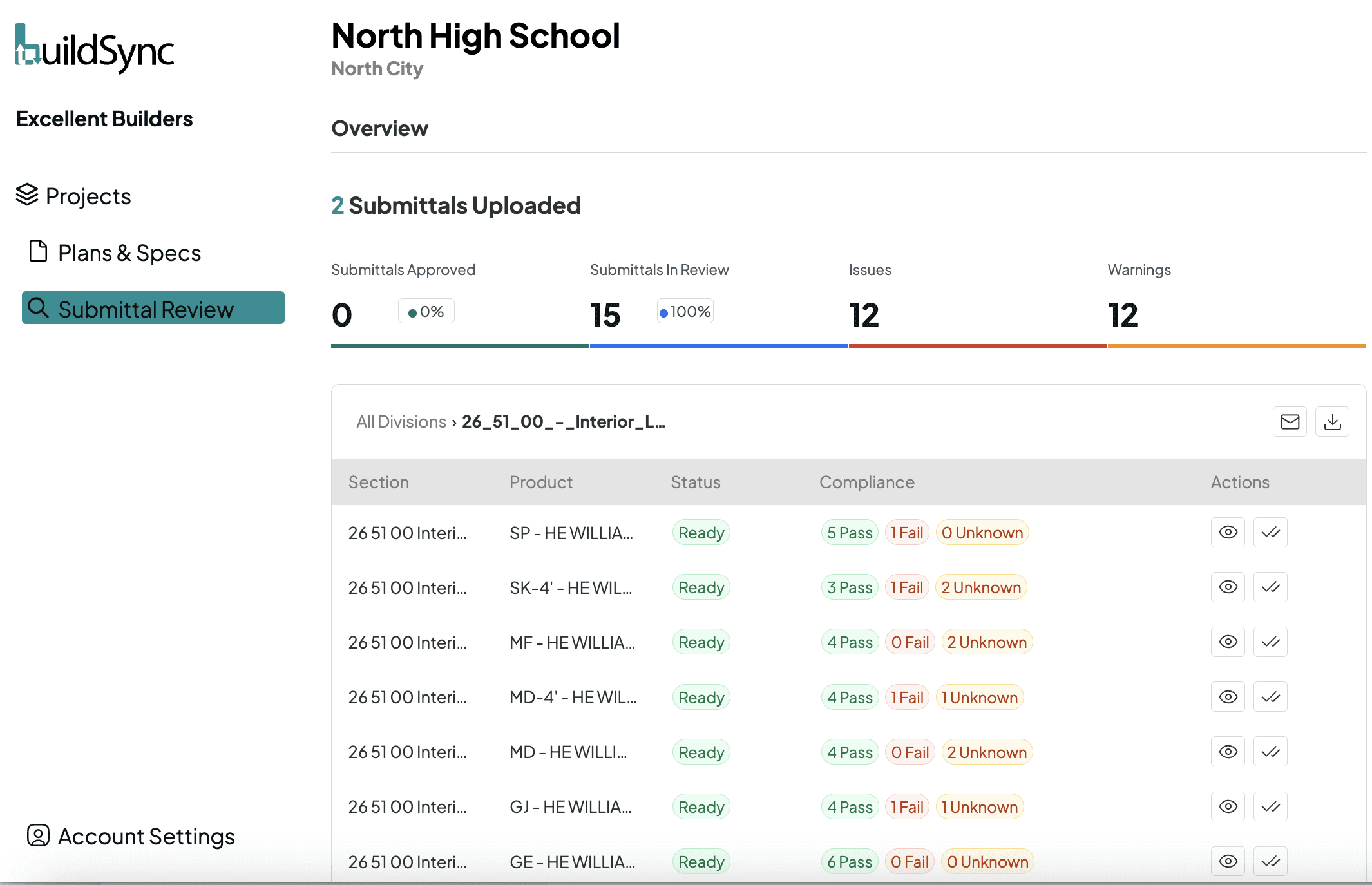
There's a category of rejection that doesn't come from carelessness. It comes from the scale of what a thorough review actually requires. A lighting submittal with 40 fixture types. An AHU package with 60 technical characteristics to check. A combined A/V and controls package running 530 pages.
At that scale, even a careful project engineer working from a solid submittal review checklist will miss things. Final direction on a grilles and diffusers submittal. Light transmittance listed at 33% when the spec called for 42% minimum. Warranty coverage that fell two years short of the requirement. These aren't obvious failures. They're the kind of detail that's easy to overlook when you're processing volume under schedule pressure.
Daniel Recktenwald, Project Manager at Monteith Construction, described what that looked like before BuildSync:
"Before BuildSync we were moving through submittals like quicksand, often overwhelmed and missing problems. After BuildSync, submittals have become something that is part of your day and not your whole week."
The grilles and diffusers catch Recktenwald referenced specifically, fins oriented the wrong direction, is the kind of rejection that wouldn't show up on most checklists. It requires actually reading the submittal against the drawings at the product level.
When Manual Review Hits Its Ceiling
There's a point on most projects where the volume of submittals outpaces the capacity for thorough manual review. Startup phase on a large commercial project can mean dozens of submittals moving simultaneously, each requiring cross-referencing against specifications, drawings, RFIs, and contract documents. The project engineer doing that work is also handling coordination, RFI responses, and schedule management.
Jacob Delargy, Project Engineer at Monteith Construction, put it plainly:
"BuildSync has helped us review multiple submittals against multiple specs that I would not have thought to reference during my own review process."
That's the reality of manual review at scale: there's a throughput limit, and the consequences of hitting it show up as rejections, delays, and strained relationships with the design team. Deloitte's 2025 Engineering and Construction Industry Outlook identifies AI-enabled automation as a key strategy for helping construction teams focus on higher-value work.
AI-powered submittal review addresses this by doing the extraction and comparison work automatically: pulling every technical characteristic from the submittal, checking each one against the relevant spec section, and flagging failures and unknowns with the source documents attached. The submittal review checklist becomes the output of the review, not the input.
Tom Port, the-cofounder of BuildSync, says:
“The first thing that usually breaks isn’t the team’s technical knowledge, it’s consistency.
Early on, reviews are thorough and methodical. But once the volume ramps up, teams start relying on speed and pattern recognition just to keep submittals moving.
That’s when small compliance issues begin slipping through: a missed rating, an incomplete schedule, a requirement buried deep in the spec. From our vantage point, the pattern is almost always the same. The team isn’t careless, they’re overloaded. Manual review has a throughput limit, and once projects push past it, rejection rates and review times both start climbing.”
What to Do When You Get a Revise and Resubmit
Not every rejection is preventable. When one comes back, the priority is making sure it doesn't come back twice. That means reading the rejection notes carefully, not just flagging it as a revise and resubmit. It means communicating the specific failures to the sub with enough detail that the corrected package actually addresses them. And it means closing the loop internally so the team understands what was missed and why.
A rejection that generates a clear, specific correction request is recoverable. A rejection that generates a vague "revise and resubmit" response, with no explanation of which characteristics failed or why, almost always produces a second rejection. The quality of the feedback loop matters as much as the quality of the initial review.
Frequently Asked Questions
What is a submittal review?
A submittal review is the process of verifying that proposed materials, products, or equipment meet the technical requirements defined in the project specifications before they're procured or installed. The general contractor conducts an internal review first, then the submittal goes to the design team for final approval. The goal is to confirm compliance with contract documents before anything is ordered or built.
Who is responsible for preparing submittals?
Is there a trick to reviewing submittals faster?
Related reads for you
Discover more articles that align with your interests and keep exploring.


