Industry Insights
/
May 1, 2026
Types of Construction Submittals Every PM Should Know
Learn the construction submittal types every PM encounters. Get practical guidance on what to review for each type and how to streamline your process.


Your construction project has 800 construction submittals to review.
Some are 2-page lighting fixture cut sheets. Others are 70-page mechanical equipment packages with 30+ technical specifications to verify. You're responsible for checking all of them against project specifications before they reach your design team.
How do you handle this, knowing that not all construction submittals are created equal?
Understanding what to look for in each submittal type helps you review smarter and catch issues before they become problems in the construction submittal process. It also helps allocate your time where it actually matters in the submittal process.
Here's what you need to know about the types of submittals in construction you'll encounter, and how to approach them effectively.
Understanding Construction Submittals: Why Types Matter
Construction submittals are the submittal documents, physical samples, and data that demonstrate how materials and equipment meet (or don't meet) your project specifications. They're your first line of defense against non-compliant materials showing up on site and a critical component of the construction submittal process.
According to industry research, the average construction project experiences a 30-40% submittal rejection rate. Each rejected construction submittal adds an average of 2+ weeks to your construction schedule. When you're reviewing critical path items like mechanical equipment, structural steel, and curtain wall systems, those delays cascade across your entire submittal process and project timeline.
The cost is also relatively tangible. Research from BuildSync indicates that each submittal rejection costs construction projects an average of $805 when you factor in project manager/project engineer time, design team review time, resubmittal processing, and schedule delays.
But here's the challenge: You're expected to review submittals from door hardware to complex HVAC systems with the same level of scrutiny. That's not realistic.
Different submittal types require different review approaches, technical knowledge, and largely distinct time investments in the construction submittal process.
Understanding types of submittals helps you minimize costly mistakes. It also helps you:
Prioritize your review time based on complexity and risk
Know what technical details actually matter for each submittal type
Catch common rejection issues before they reach your design team
Allocate resources effectively across hundreds of construction submittals
Manage your submittal log more strategically
Types of Construction Submittals
There are 9 major types of construction submittals, and we'll be going through their basics in this section. Understanding these types of submittals in construction is fundamental to managing the submittal process effectively.
Submittal Type | Purpose | Common Examples |
Product Data | Confirms materials and systems match project requirements before procurement | Manufacturer cut sheets, performance ratings, compliance documentation |
Shop Drawings | Translates designer intent into buildable details with exact dimensions and installation sequences | Fabrication drawings, trade coordination drawings |
Samples | Confirms aesthetic choices and sets baseline quality standards | Tile squares, carpet textures, paint colors, material finishes |
Mock-ups | Evaluates real-world performance, constructibility, and durability | Partial wall assemblies, full-size room setups, façade panels |
Warranties & O&M Manuals | Provides operating guidance and performance assurances for installed systems | Coverage terms, maintenance procedures, troubleshooting guides |
Vendor Information | Verifies suppliers and specialty contractors meet project standards | Supplier qualifications, manufacturer credentials |
Test Reports & Certifications | Provides third-party verification of code compliance and performance | Fire-rating certificates, structural load tests, concrete strength results |
As-Built Drawings | Documents the final constructed condition, including field changes | Updated drawings reflecting deviations from original plans |
Engineering Calculations | Provides numerical proof that proposed solutions meet performance and code requirements | Structural calculations, MEP sizing calculations, load analyses |
Product Data Submittals
Product data submittals are usually the first wave of construction submittals that hits a project manager's desk. These data sheets give everyone a clear picture of what materials or systems the general contractor wants to use. They're typically straight from the manufacturer and outline things like performance ratings, material composition, installation guidelines, and compliance with standards.
What makes product data important is the assurance that what's coming to the site actually aligns with the project requirements. From insulation and doors to waterproofing membranes or mechanical components, these submittals help catch mismatches early, before procurement moves too far in the construction process.
Shop Drawings
Shop drawings take the designer's intent and translate it into buildable details. They are basically illustrations of how the contractor will meet the construction project's overall design intent. Shop drawings show how parts come together, focusing on critical details like exact dimensions, field-verified measurements, installation sequences, and interface points with other trades. Once approved, shop drawings serve as the roadmap for major elements such as fabrication and installation.
The architect and design team reviews shop drawings carefully, as they form the basis for coordination across trades and ensure the construction submittal aligns with design documents.
Samples
While product data explains what something is, material samples show what it will actually look and feel like. These physical examples can be small pieces like tile squares, carpet textures, paint colours, or digital samples for certain modern products. They help designers and owners confirm aesthetic choices before full procurement in the submittal process.
Samples also provide baseline quality expectations. Once a sample is approved through the review and approval process, it becomes a reference standard for the responsible contractor, so any future installation must match the look, texture, and finish of that approved piece to meet the intended quality.
Mock-ups
Mock-ups take sampling a step further by showing real-world performance and functionality. Depending on the construction project, a mock-up might be a partial wall assembly, a full-size room setup, or even a full façade panel erected outdoors to test weatherproofing.
Mock-ups are used to evaluate the product's appearance, constructibility and most especially durability. They allow the project team to refine details, test installation methodologies, and verify that interfaces between materials behave as expected. For complex envelope systems or high-finish interiors, mock-ups often become the gold standard that all onsite work must match.
Warranties and O&M Manuals
O&M manuals outline how each installed system works, and also offer the practical guidance workers need on daily operation, routine maintenance, troubleshooting, and more. These manuals contractors provide are critical for long-term building operation. Warranties, on the other hand, provide formal assurances that materials, equipment, or workmanship will perform as expected for a specified period.
These warranty documents outline coverage terms, duration, and the steps to follow if repairs or replacements are needed. Together, warranties and manuals help the project owner have both the knowledge and protection required to manage the building effectively after the construction submittal process concludes.
Vendor Information
Vendor Information is often grouped under product data, but on larger or more complex projects, it becomes a distinct submittal as it serves a different purpose. It provides project information about the supplier, manufacturer, or specialty contractors responsible for delivering a product or system.
While product data focuses on what is being installed, vendor information focuses on who is supplying or fabricating it and whether they meet the project's standards set forth in the construction contract.
Test Reports & Certifications
Some materials and systems need more than the manufacturer claims. They require verified proof that they meet safety codes, performance requirements, and regulatory standards. This is where test reports and certifications come in to demonstrate compliance with contract requirements.
These construction submittals may include fire-rating certificates, structural load test results, concrete strength test results, and various essential compliance reports. They're often issued by third-party labs or independent inspectors. The construction manager uses them to confirm that the chosen material or system performs exactly as needed under real conditions before adding them to the submittal log.
As-Built Drawings
As-built drawings document exactly how a construction project was constructed, reflecting any changes, adjustments, or deviations from the original construction documents. They are prepared during or after construction to capture the project's final, "built" condition.
Unlike other submittal types, as-built drawings are a permanent record. They are often submitted alongside warranties, O&M manuals, and commissioning reports as part of the project closeout package, forming essential project documentation for future reference.
Engineering Calculations
These are technical submittals that provide the numerical justification behind a proposed design, system, or piece of equipment. They demonstrate that the general contractor's or engineer's solution meets the construction project's performance criteria, safety requirements, and code standards.
Engineering calculations are often submitted alongside shop drawings or MEP equipment data to prove that what's being proposed is compliant, safe, and constructible. Ultimately, engineering calculations help design professionals verify that critical building systems will function as intended under real operating conditions.
How to Ensure Efficiency in the Construction Submittals Process
Understanding the types of construction submittals is just the beginning. Here's how to manage them efficiently in your submittal workflow and improve construction submittals across your project:
Categorize submittals by type and complexity
When construction submittals come in, quickly categorize them in your submittal log:
What submittal type is this? (product data, shop drawing, certificate)
What's the technical complexity? (High, medium, low)
What's the schedule impact? (Critical path, important, standard)
Proper submittal log creation and maintenance helps the construction manager track everything systematically and prevents bottlenecks in the review process. A good submittal log becomes the single source of truth for your entire team. That log only works if it starts from a complete list of required submittals pulled from the specifications, since a log can't track an item nobody identified as required.
Allocate review time based on risk and complexity
Not every construction submittal deserves 4 hours in the review process. A lighting fixture cut sheet might need 20 minutes. An AHU submittal needs 6 hours. Allocate accordingly in your submittal schedule.
Use systematic approaches for high-volume types
When you have 80 lighting fixtures to review submittals in your submittal log, you need a systematic process. Extract technical characteristics consistently. Verify against specs systematically in the submittal workflow. Don't reinvent your review process for each fixture.
Focus deep technical review on the highest-risk items
Your expertise matters most on complex MEP equipment, coordination-critical shop drawings, and long-lead critical path items in the construction submittal process. That's where deep technical review prevents expensive problems on the construction project.
Leverage technology for systematic, high-volume review
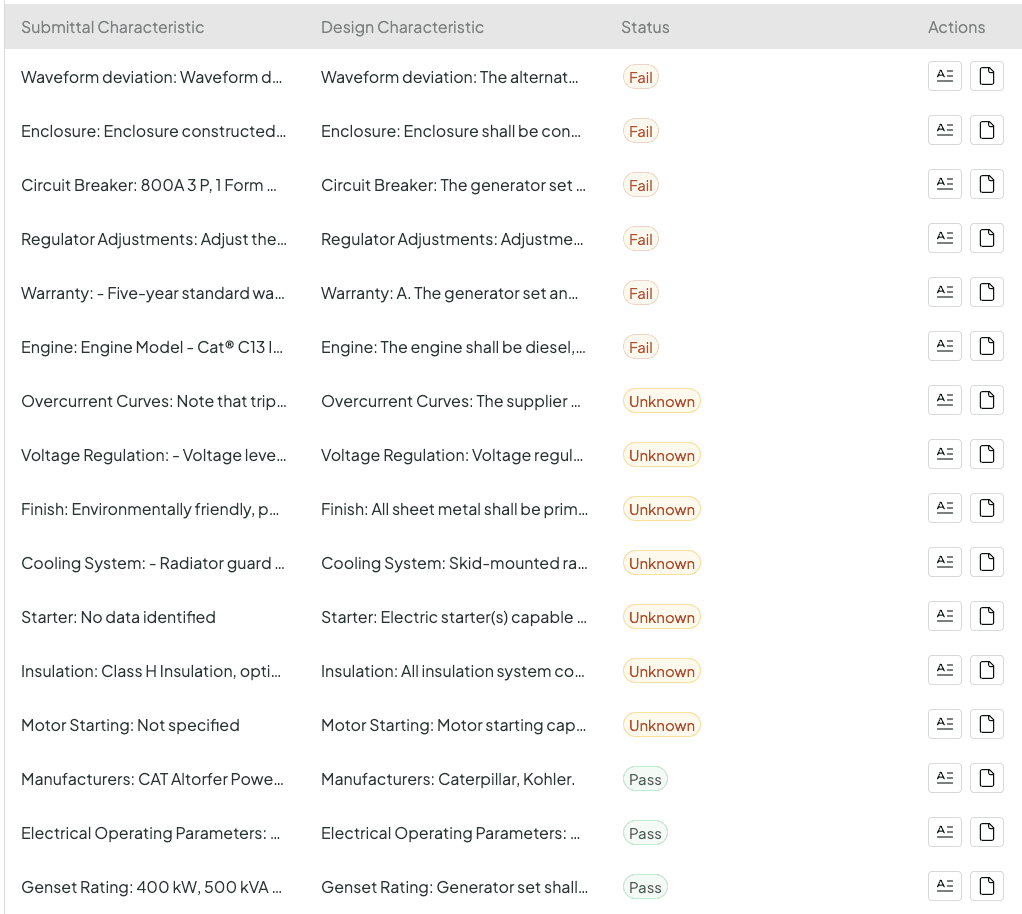
Product data submittals and MEP equipment construction submittals are where technology can help improve the submittal process. BuildSync performs deep technical analysis by extracting technical characteristics and comparing them against design specifications, catching technical compliance issues that manual reviews routinely miss.
For the systematic, high-volume work (extracting characteristics, cross-referencing specs, documenting findings), technology handles it. For coordination, judgment, and complex decision-making in the construction submittal process, your expertise remains critical.
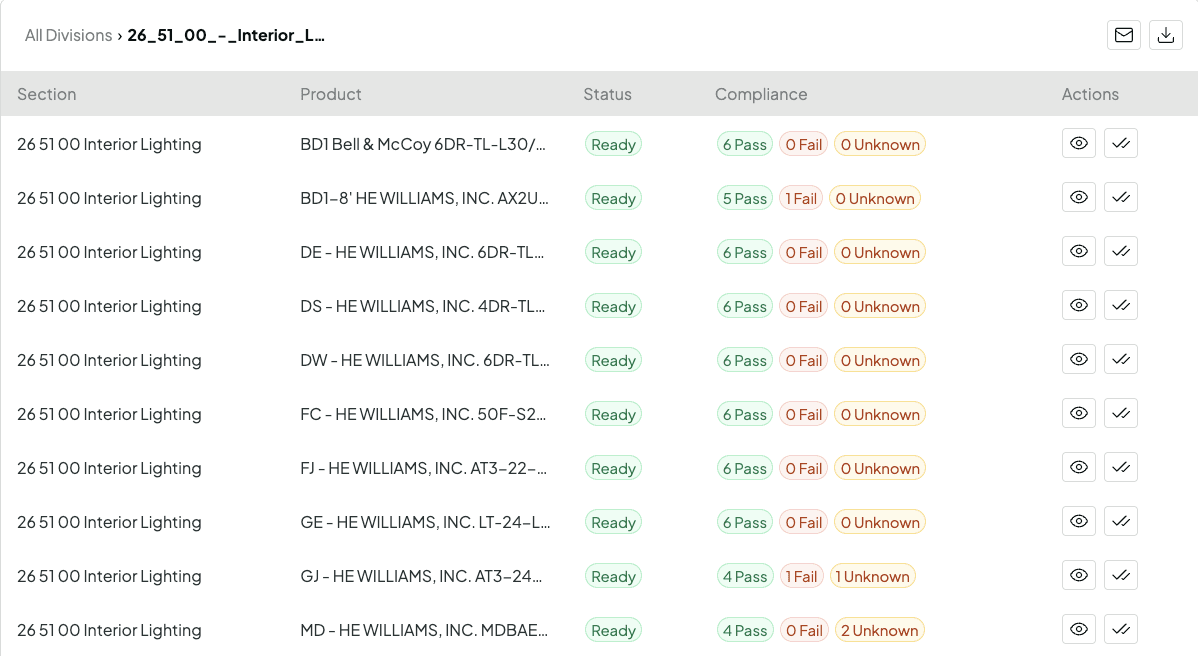
Processing hundreds of product data and MEP equipment submittals on your construction project? See how BuildSync extracts and verifies technical characteristics automatically, so your team can focus on the judgment calls that actually need their expertise.
How PMs Can Streamline Construction Submittal Management
The math on submittal management is simple but brutal: a typical 800-submittal project following traditional manual processes requires 730+ hours of review work. That's 18+ weeks of full-time effort, and it doesn't account for the coordination meetings, resubmittals, or fire drills when critical path items get rejected.
The uncomfortable truth? You can't eliminate required submittals. But you can fundamentally change how you process them in the construction submittal process.
The Strategic Workflow Foundation
Before construction begins, establish these foundational processes that separate high-performing teams from overwhelmed ones:
Set internal deadlines 7-10 days before the contract due date
This buffer isn't about padding the submittal schedule. It's about creating space for internal quality control. When subcontractors miss the internal deadline, you still have runway to catch issues before they become rejections that delay your construction project by 2-4 weeks.
Create submittal-specific QC checklists by type
Product data submittals need different verification than shop drawings. Your checklist for mechanical equipment should confirm: complete cut sheets, specified model numbers, required certifications, performance data matching specs, and coordination notes for interfacing systems. Build these once, reuse them hundreds of times across the submittal process.
Establish clear routing and approval authority
According to the AIA A201-2017 General Conditions, the architect's review is limited to checking for conformance with design concept and contract documents. Knowing exactly who reviews what, and in what order, prevents construction submittals from sitting in limbo while responsible parties argue about ownership in the approval process.
The Version Control System That Prevents Disaster
Here's a scenario that plays out weekly on construction projects: A steel fabricator submits shop drawings based on the architectural drawings dated January 15. The structural engineer from the design team reviews against their drawings dated February 3. The mechanical general contractor coordinates ductwork against the architectural drawings dated January 15. When everyone shows up at the jobsite, nothing fits.
Version control isn't just good practice. It's project survival for any construction project. Your system must:
Track every document version with timestamps and change logs
Flag when construction submittals reference superseded drawings
Maintain a clear audit trail showing who reviewed what, when
Automatically notify affected trades when specifications or drawings change, keeping everyone on the same page
Digital submittal review platforms like BuildSync provide this infrastructure. BuildSync goes further by automatically detecting changes between drawing versions, showing exactly what changed and how it impacts your existing submittals in the submittal workflow.
The Coordination Meeting That Actually Works
"Coordination meeting" often means everyone stares at drawings for two hours, identifying obvious conflicts that should have been caught weeks ago in the submittal review. Make these meetings productive through genuine stakeholder collaboration:
Before the meeting: Share submittal packages digitally. Give trades 72 hours to review and mark up potential conflicts. Come prepared with specific questions, not general "any issues?" discussions about the construction submittal.
During the meeting: Focus on interface points. Where mechanical meets structural, where electrical penetrates the building envelope, where plumbing conflicts with ductwork in ceiling spaces. Use 3D coordination models when available. Document every decision and assign follow-up actions with owners and deadlines to keep the project team aligned.
After the meeting: Update submittal packages immediately with coordination notes. Don't wait for the official meeting minutes. By then, someone's already ordering equipment based on the uncoordinated construction submittal.
Where Technology Transforms the Process
Manual submittal review doesn't scale. Preparing submittals and reviewing them manually is time consuming work, and a thorough line-by-line review of every package is physically impossible within realistic project timelines for any construction manager.
This is where automation changes the game. Not by replacing your judgment, but by handling the systematic, repeatable verification that consumes the majority of review time in the submittal review process:
Automated extraction: Pull technical characteristics from 70-page equipment packages in minutes instead of hours
Spec comparison: Cross-reference every data point against your project specifications systematically
Compliance verification: Flag non-compliant items with specific references to both the construction submittal and the spec section in your project manual to ensure compliance
Complete documentation: Generate detailed reports showing what passes, what fails, and exactly why in the submittal process
BuildSync's AI-powered submittal review handles this systematic work at scale. You get construction submittals pre-reviewed with 95%+ accuracy, catching the technical mismatches that would otherwise get missed in the volume crunch. Your project team focuses on coordination decisions, judgment calls, and the complex review work where human expertise actually matters.
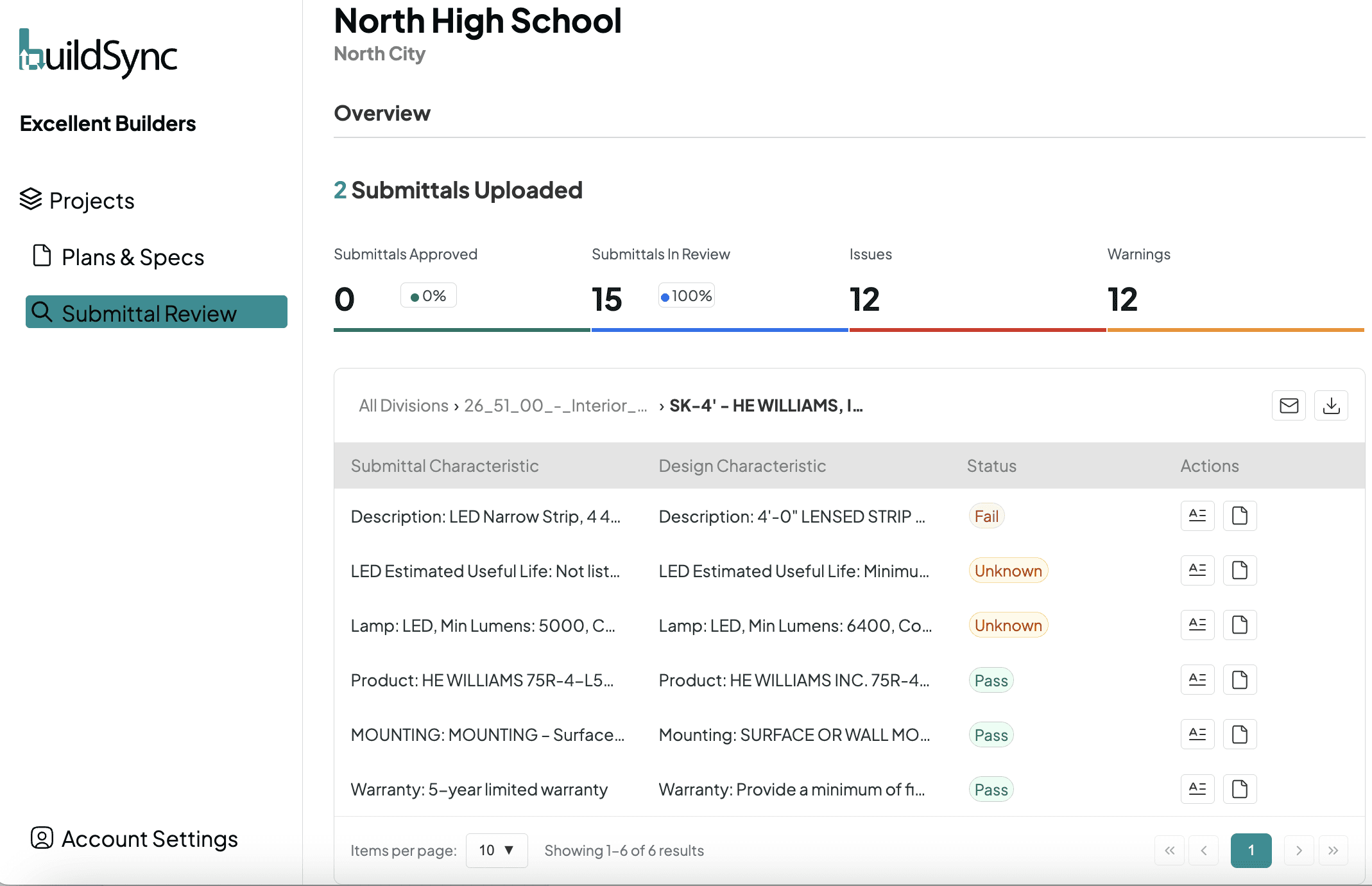
The result? Rejection rates fall dramatically, with more submittals approved on the first try, while construction managers and PEs reclaim significant time each week for actual project management work. Coordination, problem-solving, and keeping the construction project moving forward.
Stop losing weeks to submittal rejections. See how BuildSync helps construction teams drive first-time approval rates up while giving hours back to your project engineers.
Request a demo to see it work on your actual construction submittals.
Common Submittal Mistakes & How to Avoid Them
Walk into any general contractor project management office and ask about their biggest submittal frustrations.
You'll hear the same patterns: "They submitted the wrong spec section." "Half the required certifications are missing." "The shop drawings are based on drawings from two revisions ago." "Nobody coordinated with the other trades."
These aren't isolated incidents. They're systemic failures that drive the industry's persistently high submittal rejection rate. Let's break down the most common mistakes in submittals in construction and, more importantly, how to prevent them from happening on your construction project.
Mistake #1: Submitting Without Internal Quality Control
The pattern: Subcontractors rush to meet the submittal deadline, uploading whatever they have five minutes before it's due. The submittal package has obvious problems: missing pages, incomplete data, wrong specification references, or product data for a different project entirely.
The cost: The general contractor returns it immediately without review. The sub now has to redo the entire submittal package, pushing the submission back 5-7 days. If this is a critical path item in the submittal schedule, the entire project timeline shifts.
The fix: Require subs to complete a pre-submission checklist before uploading to the submittal log. Create a simple verification document:
All pages present and readable
Correct project name and specification section referenced in project manual
All required manufacturer certifications included
Technical data matches specified requirements
Coordination notes address interface points
Shop drawings reference current drawing versions
Make submittal package completeness a scored metric in your subcontractor evaluation. When subs know you're tracking this data and it affects future bid opportunities, internal QC dramatically improves in the submittal process.
Mistake #2: Missing Required Information
The pattern: The construction submittal looks complete at first glance, until your design team starts their submittal review and discovers critical information is missing. The fire-rated door assembly has no UL listing. The HVAC unit has performance data but no seismic certification. The electrical transformer has specifications but no test reports, forcing reviewers to request clarification from the electrical contractor.
The cost: Beyond the obvious delay, this creates frustration with your design team. When this happens repeatedly, architects and engineers start assuming your construction submittals will be incomplete, leading to unnecessarily detailed review and slower response times even on good submittals in the review process.
The fix: Build specification-specific submittal requirements matrices. For every major submittal type in your project manual, document exactly what necessary documentation must be included. For example, your mechanical equipment submittal checklist might specify:
Manufacturer cut sheets with complete technical specifications
Performance curves and data matching project requirements
Required testing and certification documents (AHRI, UL, etc.)
Warranty information
Installation instructions
Maintenance manuals and parts lists
Coordination drawings showing clearances and connections
Share these matrices with subcontractors at the pre-construction meeting. Better yet, build them into your submittal platform so the system automatically flags missing information before the submittal package even leaves the sub's hands.
Mistake #3: Working from Outdated Drawings
The pattern: The shop drawing fabricator starts work based on the architectural drawings they received three months ago. Meanwhile, the design team issued two addenda and a revision specifically affecting that area. The fabricated components arrive on site and don't fit the as-designed condition.
The cost: This is one of the most expensive mistakes in the construction industry. Beyond the 2-4 week delay for re-fabrication, you're looking at potential backcharges for the incorrect materials needed, expediting fees, and schedule acceleration costs that impact project success.
The fix: Implement mandatory drawing version verification at three critical checkpoints in the submittal review process:
At pre-construction: Establish a single source of truth for current drawings and specs
At submittal preparation: Require subs to reference specific drawing numbers and dates in the construction submittal, along with any related documents
At submittal review: Verify referenced drawings match current versions before proceeding with the review process
Technology solves this systematically. BuildSync's drawing change detection automatically identifies changes between revisions, flags affected construction submittals, and notifies relevant trades. No more manual drawing comparisons, no more fabrication based on superseded information.
Mistake #4: No Trade Coordination
The pattern: The mechanical, electrical, and plumbing trades submit their equipment and rough-in shop drawings independently. Each submittal package technically meets project specifications when reviewed in isolation by the construction manager. Then you discover the electrical system switchgear is exactly where the mechanical engineer located the main AHU. Or the plumbing riser conflicts with the structural column schedule.
The cost: Beyond the rejection and resubmittal delays in the submittal process, coordination failures caught late often require design changes, RFIs, and potential change orders. According to the Construction Specifications Institute (CSI), coordination issues are among the leading causes of rework in commercial construction.
The fix: Schedule coordination review sessions before a single submittal goes to the design team. For major systems:
Review mechanical equipment submittals alongside electrical power requirements
Coordinate rough-in drawings across all trades before any single trade submits
Use 3D coordination models for congested areas (mechanical rooms, above-ceiling spaces, underground utilities)
Document coordination agreements and attach notes to each affected construction submittal in your submittal log
Make coordination verification a required step in your digital submittal workflow. When the MEP coordinator signs off in the approval process, the system permits release to the appropriate parties on the design team. Not before.
The Systematic Prevention Strategy in Submittal Process
These mistakes share a common cause: insufficient process discipline under schedule pressure. When you're managing 800 submittals in construction and juggling ten other PM responsibilities, it's easy to let quality slip, especially when multiple reviewers are involved at different stages.
The teams that consistently avoid these errors have done two things:
Systemized their quality checks: They've built submittal management processes that catch these mistakes automatically, not through individual heroics
Invested in appropriate technology: They use tools that enforce the submittal workflow, flag potential issues, and create accountability without requiring constant manual oversight
Want to see how BuildSync catches these common mistakes before they become rejections? Request a demo and we'll review your most complex construction submittals to show you exactly what we catch.
Conclusion: Master the Types, Transform the Process
Understanding the nine types of construction submittals (product data, shop drawings, samples, mock-ups, warranties and O&M manuals, vendor information, test reports and certifications, as-built drawings, and engineering calculations) forms the foundation of effective submittal management.
But here's the perspective you won't find in other submittal guides: knowing the types of submittals isn't enough. The construction industry has understood submittal types for decades, yet most construction submittals still get rejected on first review, costing construction projects real money per rejection and adding weeks to schedules.
The Path Forward
Submittal management done right becomes your competitive advantage for project success. Lower rejection rates in the construction submittal process mean:
Faster procurement and fabrication schedules
Better relationships with design teams and subcontractors
Fewer schedule delays and budget overruns
Time for your project team to focus on proactive project management instead of reactive damage control
Start by understanding the nine types of submittals in construction and what makes each one unique. Then build the processes and adopt the technology that lets you manage submittal items systematically at scale.
Because in the construction industry, submittal mastery doesn't just mean understanding the types. It means executing flawlessly across all of them, on every construction project, every time.
Ready to transform your construction submittal process?
Request a demo and see how BuildSync helps construction teams achieve 95%+ first-time approval rates while reclaiming 70-80% of their review time in the submittal review process.
FAQs
What Are the Three Types of Submittals in Construction?
When people ask about "the three types of submittals," they're usually referring to the three most common categories in the construction submittal process. These are product data submittals, shop drawings, and samples. However, modern construction projects typically involve nine distinct types of construction submittals, each serving a specific purpose in the submittal workflow and each requiring its own set of relevant documents.
Who is responsible for preparing and submitting construction submittals?
What are the common categories of construction project submittals?
What are MEP submittal types and coordination requirements?
Related reads for you
Discover more articles that align with your interests and keep exploring.


