Industry Insights
/
Apr 22, 2026
Division 23 Construction: The Complete HVAC CSI Code Guide
Master Division 23 construction & HVAC CSI codes — covering specs, subsections, and common mistakes. The complete guide for PMs and contractors using BuildSync AI.

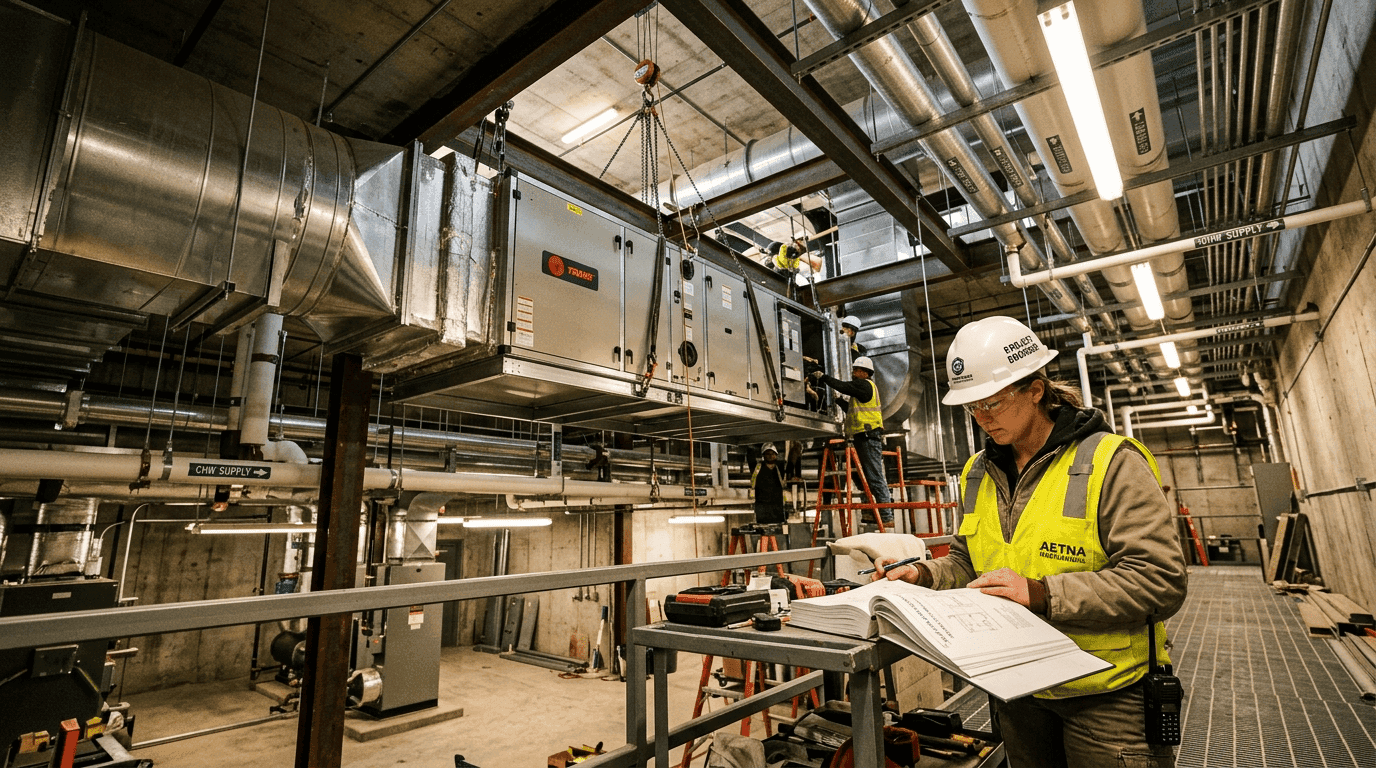
Picture a project engineer three weeks into a hospital renovation. The mechanical submittal schedule has 43 line items. The Division 23 spec runs 94 pages across 11 sections. An air handler submittal just landed, and someone needs to verify it against the specifications before it goes to the design team.
Where do you even start?
This is the daily reality of working with the HVAC CSI code on commercial construction projects. Division 23 construction exists precisely to answer that question, but understanding its structure and actually using it to verify compliance are two very different things. This guide covers both.
What Is CSI Division 23 in Construction?
Division 23 is the CSI MasterFormat classification dedicated entirely to heating, ventilating, and air conditioning systems in commercial buildings. It sits within the Facility Services Subgroup alongside Division 22 plumbing, Division 25 integrated automation, and Division 26 electrical, and it covers every component, system, and installation requirement involved in managing a building's indoor environment.
For anyone working in construction, Division 23 is the spec section that defines what HVAC equipment gets installed, what performance standards it has to meet, how systems get controlled, and what documentation contractors need to provide.
Architects, engineers, GC project managers, and mechanical subcontractors all interact with it at different stages of a project. Understanding its structure is the first step toward using it effectively rather than fighting through it.
The same discipline carries over to Division 22, where assembling a plumbing submittal package means working the fixture schedule tag by tag rather than the equipment schedule used in Division 23.
The CSI MasterFormat division structure organizes all construction specifications into a consistent numbering framework. Division 23 is where every HVAC-related specification lives on a commercial project.
Division 23 Heating Ventilating and Air Conditioning: The Full Subsections Breakdown
Understanding what each subsection of Division 23 heating, ventilating, and air conditioning covers is what separates teams that navigate specs efficiently from those that spend hours hunting through the wrong sections. The table below maps the major subsections to what they actually govern and why they matter during submittal review.
Section | Title | What It Covers | Submittal Impact |
23 05 00 | Common Work Results for HVAC | Hangers, supports, seismic bracing, sleeves, firestopping | Often referenced but overlooked; material submittals here are easy to miss |
23 09 00 | Instrumentation and Control for HVAC | BAS, DDC controls, sensors, thermostats, control sequences | Control documentation is a frequent source of incomplete packages |
23 10 00 | Facility Fuel Systems | Natural gas piping, fuel oil systems | Less common but critical on projects with gas-fired heating equipment |
23 20 00 | HVAC Piping and Pumps | Hydronic piping, refrigerant piping, pumps, valves | Piping material specs and insulation requirements live here |
23 30 00 | HVAC Air Distribution | Ductwork, diffusers, grilles, registers, dampers | SMACNA standards referenced here; duct pressure class lives here |
23 50 00 | Central Heating Equipment | Boilers, heat exchangers, furnaces | Efficiency ratings and fuel type requirements are compliance-critical |
23 60 00 | Central Cooling Equipment | Chillers, cooling towers, condensers | Refrigerant type and efficiency are the most common failure points |
23 70 00 | Central HVAC Equipment | Air handling units, makeup air units | AHUs generate the highest characteristic counts in BuildSync reviews |
23 74 00 | Packaged Outdoor HVAC Equipment | Rooftop units, packaged systems | RTU submittals are among the most submittal-volume-heavy sections |
23 80 00 | Decentralized HVAC Equipment | VRF systems, unit heaters, fan coil units | Equipment schedules here often involve dozens of unique tags |
23 81 00 | Terminal HVAC Equipment | VAV boxes, terminal units | Tag-by-tag review is essential; shared data sheets cause frequent unknowns |
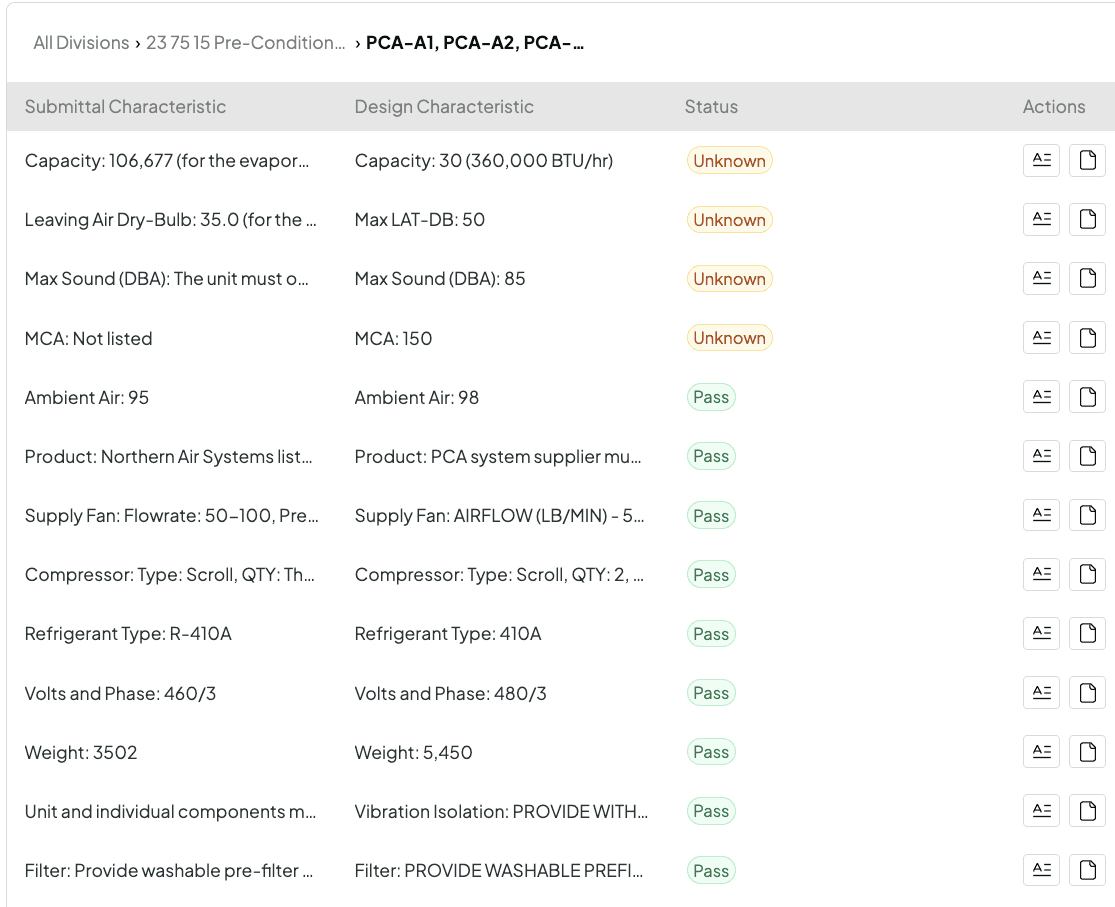
The sections that generate the most submittal volume on a typical commercial project are 23 70 00, 23 74 00, and 23 80 00. These cover the equipment with the most technical characteristics to verify: airflow, static pressure, refrigerant type, motor efficiency, electrical data, sound ratings, certifications, warranties, and attic stock requirements. A single air handler submittal can yield 60 or more individual characteristics to check.
Tom Port, the co-founder of BuildSync, when asked which subsections of Division 23 submittals across hundreds of projects consistently generate the most rejections, says:
The highest rejection rates come from the equipment-heavy sections like 23 70 00 and 23 74 00, but the root cause isn’t the equipment; it’s the fragmentation.
Requirements are split across controls, common work, and equipment specs, so unless you’re systematically cross-referencing, you’re going to miss something.”
Why Division 23 Is Critical for Building Energy Efficiency
Division 23 is where energy efficiency requirements stop being abstract and become specific equipment specifications. Every minimum efficiency rating that ASHRAE 90.1 mandates for commercial buildings gets translated into a Division 23 specification requirement that a submitted piece of HVAC equipment has to meet. That connection is direct and binding.
The 2022 edition of ASHRAE 90.1 introduced several updates that flow directly into Division 23 specifications:
Updated Integrated Energy Efficiency Ratio (IEER) requirements for commercial rooftop units
New SEER2/HSPF2 metrics for air-cooled heat pumps
Mandatory energy monitoring for buildings over 25,000 square feet
When a mechanical contractor submits HVAC equipment, the efficiency ratings on that cut sheet have to match or exceed what the spec requires, or the submittal fails.
The efficiency-related characteristics that most commonly surface as failures during submittal review include:
Minimum EER or IEER ratings for cooling equipment
Minimum AFUE or thermal efficiency for heating equipment
Energy recovery requirements for air handling units
Demand control ventilation specifications
These aren't obvious failures. They're buried in product data sheets, often expressed in different metrics than the spec uses, and easy to miss without systematic extraction and comparison.
ACCA (Air Conditioning Contractors of America) Manual J and related standards also influence how equipment is sized and specified under Division 23, particularly for decentralized systems where equipment selections are driven by room-by-room load calculations. Contractors and engineers working to standards from both ASHRAE and ACCA will find those requirements reflected throughout Division 23 specifications.
What a Well-Written Division 23 Spec Actually Looks Like (And Why It Matters)
Most content about Division 23 focuses on how to read a spec. This is the question that actually determines submittal outcomes: how well was the spec written in the first place?
A well-written Division 23 specification does several things clearly:
Defines approved manufacturers by name, not just "or approved equal"
Specifies efficiency requirements in the same metric used on manufacturer cut sheets, so there's no ambiguity about whether a submitted product complies
Places related requirements in a single section rather than scattering them across multiple spec sections without cross-references
Defines warranty requirements and attic stock expectations explicitly, not by implication
When Division 23 specs do the opposite, the downstream effects are predictable:
Spec Problem | Downstream Effect |
Requirements buried across 23 05 00, 23 70 00, and 23 09 00 without cross-references | Reviewers miss requirements; rejections follow |
"Approved equal" language without defined equivalency criteria | Every substitution request becomes a judgment call that delays the review |
Conflicting efficiency standards between the spec body and equipment schedule | Ambiguity surfaces as "unknown" flags and triggers RFI cycles |
These are patterns that repeat across commercial construction projects of all types and sizes. The spec quality problem is the hidden variable in submittal rejection rates that nobody talks about, because the contractor rarely has visibility into why a well-intentioned submittal keeps coming back.
Want to see how BuildSync processes Division 23 submittals against your specifications? Book a demo.
The Most Commonly Missed Division 23 Compliance Points
The compliance failures that repeat most often across Division 23 submittal reviews aren't the obvious ones. They're the characteristics that sit quietly in product data sheets, easy to overlook without a systematic extraction process.
Refrigerant type
The commercial HVAC industry is mid-transition from R-410A to R-454B and other lower global warming potential alternatives. A submittal with the wrong refrigerant type is an outright failure, and it happens more often than it should when product data is pulled without explicitly cross-checking this characteristic against the spec.
Motor efficiency
ASHRAE 90.1 sets minimum efficiency requirements for HVAC motors that vary by horsepower. Submitted equipment that doesn't hit the required efficiency level fails regardless of everything else being correct. This characteristic is frequently buried in electrical data tables rather than the main product summary.
Approved manufacturers
If the spec lists acceptable manufacturers and the submitted product isn't among them, the review stops there unless a substitution request has been formally approved first.
Warranty and attic stock
Warranty terms stated as "standard manufacturer warranty" when the spec calls for a specific duration and coverage from date of substantial completion are a recurring unknown. Spare parts and attic stock requirements, including items like spare fan belts and filters, are among the most commonly missed requirements at submittal and the most commonly disputed at closeout.
Duct pressure class
Duct submittals that reference SMACNA duct construction standards but don't explicitly address the pressure class called out in section 23 30 00 of the spec are a consistent rejection source on MEP-heavy projects.
Electrical characteristics alignment
Motors, VFDs, and HVAC controls require coordination between Division 23 and Division 26. Voltage, phase, amperage, MCA, and MOCP all need to be consistent between the submitted product data and the electrical drawings. Discrepancies here don't always surface during the Division 23 review because the mechanical reviewer may not be cross-referencing the electrical schedule. For how assembling the electrical submittal package supports that coordination, this guide covers the cut sheets, calculations, and certifications an electrical submittal should include before it enters interdisciplinary review.
Control sequence documentation
Section 23 09 00 often requires sequence of operations documentation as part of the submittal. Packages that address equipment but omit controls documentation are a frequent source of incomplete reviews, particularly for building automation systems with custom programming.
Coil coatings
For projects in coastal or industrial environments, specifications frequently require corrosion-resistant coatings on evaporator and condenser coils for salt air or chemical exposure. A submittal that lists a coating generically without confirming it meets the specific requirement in the spec will surface as an unknown.
How Division 23 Submittals Get Reviewed (And Where They Usually Go Wrong)
A project engineer receiving a Division 23 submittal opens the package, locates the corresponding spec section, and starts working through it characteristic by characteristic. For a straightforward packaged rooftop unit, that might take 45 minutes.
For a complex air handling unit with 60 or more technical characteristics across performance data, electrical data, controls specifications, and accessories, it can easily take three to four hours. On a project with 40 open HVAC line items on the submittal schedule, that math becomes a problem quickly.
The volume compounds the risk. When engineers are moving fast through a large submittal log, the characteristics most likely to get missed are the ones that require cross-referencing multiple sections, checking a secondary document, or doing a calculation to verify compliance. Those are exactly the characteristics that generate rejections.
Jacob Delargy, project engineer at Monteith on a $100M+ high school build, put it plainly: BuildSync helped his team review submittals against multiple spec sections they wouldn't have thought to reference during a manual review.
On a project where a single submittal ran 530 pages, that capability isn't a convenience. It's the difference between catching a compliance issue before it reaches the design team and discovering it after a rejection.
AI and Division 23: A New Way to Navigate Heating Ventilating and Air Conditioning Specs
The structured organization of Division 23 is actually what makes AI-powered submittal review effective. A well-written spec section gives AI the same advantage it gives a skilled human reviewer: a clear map of where requirements live and what each one demands.
The difference is that AI can hold all of those requirements in view simultaneously, extract every relevant characteristic from the submitted product data, and check each one systematically without losing track of where it is in the document.
BuildSync processes Division 23 submittals in three steps:
Break down to the product level: Each submittal is separated into its individual products. A rooftop unit submittal with multiple tags gets separated by tag, not reviewed as a single document.
Extract every technical characteristic: For each product, BuildSync pulls every relevant data point from the submitted documentation: airflow, refrigerant type, motor efficiency, coatings, warranty terms, attic stock, and more.
Compare each characteristic against the plans and specifications: Every determination comes with a cited source: the exact page in the submittal where the value was found, and the exact page in the spec where the requirement is stated.
That's the "trust but verify" principle built into the product, so engineers can spot-check any determination instantly rather than having to take the AI's word for it.
Output | What It Means |
Pass | The submitted characteristic meets the requirement in the plans and specifications |
Fail | The submitted characteristic does not meet the requirement; low-hanging fruit for follow-up with the sub or vendor |
Unknown | Ambiguous; the information needed to make a determination isn't present in either the submittal or the spec. Not a system limitation; a gap that requires human clarification |
Conflicting specs | Both requirements are noted, flagged as related, and the more stringent requirement is identified so the team can write a targeted RFI |
For teams managing large HVAC submittal schedules, the practical outcome is significant. The ability to process a complex HVAC submittal package in hours rather than days, with every characteristic extracted and verified, changes what's possible at the project level.
Submittals that would have consumed a junior PE's entire week get reviewed before lunch. Issues that would have gone unnoticed until the design team flagged them get caught before the package leaves the GC's hands.
Ready to cut your Division 23 submittal review time? Start a free trial.
Frequently Asked Questions
How do I read a Division 23 spec section number?
Division 23 section numbers follow a six-digit format that indicates three levels of specificity. The first two digits identify the division: 23 always means HVAC. The middle two digits identify the section group within the division: 23 74, for example, means Packaged Outdoor HVAC Equipment. The final two digits identify the specific section: 23 74 00 is the full section number. Some specifications extend to a fourth decimal level for additional detail, such as 23 81 23.16 for a specific type of rack-mounted computer room unit. When a submittal references a spec section, that number should match the project's specifications exactly. Using the wrong section number routes the submittal to the wrong reviewer and creates tracking problems on the submittal schedule.
Does Division 23 cover building automation and controls?
How do I coordinate Division 23 with Division 26 electrical systems?
Who is responsible for Division 23 submittals - the GC or the mechanical sub?
Related reads for you
Discover more articles that align with your interests and keep exploring.


