Construction Technology & Innovation
/
Sep 23, 2026
How to Review Submittals Faster: 8 Practical Steps


The answer to how to review submittals faster has less to do with reading speed and more to do with the order of operations. Teams that move quickly through construction submittals build the list of project requirements from the specifications first, then test the submittal against that finite list. Teams that move slowly open the product data at page one and hunt forward, hoping something jumps out.
That difference decides whether a review has an end point or just an eventual stopping point.
Why does the construction submittal process run slow before anyone opens a spec?
Manual submittal reviews run slow because they start as an open-ended search rather than a bounded check. A 70-page cut sheet package is organized to sell equipment, not to answer the questions in Section 23 74 13. So the reviewer reads, cross-references, backtracks, and re-reads, without ever knowing how much is left.
Most teams land somewhere between four and eight hours on a complex package, and the benchmarks for how long submittal reviews should take show that time concentrating in four activities:
Locating the right specification section across a project manual that can run 200 pages
Pulling technical data out of a submittal organized for marketing, not for compliance
Interpreting contradictions between the drawings and the specifications
Documenting findings in a format someone else can act on
Very little of that is decision-making. Almost all of it is getting to the point where a decision is possible. Reorder those four activities and the same review gets substantially shorter without loosening anything.
8 steps for faster approvals on construction submittals
1. Extract project requirements on the front end, before opening the submittal
Open the specification first and write down what the section actually demands:
Acceptable manufacturers and approved equals
Performance ratings and efficiency thresholds
Required certifications and listings
Warranty duration and start date
Extra materials and attic stock
Ten minutes here converts an unbounded reading exercise into a checklist with a known length. Reviewers who skip this step spend the review deciding what matters instead of deciding whether it complies.
2. Screen the entire package for completeness before reviewing anything in it
Confirm the submittal includes marked cut sheets, all referenced certifications, and equipment tags that match the schedule. An incomplete package returned in five minutes costs five minutes. The same package reviewed in full, then returned, costs a full rejection cycle and roughly two weeks of schedule.
3. Break the submittal into products and equipment tags
Separate the package into individual products before checking anything. One lighting submittal can contain 14 fixtures; one VAV data sheet can cover a dozen tags. Reviewers lose time and miss items when a single sheet applies to units 1-1 through 2-9, and the review treats it as one product.
When asked which characteristics most often turn up as failures that reviewers rarely check first, and which three things PEs should check before sending a package, Tom Port, the co-founder of BuildSync, says:
“The characteristics that keep showing up as failures are usually the ones buried in the details rather than the headline performance numbers. On mechanical equipment, that might be refrigerant type, MERV rating, coil coating, or required spare parts.
On lighting, it’s often the selected lens, finish, accessories, or whether the fixture tag actually matches what was scheduled. If a PE could only check three things before sending a package on, I’d tell them to check the exact product and tag match, the high-consequence technical requirements that would force a resubmittal, and whether every required option or accessory has actually been selected rather than just shown somewhere on a cut sheet. Those are the misses that can look small but still send the whole package back.”
4. Check the high-consequence product data first
Run the characteristics that trigger revise-and-resubmit before the easy ones. They cluster by equipment type, and these are the ones that turn up repeatedly in real reviews:
Equipment type | Characteristics that fail most often |
Mechanical (AHUs, RTUs, chillers) | Refrigerant type, filter MERV rating, coil coating, spare parts and extra materials |
Lighting fixtures | Lens type selected, finish, accessories such as wire guards, fixture tag match |
Glazing and openings | Named manufacturer, visible light transmittance, thermal performance values |
A refrigerant mismatch buried on page 41, R-410A submitted against a spec calling for R-454B, is worth more review minutes than a dozen dimensional checks that were never going to fail.
Substitutions belong in this first pass too. When a submittal proposes an "or equal" product rather than a named manufacturer, check it against the spec's substitution procedure before checking anything else about it. An unapproved substitution fails on process no matter how well the product performs, and finding that out on page one saves the two hours it takes to verify a product that was never eligible.
5. Resolve contradictions between contract documents while still in the documents
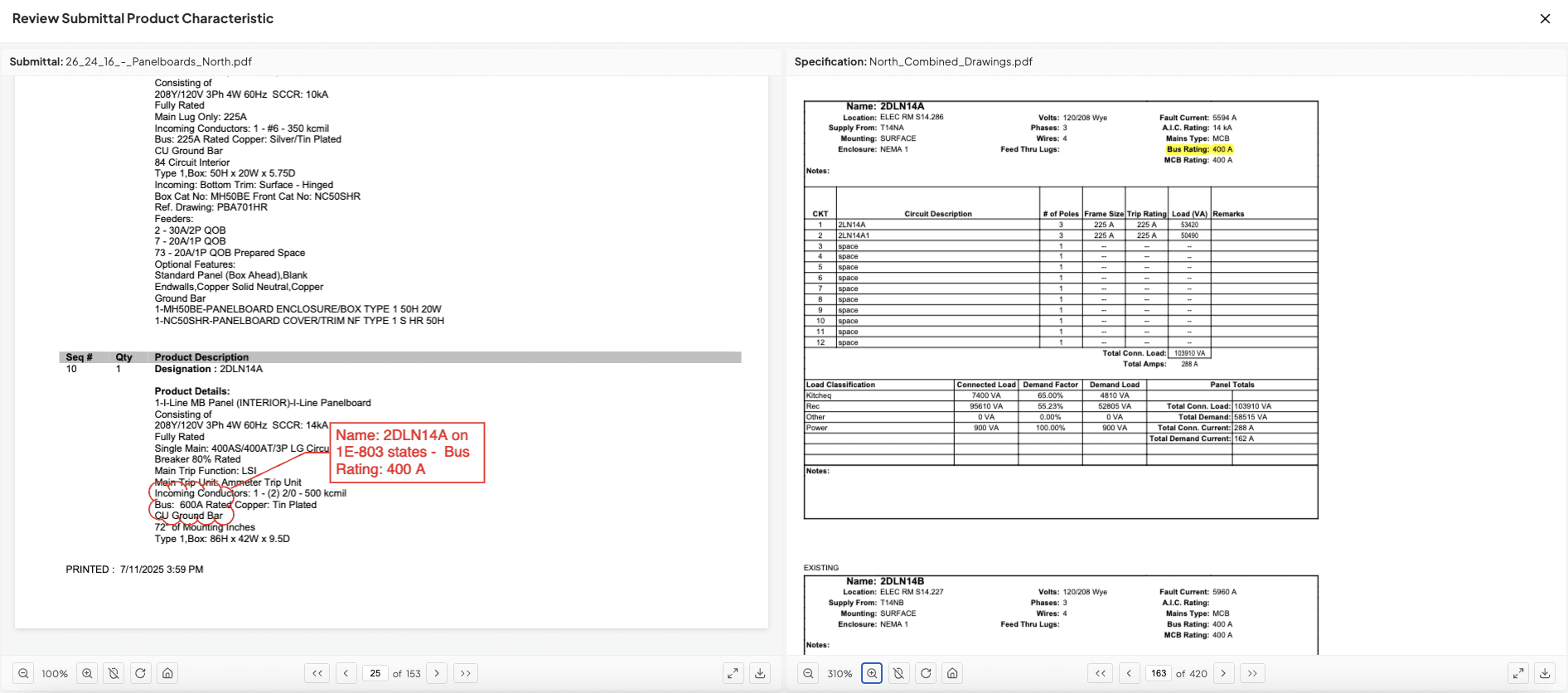
When the schedule on the drawings and the specification disagree, note both requirements, flag the more stringent one, and write the RFI in that sitting. Deferring it means reopening the whole package later, reconstructing the context, and explaining it to the design team twice.
6. Use unknowns and partial approvals instead of guessing
A characteristic that cannot be confirmed from the submittal or the specs should be recorded as unknown, not passed on instinct. Unknowns are useful output. A submittal that lists no warranty against a spec requiring 10 years from substantial completion is a phone call to the vendor, and partial approvals let the compliant scope keep moving while that call happens.
When asked why flagging an unknown is better than making a potentially incorrect call, and what the fastest teams do with their unknowns list, Tom Port, the co-founder of BuildSync, says:
“An unknown is a better outcome than a guess because it tells the team exactly where the information gap is. If the submittal or the spec doesn’t give you enough to make a defensible call, passing it on instinct just hides the risk.
The fastest teams treat unknowns as an action list: they send the specific questions back to the sub or vendor immediately, keep the compliant parts of the package moving where they can, and close those gaps without reopening the entire review. That’s much faster than making an assumption and discovering later that it was wrong.”
7. Document findings once, in a form the design team can act on
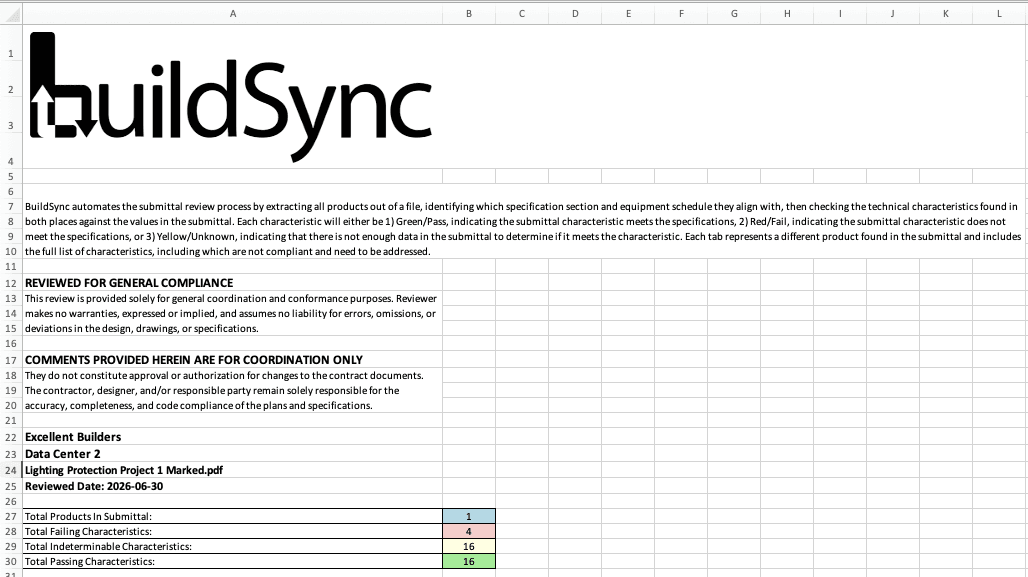
Write the review as a compliance record while checking, not afterward from memory. "Does not meet spec" sends the subcontractor guessing and buys another round. A finding that cites the submittal page and the spec paragraph gives them what they need to fix it on the first round, and it doubles as the cover sheet that makes design professionals process the package faster.
8. Move technical extraction off the reviewer's plate
Steps 1 through 4 are extraction and comparison work, which is repeatable and delegable. Steps 5 through 7 are judgment, which is not. Separating the two is the single largest available reduction in review time, whether that extraction goes to a standardized checklist, a dedicated reviewer, or software.
What do real-world examples show about submittal review time on a construction project?
Real-world examples show review time dropping by 70% or more once technical extraction stops being manual, without any loss of depth. Skepticism about AI reviewing technical documents is reasonable. The stakes on a construction project justify it, and no responsible answer starts by asking anyone to take the output on faith.
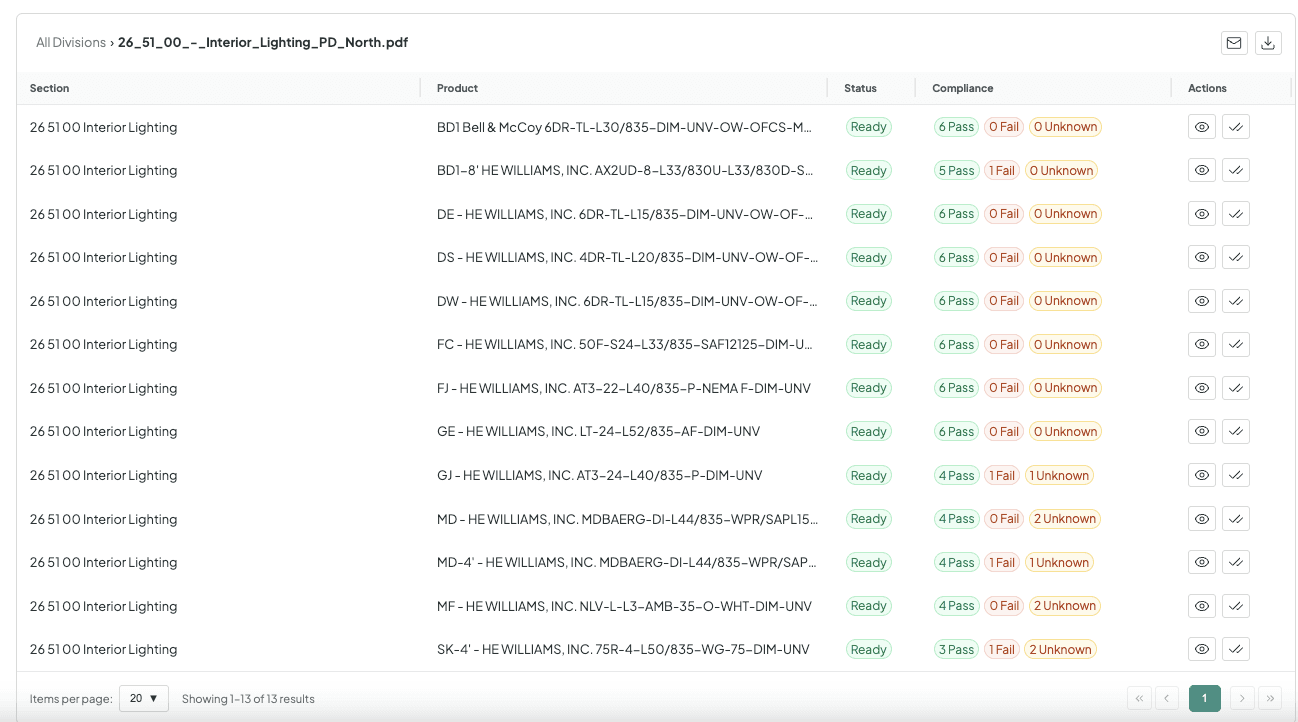
Here is what happens mechanically. BuildSync's automated submittal review breaks each submittal into products and extracts every technical characteristic, marking each one pass, fail, or unknown with a stated reason.
Every characteristic links to its source: the submittal page on one side, the spec requirement on the other. Any finding can be checked in seconds. Trust but verify, on every line.
Monteith Construction, a commercial GC running healthcare and education work, put this in front of project engineers at different experience levels and saw 70% faster submittal reviews across the board. PE Jacob Delargy noted the effect that matters most for how junior PEs learn the work: the system surfaced cross-references to spec sections he would not have thought to check during his own review.
Free trial. Run it on the hardest submittals currently sitting in your queue.
How fast is too fast for submittal reviews?
A review is too fast the moment speed comes from skipping verification rather than removing manual work. Under AIA A201 §3.12.6, submitting shop drawings, product data, and samples means the contractor represents that it has reviewed, verified, and coordinated that information against the contract documents. Rubber-stamping does not shorten the work; it relocates the risk downstream.
CSI's guidance on submittal review liability makes a related point about the industry's usual shortcut: because reviews are time-consuming and widely treated as drudgery, they get handed to less-experienced staff, which raises risk for everyone on the project. Faster approvals should come from better sequencing and better documentation, not from thinner review.
When asked where the line is between speed and accuracy in GC review, and how to tell when a team has become faster versus simply looser, Tom Port, the co-founder of BuildSync, says:
"For a GC, the line is whether speed comes from eliminating repetitive work or from eliminating verification. Getting faster because you’ve automated the extraction, comparison, and documentation is a good thing. Getting faster because you’re checking fewer requirements or accepting things you haven’t verified is just a looser review.
The best teams we see still expect every decision to be defensible against the contract documents, they’ve just removed a lot of the searching and cross-referencing that used to consume the reviewer’s time. Speed should come from getting to the evidence faster, not from lowering the standard.”
Frequently asked questions
Should the PM or the PE handle submittal reviews?
Project engineers typically own the technical review, with project managers handling scheduling, priority, and the final call on submittals affecting the critical path. The right reviewers are assigned by equipment familiarity rather than by seniority alone. Complex MEP packages benefit from a second set of eyes regardless of who runs the first pass.
Does batching similar equipment types speed up submittal review?
What should happen to a submittal that has already been rejected once?
How does the submittal schedule affect review speed?
Related reads for you
Discover more articles that align with your interests and keep exploring.