Construction Technology & Innovation
/
Dec 1, 2025
7 Ways To Improve Your Construction Submittal Review Process
Tired of submittal rejections pushing your timeline out 2+ weeks? Learn 7 practical ways to improve your review process, reduce rejection rates, and free up your team's time.


Your submittal just got rejected. Again.
When a submittal comes back, the distinction between status stamps like "Revise and Resubmit" versus "No Exceptions Taken" determines how much rework you're facing.
That's 2+ weeks added to your timeline, another round of back-and-forth with your sub, and your superintendent asking when the long-lead equipment will actually arrive.
Sound familiar?
If you're getting 30-40% of your submittals rejected, you're not alone - it's the industry average. But each rejection cycle pushes your project schedule out, costs money, and eats up time your team doesn't have.
Here's what most articles about improving the construction submittal process won't tell you: the problem isn't just workflow.
The real issue is catching technical non-compliance in submittal documents. A single piece of mechanical equipment can have dozens of specifications to verify against your contract documents. Plans and specs run hundreds of pages. Your project engineers can't possibly catch everything while juggling five construction projects.
This article covers seven practical ways to improve your submittal review process and expedite approvals. Some you can implement today. Others require bigger changes. All are designed to reduce rejection rates, save time, and keep your construction project moving.
1. Start Reviewing Submittals Earlier
Most teams start thinking about project submittals after contracts are signed and construction begins. By then, you're already behind.
Starting earlier is the single biggest way to speed up your submittals process and ensure submittal requirements are clear from the outset.
What to Review During Buyout
Review critical types of submittals during buyout
Identify long-lead items and their submittal requirements before breaking ground
Flag spec conflicts while there's time to resolve them with the design team
Establish submittal tracking protocols all relevant stakeholders understand
Align submittal workflow with your project schedule
Week One: Build Your Submittal Register
Create your submittal register in week one, not month one
Set realistic deadlines in your master project schedule from day one
Communicate deadlines to subs before they order materials
Review construction documents with your team so everyone understands project requirements
Clarify which types of submittals will require the most attention
Pre-Identify Which Specs Apply to Each Package
Pre-identify which specs apply to which submittal package
Note design team preferences and common rejection reasons
Brief your PE team on critical requirements for building systems
Ensure the contractor remains responsible for quality but understands your process
Once a submittal is late, you're in reactive mode. You rush the review, miss things, and get rejections. According to Autodesk research, poor planning is a top cause of submittal delays in the construction process.
Front-loading gives your team adequate review time without panic and helps you manage all your submittals more effectively from the start.
2. Add a Pre-Submission Quality Check
Here's a change that delivers quicker submittal approvals: Add quality control before submittals reach the design team.
GC Review: Catch Issues Before They Reach the Design Team
When a contractor submits a submittal package, don't just forward it. The PE or PM should review it first to verify it meets basic project requirements.
Check for obvious issues:
Is it complete? (Cut sheets, specs, certifications, material samples, performance data, installation instructions)
Does equipment match basic requirements? (Size, capacity, voltage)
Any red flags that guarantee rejection? (Wrong manufacturer, missing features, spec conflicts)
Does the entire package include all relevant documents for the building systems involved?
Sub Review: Spot-Check Before Submitting to the GC
Have a senior team member spot-check submittal packages before submitting to the GC. The contractor reviews should look for:
Package completeness against submittal requirements
Alignment with contract documents and project requirements
Manufacturer data matching what you'll install
Proper documentation including physical examples when specified
Why Catching 15 Rejections Saves 30 Weeks
Each rejection adds 2+ weeks to your project schedule. If you catch half the potential rejections at the GC level, you've eliminated an entire submittal revision trip.
Processing 100 submittals with 30% rejected means 30 rejection cycles. Pre-submission QC preventing just 15 rejections saves 30 weeks of schedule time across your construction project. Critical on more complex projects where the entire process extends timelines.
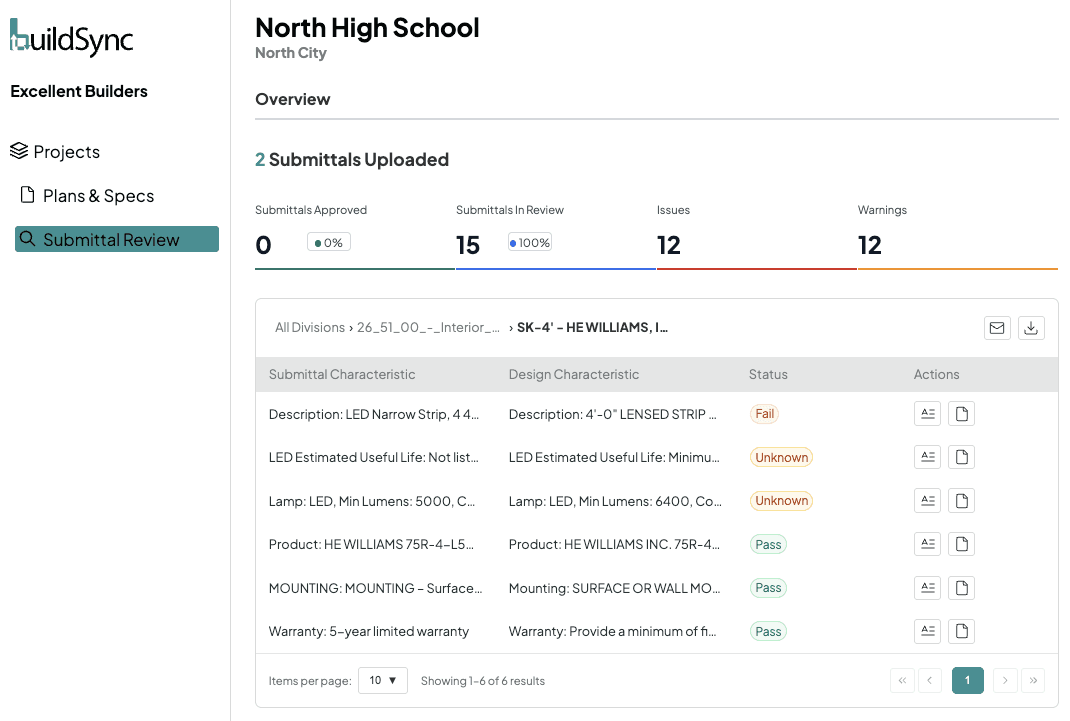
Caption: BuildSync Technical Requirement Comparison
Want to see how AI catches these issues before they reach your design team? See BuildSync in action.
3. Standardize Your Review Checklist
One of the biggest common submittal challenges: The reviewer didn't know what to look for across different types of submittals.
A window submittal needs verification of glazing type, U-factor, SHGC rating, frame material, hardware finish, and testing certifications - for one window type. Multiply that across other types of submittals for various building systems and you see the problem.
Create review templates to improve submittal review process consistency across all your submittals, recognizing that standard product data packages differ fundamentally from delegated design submittals, which require verification of engineering calculations and professional stamps in addition to compliance with performance specifications.

What Your Templates Should Cover
Physical and Performance Requirements:
Physical dimensions and clearances
Performance data (capacity, efficiency, power)
Materials and finishes
Control systems and integration for building systems
Certifications and Testing Your Specs Require:
Manufacturer certifications
Testing and listing requirements (UL, FM, etc.)
Energy efficiency compliance
Engineering calculations where applicable
Mounting, Utilities, and Coordination Details
Mounting specifications from detailed drawings
Utilities and connections needed
Access and maintenance clearances
Coordination with other trades and building systems
Warranty Terms and Spare Parts Requirements
Warranty terms (often specified in submittal requirements)
Service requirements
Spare parts or attic stock
The challenge: These are different for every equipment type and vary by types of submittals. An air handler has completely different requirements than a lighting fixture or fire pump.
This is why experienced construction professionals develop checking instincts - and why junior PEs struggle. They haven't built that mental database yet for different submittal requirements.
Many successful teams hold weekly submittal review meetings to discuss templates and share insights about various types of submittals. This helps speed up your submittals process by building institutional knowledge across your construction project.
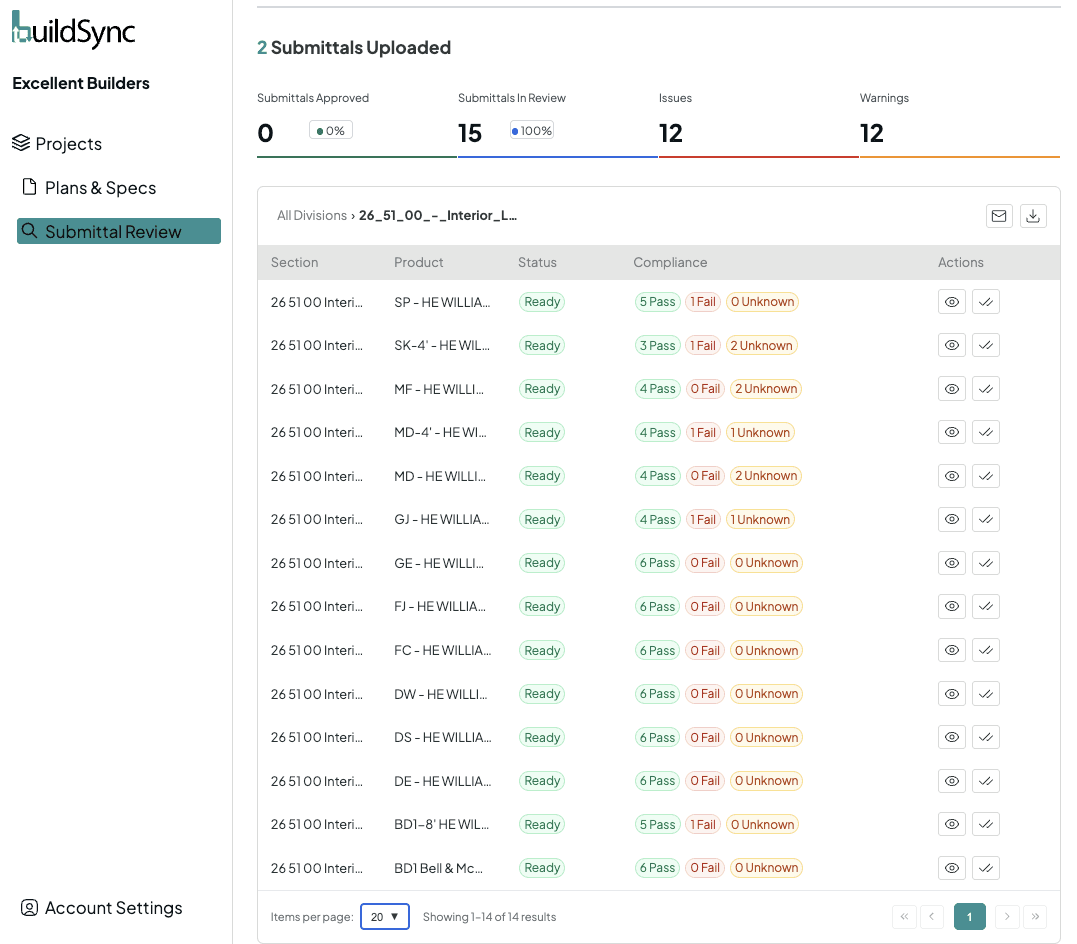
Caption: BuildSync Submittal Review Product breakdown
4. Optimize Your Project Management Workflow
If you're using Procore, Autodesk Build, or similar construction submittal software, you have submittal tracking tools. Are you using them to create an efficient submittal workflow?
Route Submittals Automatically to the Right Reviewers
Create submittal workflow systems that route to relevant stakeholders automatically:
Define who reviews what types of submittals (construction manager, specialty consultants, project owner reps)
Set required turnaround times based on project schedule
Enable automatic reminders for overdue reviews
Track status for visibility across all your submittals
Tie Submittal Deadlines to Procurement and Installation Dates
Link your submittal log to your project schedule:
Tie critical submittal packages to dependent activities
Set deadlines based on procurement and installation dates
Track status alongside project schedule performance
Flag at-risk activities when submittals delay
Review submittal status in project meetings
Create Consistent Naming and Numbering Conventions
Create consistent conventions for submittal tracking across your construction project:
Match numbering to spec sections in contract documents
Use consistent file naming for different types of submittals
Require complete submittal packages (no partial approvals initially)
Store all correspondence centrally in your submittal workflow
How AI Analysis Works Inside Your Existing Workflow
AI-powered analysis can operate within your existing submittal workflow, reviewing submittals in the background and returning detailed reports. The submittal package comes through your system, gets analyzed, and comes back with technical findings - no workflow changes needed. This expedites the construction submittal review process from submission through approval while keeping your project schedule on track.
Learn more about how BuildSync integrates with Procore.
5. Train Your Team on Technical Specs
Many project engineers don't fully understand the specifications they're reviewing in construction documents, especially across different building systems.
That's reality in the construction industry. A mechanical engineer might struggle with electrical specs. A junior PE fresh from school might not know what to check in various types of submittals. Even experienced construction professionals get tripped up outside their expertise.
Training helps improve submittal review process quality, but must combine with other strategies to truly expedite reviews across your construction project.
For a solid breakdown of where deferred submittals fit into the broader submittal workflow, BuildSync's deferred submittal guide is worth referencing.
Build Technical Knowledge Over Time
Onboarding: Pair Junior PEs with Senior Staff
Create submittal review training in onboarding covering different types of submittals
Pair junior PEs with senior staff for complex reviews of building systems
Build a library of past submittal packages (approved and rejected) as examples
Review actual submittal documents representing successes and failures
Quarterly Reviews: Share Lessons from Recent Projects
Hold quarterly reviews of common submittal challenges
Share lessons from recent successful construction projects
Bring in consultants or manufacturers for technical sessions on building systems
Discuss how different types of submittals represent different construction process aspects
Summarize Critical Specs at Kickoff
At the pre construction meeting, create a summary highlighting:
Critical specifications for major building systems
Common substitution rules and preferences of the owner and design team
Design team triggers for rejection across different types of submittals
Coordination requirements between trades
Key details from detailed drawings impacting submittal requirements
What Training Can't Fix: The Time Problem
Training helps. But even your most experienced PE can't manually extract and verify dozens of technical data points across hundreds of specification pages in reasonable time when managing multiple construction projects. Training improves accuracy but doesn't change time constraints.
Be honest about what's realistic. Can your team catch 80% of issues across all your submittals? Probably. Can they catch 95%+ while managing five construction projects and attending meetings? That's where additional solutions become necessary.
Related: Construction Submittal Review Process: Complete Guide (2026)
6. Improve Communication With Design Teams
Some rejections aren't technical non-compliance - they're misunderstanding what the architect's review focuses on or what design professionals want for specific project requirements.
Clarify Expectations Before You Submit
Clarify Substitution Rules:
What does "or equal" mean to this design team for this construction project?
What documentation do they expect for equivalency in your submittal package?
Which manufacturers or products have preferences for different building systems?
Will they consider partial approvals for certain types of submittals?
Understand Their Process:
What's typical turnaround time for different types of submittals?
Who reviews what building systems?
What format for markups or questions?
Does the project owner have specific requirements for certain submittal packages?
Flag Issues Early:
If something won't comply with construction documents, don't hide it
Send substitution or clarification requests before submitting the full submittal package
Document responses for project records
Remember the contractor remains responsible after clarifications
Keep Submittals Moving Through Review
Bundle Intelligently:
Don't overwhelm with 50 submittals at once on strict deadlines
Group related types of submittals needing coordinated review (like window submittal with flashing)
Stagger so you get feedback to apply to other submittals in your submittal workflow
Include relevant documents together for building systems that integrate
Respond Promptly:
Provide requested information or material samples immediately
Don't let submittal packages sit in "revise and resubmit" limbo
Track open items and follow up
Update all relevant stakeholders on changes to maintain project schedule
Document What Was Approved and Share with the Field
Keep clear records of what was approved and when
Note special conditions for installation
Share approved submittals with field teams before needed
File with other project documents for completed project records
According to the Associated General Contractors of America, poor stakeholder communication is a leading cause of construction delays and project schedule impacts. Better communication prevents rejections from misunderstandings, especially when following tasks depend on approved submittal packages.
7. Use Construction Specific AI to Handle Technical Analysis
Can AI really review construction submittals across different building systems?
Fair question. The stakes are high on any construction project. If something isn't per spec, you're looking at expensive replacements, delays to your project schedule, and liability. You need accuracy.
Reality: AI won't replace your PMs or PEs. What AI built specifically for the construction industry can do is handle tedious work of extracting technical data from submittal documents and checking against contract documents. This is becoming one of the most powerful ways to improve submittal review process efficiency across all your submittals.
Submittal review is one of several places construction AI has moved past pilot stage, and this roundup of AI construction tools worth using in 2026 shows where each one fits.
What Construction Specific AI Does
Consider an air handling unit submittal package. Sixty-plus pages of performance data and detailed drawings. Specifications another thirty-plus pages. For thorough review when the contractor reviews would take hours, someone must:
Extract every specification (airflow, static pressure, fan type, motor horsepower, coil configuration, filters, controls, sound ratings, etc.)
Find corresponding project requirements in specifications
Compare each submittal value against each requirement
Document clearly for PM decisions
That's 2-4 hours per piece of equipment. Multiply across all major building systems on your construction project and you see why reviews consume PE time - and why adequate review time is hard to provide across all your submittals. Knowing the review time benchmarks for each equipment complexity level makes it easier to set realistic expectations with your team and flag submittals that will need more than a quick pass.
AI Provides Analysis, Your Team Makes Decisions
AI analysis provides information, doesn't replace judgment. Your PE reviews findings, makes decisions on borderline cases, and communicates with subs and design team. But instead of hours extracting data manually from each submittal package, they spend 20 minutes reviewing comprehensive analysis. This dramatically reduces time while improving accuracy - truly speeding up your submittals process without compromising quality or impacting your project schedule.
The contractor remains responsible for quality; the GC gets better verification tools before submittal packages reach design professionals.
Why You Should Question AI Accuracy (And How to Verify)
Question AI accuracy. Consequences of errors are significant on any construction project. Responsible implementation looks like:
Transparency: See exactly where information came from in submittal documents and specs
Verification: Findings include references to original documents for spot-checking
Gradual Adoption: Start with a pilot - test on complex types of submittals and verify manually
Human Oversight: AI provides analysis; your team decides
The goal isn't blind automation. It's giving your team information to make good decisions faster across different types of submittals and building systems.
From 30% Rejections to 5%
Properly implemented AI-powered analysis helps reduce rejection rates from 30% to 5%. That's comprehensive technical checking catching non-compliance before reaching design teams.
Time savings? Teams report reducing manual extraction and checking work by up to 80%, freeing PMs and PEs for coordination, problem-solving, and managing construction projects. Particularly valuable where successful projects depend on catching issues early - one of the most effective ways to expedite the construction submittal review process while improving accuracy and maintaining your project schedule.
Ready to see how this works with your submittals? Schedule a BuildSync demo.
Better Process + Better Technical Analysis = Fewer Rejections
Most advice about improving the construction submittal process focuses on workflow: better software, more communication, advance planning. That's valuable but incomplete.
Workflow optimization alone won't solve the fundamental problem: technical non-compliance in submittal documents is hard to catch across different types of submittals and building systems, and manual review is time-consuming and error-prone.
To truly improve submittal review process outcomes, you need both:
Better processes so submittal packages move efficiently through your submittal workflow
Better technical analysis so you catch issues before rejections impact your project schedule
These seven strategies give you both. Some address process (front-loading, templates, communication with the owner and design team). Others address accuracy (pre-submission QC, training, AI analysis). Together, they're proven ways to expedite the construction submittal review process across all your submittals.
Start with process improvements you can implement at your next pre construction conference. Improve submittal tracking in your submittal workflow. Standardize how the contractor submits and how contractor reviews work. Hold weekly submittal review sessions for common submittal challenges across different types of submittals.
Then honestly assess whether your team has adequate review time and expertise for technical review preventing rejections across your construction project. If not - and for most teams on complex projects managing multiple building systems it isn't - look at tools augmenting capabilities and reducing time spent reviewing all your submittals.
The goal isn't perfection. It's reducing rejection rates from 30% to manageable, saving hundreds of hours annually, and keeping your construction process on schedule toward a completed project while meeting all submittal requirements.
Ready to reduce your rejection rate and free up your team? BuildSync provides AI-powered technical analysis working within your existing submittal workflow. See how construction professionals achieve quicker submittal approvals while spending up to 80% less time reviewing all your submittals.
Frequently Asked Questions About Construction Submittal Review
What is the construction submittal approval process?
The construction submittal approval process is the formal procedure for reviewing and approving materials, equipment, and installation methods before incorporation into a construction project. This process follows a typical workflow that begins when a contractor submits a submittal package with product data, shop drawings, or material samples to the general contractor. The GC then reviews submittal documents for completeness and compliance with contract documents and project requirements before passing them to the design team, who reviews for technical compliance with specifications. The design team then issues a response that can be Approved, Approved as Noted, Revise and Resubmit, or Rejected, though partial approvals may be granted. If needed, resubmission continues until approval is achieved. It's important to note that the contractor remains responsible for all work after submittal approval, as approval doesn't relieve contractual obligations for meeting submittal requirements.
How long does construction submittal review typically take?
What are the roles and responsibilities in the construction submittal review process?
What are common submittal challenges in construction?
What's the difference between manual and digital construction submittal review systems?
Related reads for you
Discover more articles that align with your interests and keep exploring.


