Construction Technology & Innovation
/
Dec 1, 2025
Construction Submittal Review Process: Complete Guide (2026)
Master the construction submittal review process with our comprehensive guide. Learn requirements, best practices, compliance checks, and how to avoid costly rejections.


Let's talk about something the construction industry has quietly normalized: a 30% submittal rejection rate.
If 30% of your concrete pours failed inspection, you'd have a crisis. If 30% of your change orders were disputed, you'd investigate immediately. But when 30% of project submittals get rejected on first review? That's just Tuesday.
Why has this been tolerated? Because until recently, there was no alternative. Manual submittal review - extracting data from 70-page cut sheets, cross-referencing against 200-page specifications - was the only option. And it didn't scale.
That just changed. Here's how the best construction teams are eliminating submittal review as a bottleneck.
In this guide, you'll get:
The hard numbers on what submittal rejections actually cost you on most construction projects (spoiler: $120,750+ per 500-submittal project)
Where the submittal process breaks down - and exactly how to fix each bottleneck
Five proven strategies that consistently drive rejection rates from 30% down to under 5%
How forward-thinking teams are using AI to scale review capacity without adding headcount
You already know submittals are painful. Let's fix it.
What Is Construction Submittal Review?
Construction submittal review is the quality control process that verifies proposed materials, equipment, and products meet code and project requirements, and owner expectations before installation.
The process involves multiple parties: subcontractors prepare submittal documents, vendors supply product data, general contractors conduct preliminary reviews, and design teams (architects and engineers) provide final technical approval before procurement.
Currently, industry averages show that 30% of submittals get rejected on first review, costing $805 per rejection and adding 2-4 weeks to project timelines. For a typical 500-submittal project, that's $120,750 in preventable costs and 525 weeks of cumulative delays across all submittals.
The Real Cost of Getting The Reviews Wrong: Example
Consider a rooftop HVAC unit submittal for a hospital construction project. The specifications call for R-454B refrigerant. The submitted unit uses R-410A. It's a single line item buried in a 70-page cut sheet - easy to miss when you're rushing through your twentieth submittal of the week. But if installed, it could violate a warranty.
The unit must be returned. A compliant unit must be ordered - 16-20 week lead time. Installation gets delayed, the construction schedule is affected, and project efficiency tanks. Downstream mechanical trades get impacted.
Total cost: $75,000-$150,000. Time lost: 4-6 months. All because one specification wasn't caught during review.
Once equipment or materials are installed, replacing non-compliant work costs 50-100 times more than catching issues on paper. Running a structured submittal review checklist before each package leaves the GC's desk is the most reliable way to catch those issues while the cost of fixing them is still measured in hours, not months.
What Submittal Review Ensures
Construction submittal review verifies six critical aspects before installation:
Verification Area | What Gets Checked |
Code Compliance | Building codes, energy codes, fire codes, accessibility codes, electrical codes |
Design Intent Maintained | Aesthetic, functional, and performance requirements match what was designed |
Product Quality Standards | Materials, durability, and specifications meet contract requirements |
Proper Certifications | UL, AHRI, ASME, ETL, NSF, DLC, Energy Star, and required testing documentation |
System Coordination | Physical dimensions, clearances, connections, and integration with other building systems verified |
Project Documentation | Complete information for as-built records, O&M manuals, and building operations |
How to Review Submittals: Step by Step
The submittal process follows six steps:
Submittal preparation by subcontractor (often in coordination with vendors who supply product data)
GC preliminary review
Submission to the design team
Design team technical review
Response and revisions if needed
Final approval and procurement
Step 1: Submittal Package Preparation (Subcontractor/Vendor)
What happens: Subcontractors gather manufacturer product data, cut sheets, technical specifications, certifications, and test reports. They mark up cut sheets to highlight specific products for specific locations, prepare submittal transmittal forms with project information, and ideally create compliance matrices showing how products meet specifications.
Who's responsible: Specialty contractors - MEP, electrical, plumbing, fire protection
Timeline: 2-5 days for standard equipment; 1-2 weeks for complex custom items
Common issues that cause problems later:
Incomplete information (missing certifications, unmarked cut sheets)
Wrong products selected that don't match specs
Generic manufacturer literature not tailored to the project
Missing equipment tags or location references
No documentation showing specification compliance
Documents required:
Manufacturer cut sheets and technical data
Certifications (UL, AHRI, ASME, ETL, DLC, etc.)
Test reports and performance data
Material safety data sheets (if required)
Warranty information
Installation and O&M manuals
Step 2: GC Preliminary Review (General Contractor)
What happens: The Project Engineer or construction manager reviews the submittal for completeness, checks for basic compliance with specifications, verifies correct products for correct locations, checks coordination with other trades, and adds GC review stamp and notes before transmitting to the design team.
Who's responsible: PM or PE at the general contractor
Timeline: 1-5 business days (but often longer when teams are overwhelmed)
Manual effort: 4-8 hours per complex submittal, like MEP equipment
The challenge: This is where most manual review time gets spent. During the initial review, PEs are cross-referencing 70-page manufacturer cut sheets against 30-50 page specifications from the project manual. It's tedious, detail-intensive work requiring technical knowledge across multiple disciplines. When teams are overwhelmed with volume - which is common during the first six months of a project - this step often gets rushed.
Screening the package for completeness and splitting it into equipment tags before any checking starts keeps this step quick without rushing it, and it's where any plan for how to review submittals faster begins.
Tom Port, the co-founder of BuildSync, says:
The biggest bottleneck we see is usually between the GC review and the design team submission — when GCs realize the product data doesn’t fully match the specs, but don’t have the time to dig through hundreds of technical characteristics. That’s where submittals stall.
Critical importance: The GC review is the first line of defense. A thorough review here catches issues before they reach the design team, avoiding the costly 2-4 week rejection cycle. This is the most impactful place to improve your process, ensuring that the construction project progresses smoothly.
A lot of the rejection risk comes down to inconsistent review criteria, which is exactly the gap a submittal review template can close before submittals ever leave the office.
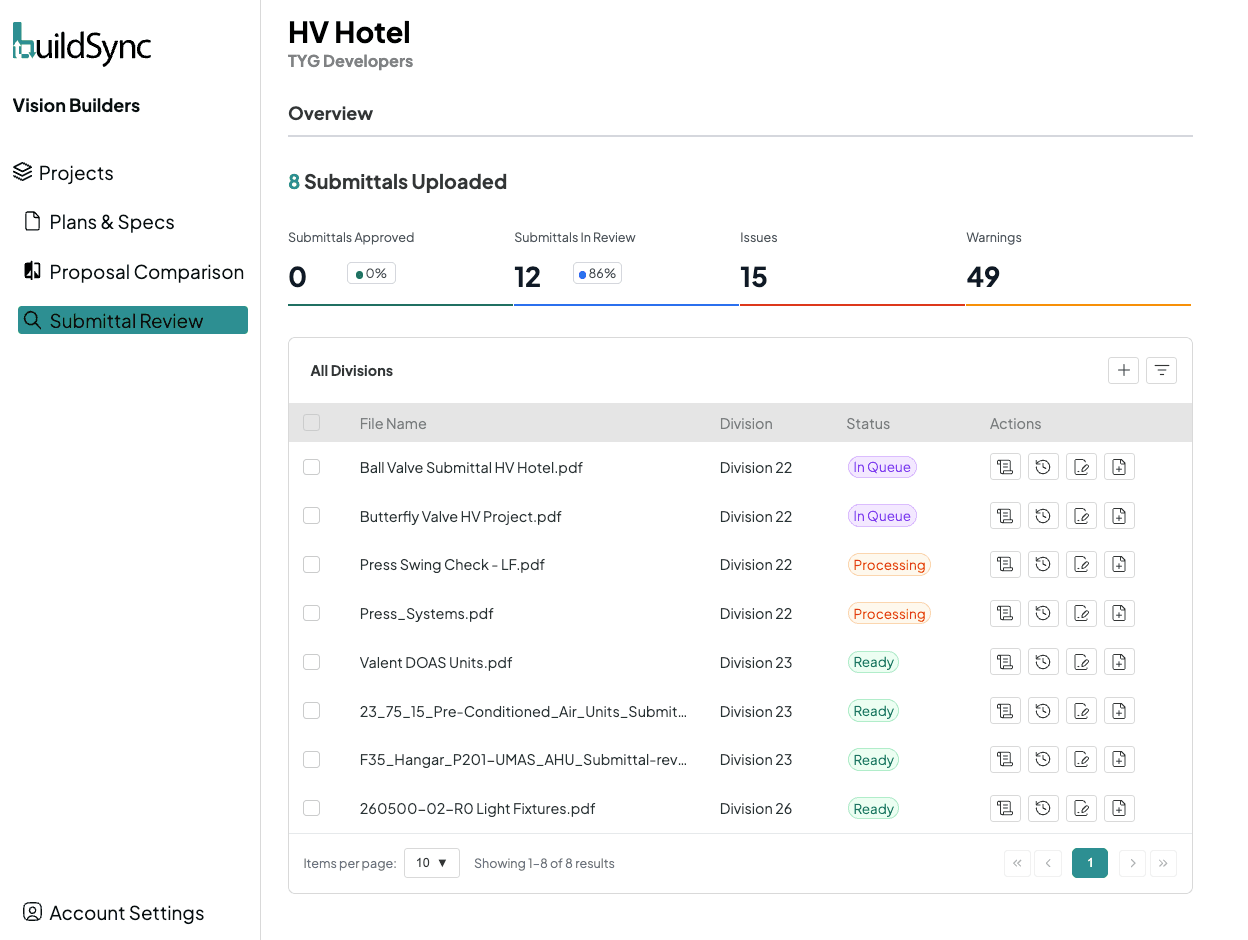
Caption: BuildSync Submittal Review Tab
Step 3: Submission to Design Team
What happens: The GC formally transmits the submittal to the architect or engineer of record, usually through project management software like Procore. The submittal package includes the original submittal with GC markups, any compliance matrices, GC review notes and questions, and a transmittal form with project details.
Who's responsible: GC project team
Timeline: 1 day (administrative processing)
Critical moment: This is the gate. From here, the submittal either gets approved or comes back rejected, sending you back to square one.
Step 4: Design Team Technical Review
What happens: The architect or engineer performs detailed technical analysis, reviewing against contract documents (both drawings and specifications), checking code compliance, verifying design intent is maintained, reviewing any substitutions or "or equal" products, and checking coordination with overall building systems.
Who's responsible: Different specialists review different submittals:
Architect: Architectural submittals (finishes, doors, glazing, roofing)
Structural Engineer: Structural submittals (steel, concrete, connections)
MEP Engineers: Mechanical, electrical, plumbing equipment submittals
Fire Protection Engineer: Fire alarm and sprinkler system submittals
Timeline: 2-4 weeks typical (can extend to 4-6 weeks when they're backlogged)
What they're checking:
Complete compliance with every specification requirement
Code compliance (IBC, ASHRAE, NFPA, NEC, local codes)
Design intent alignment
Product equivalency (if substitution proposed)
Performance requirements met
Proper certifications included
Warranty terms acceptable
Adequate O&M documentation
Their authority: Design teams have final say on all technical matters. If they reject it, it doesn't get installed - period.
Their challenge: Overworked and backlogged. Large projects generate 1,000-2,000 submittals. Design teams are often reviewing submittals for 10+ projects simultaneously. Your submittal is in a queue competing for attention.
Step 5: Response & Potential Revisions
Design team response options:
Response | Meaning | Timeline Impact |
Approved | Product meets specifications - proceed with procurement and installation | ✓ No delay |
Approved with Exceptions | Minor issues noted, but can proceed with documented modifications | ✓ Minimal delay |
Revise and Resubmit | Non-compliance issues identified - must be corrected and resubmitted | ⚠ 2-4 week delay - back to Step 1 |
Rejected | Major non-compliance, wrong product, or unacceptable substitution | ⚠ 2-4+ week delay - full resubmission |
No Exceptions Taken | Design team declines to review the proposed substitution | ⚠ Must resubmit specified product |
Impact of "Revise and Resubmit": When a submittal comes back needing revision, the entire process starts over. The subcontractor must coordinate with the manufacturer, revise the submittal, resubmit to the GC, the GC re-reviews, resubmits to the design team, and the design team re-reviews. This adds weeks to the review cycle - often longer if the issue requires significant product changes or manufacturer coordination.
Step 6: Final Approval & Procurement
What happens: The GC receives the approved submittal from the design team and forwards approval to the subcontractor. The subcontractor can now issue a purchase order to the manufacturer. The approved submittal becomes part of the permanent project record. Equipment or materials can be fabricated and delivered. Installation can proceed per the approved documents.
Delays in submittal approval directly impact these lead times, proposed timeline, and potentially the entire project schedule.
That link between approval dates and lead times explains why data center schedules slip so often, since switchgear, generators, and UPS systems can't be released for fabrication until their submittals clear.
Documentation: Approved submittals become the basis for as-built documentation, reference for warranty claims, part of O&M manual compilation, and the official record of what's actually installed.
This is where AI-powered submittal review transforms the process.
BuildSync performs that detailed Step 2 GC review in hours instead of days - extracting technical characteristics from submittals and comparing them against project specifications before anything reaches the design team.
What Are the Different Types of Construction Submittals?
There are three main types of construction submittals:
Product data submittals - manufacturer specifications and technical data (70% of submittals)
Shop drawings - detailed fabrication and installation drawings (20% of submittals)
Samples - physical material samples for visual approval (10% of submittals).
Product data submittals are most common and typically require a detailed technical specification review.
These packages are known in the field as technical submittals, and each one is a stack of claims about model, ratings, certifications, and warranty that the reviewer has to confirm line by line.
1. Product Data Submittals (70% of all submittals)
What they are: Manufacturer specifications, cut sheets, technical data sheets, performance reports, test results, and certifications for equipment and materials.
Most common examples:
Trade | Typical Product Data Submittals |
HVAC Equipment | Rooftop units, chillers, boilers, air handlers, exhaust fans |
Electrical Equipment | Lighting fixtures, panelboards, transformers, switchgear, generators |
Plumbing Equipment | Water heaters, pumps, fixtures, backflow preventers |
Fire Protection | Sprinkler heads, fire pumps, fire alarm devices, smoke detectors |
What gets reviewed: Technical specifications match contract documents exactly, capacity and performance ratings, physical dimensions and weights, materials and finishes, electrical requirements, required certifications, energy code compliance, sound and vibration ratings, warranty terms, installation and O&M documentation.
Review complexity: High - requires systematically checking dozens of technical specifications against contract documents.
BuildSync specialization: This is exactly what BuildSync excels at - deep technical analysis of product data submittals. BuildSync extracts all technical characteristics from manufacturer cut sheets and systematically compares them against project specifications.
2. Shop Drawings (20% of submittals)
What they are: Detailed fabrication and installation drawings showing exactly how something will be built, including precise dimensions, connection details, materials specifications, and coordination with other building systems.
Shop drawings show how a contractor plans to fabricate or install something the architect already designed, but when the contractor's design professional produces and stamps the final engineering, it becomes a delegated design submittal where professional liability shifts from architect to the delegated designer.
Common examples:
Trade | Shop Drawing Examples |
Structural Steel | Connection details, erection sequences, anchor bolt layouts |
Mechanical/HVAC | Ductwork layouts, equipment placement, piping coordination |
Fire Protection | Sprinkler system layouts, head locations, hydraulic calculations |
Architectural | Custom millwork shop drawings, curtain wall panel details |
Precast Concrete | Panel elevations, connection details, embedment locations |
Review complexity: Very high - requires dimensional verification, structural engineering analysis, spatial coordination review.
3. Samples (10% of submittals)
What they are: Physical examples of materials submitted for visual inspection, tactile evaluation, and quality approval before full-scale procurement.
Common examples:
Trade | Physical Sample Examples |
Flooring | Carpet, tile, hardwood, vinyl, terrazzo |
Paint & Coatings | Paint colors, stains, sealers, wall finishes |
Casework & Millwork | Cabinet door samples, countertop materials, hardware finishes |
Masonry | Brick, CMU, stone veneer units |
Ceilings | Acoustic ceiling tiles, panel finishes |
Furnishings | Fabric swatches, upholstery samples, panel fabrics |
Review complexity: Lower technical specification complexity, higher emphasis on aesthetic judgment and owner preferences.
Typical large commercial project distribution:
Product data submittals: 450-650 submittals (~60-70%)
Shop drawings: 150-250 submittals (~20-25%)
Samples, mockups, and misc: 50-120 submittals (~10-15%)
Total typical range: 650-1,000 submittals
The heaviest concentration hits during months 2-7 of construction, creating significant workload pressure on project teams.
What Should I Look for When Reviewing Submittals?
Different project stakeholders review submittals with different priorities and authority levels. Here's what each role should focus on during their review and approval process to ensure compliance with project requirements.
Project Manager: Schedule, Coordination & Completeness
Primary Focus: Keeping the construction project on schedule and ensuring all necessary documentation is complete before it reaches the design team.
What to check:
Completeness of submittal package: All required items included - cut sheets, certifications, test reports, warranty information, O&M manuals
Proper product identification: Equipment tags and location references match project detailed drawings and schedules
Schedule compliance: Lead times align with project schedule; flag long-lead items requiring expedited review
Coordination across trades: Physical dimensions and clearances verified; no conflicts with other systems
Substitution documentation: If proposing "or equal" products, equivalency documentation is thorough and complete
Subcontractor performance tracking: Which subs consistently submit quality work vs. incomplete packages
Common issues PMs catch:
Missing equipment tags or unclear location references
Incomplete certification packages that will get kicked back
Products that don't coordinate with adjacent systems
Submittal packages that will obviously fail design review
PM Authority Level: Administrative review and coordination verification; cannot approve technical compliance (that's the design team's role)
Time investment with traditional manual review: 2-4 hours per complex submittal package
Why this matters: The PM's review is the gatekeeper. A thorough review here prevents wasting the design team's time with incomplete or obviously non-compliant submittals - and avoids the costly 2-4 week rejection cycle.
Architect or Engineer: Technical Compliance & Design Intent
Primary Focus: Verifying proposed materials and equipment meet all technical requirements, code compliance, and project's design intent before authorizing procurement and installation.
What to check:
Review Category | Architect Focus | Engineer Focus (MEP) |
Aesthetics & Design | Materials, finishes, colors match design intent | Equipment appearance and integration |
Performance | Durability, maintenance requirements, warranty terms | Capacity, efficiency ratings, operational parameters |
Code Compliance | Building code, accessibility, fire code | Energy code, mechanical code, electrical code, plumbing code |
Technical Specs | Material specifications, installation details | Exact technical match: refrigerant types, electrical requirements, efficiency ratings |
Coordination | Anchoring, flashing, weatherproofing, building envelope integration | Dimensions, weights, clearances, access requirements, physical fit |
Systems Integration | Overall building aesthetics and functionality | Control system compatibility, building automation integration |
Certifications | General product certifications | AHRI, ASME, UL, ETL, NSF, DLC, Energy Star |
Sustainability | LEED credits, embodied carbon, recycled content | Energy efficiency, environmental compliance |
Substitutions | "Or equal" equivalency verification | Performance and technical equivalency |
Structural | General installation requirements | Seismic requirements, anchorage, bracing, support details |
Common issues design teams catch:
Wrong refrigerant type (code violation)
Insufficient efficiency ratings (energy code non-compliance)
Missing required certifications
Products that don't match specifications
Inadequate performance data to verify compliance
Substitutions that don't actually meet "or equal" criteria
Design Team Authority Level: Final technical authority - if they reject it, it doesn't get installed, period.
Timeline: 2-4 weeks typical for design team review (can extend to 4-6 weeks when backlogged)
Why this matters: Design teams are often reviewing project submittals for 10+ projects simultaneously. Your submittal is competing for attention. The more complete and obviously compliant it is, the faster it moves through their queue.
General Contractor: First Line of Defense
Primary Focus: Conduct a thorough preliminary review to catch issues before they reach the design team, ensuring the entire process moves efficiently without costly rejections and resubmissions.
What to check in your preliminary review:
Review Area | What to Verify |
Basic Specification Compliance | Does the proposed equipment generally match what's specified? |
Completeness Verification | All required documentation included before transmitting to design team |
Equipment Schedule Alignment | Correct products tagged for correct locations |
Obvious Non-Compliance Issues | Wrong product types, missing major requirements, clear spec violations |
Coordination Red Flags | Dimensional conflicts, clearance issues, access problems |
Substitution Quality | If sub is proposing "or equal," is the documentation thorough enough for design team review? |
Critical items that commonly get missed (and shouldn't):
Specific refrigerant types in HVAC equipment (R-410A vs. R-454B)
Light transmittance percentages in glazing (affects daylighting, energy code)
Coil coating specifications for corrosive environments
Sound ratings in dB for occupied spaces (noise ordinance compliance)
Minimum efficiency ratings (EER, SEER, thermal efficiency)
Control system protocol compatibility (BACnet vs. proprietary)
Spare parts and attic stock requirements for closeout
GC Authority Level: Preliminary review and coordination verification; final technical approval rests with design team
Time investment with manual review: 4-8 hours per complex submittal for thorough review
The reality: When project teams are overwhelmed with volume during peak periods (months 2-7 of a construction project), this step often gets rushed or rubber-stamped. That's when rejection rates spike to 40-50%.
This is where AI-powered submittal review transforms the process. BuildSync performs that detailed Step 2 GC review in hours instead of days - extracting technical characteristics from submittals and comparing them against project specifications before anything reaches the design team.
Subcontractors and Suppliers: Quality Control Before Submission
Primary Focus: Submit complete, compliant submittal documents the first time to avoid rejections, schedule delays, and relationship damage with the GC and design team.
What to verify before submitting:
Documentation Type | Required Content |
Product Identification | Equipment tags match project drawings and schedules exactly |
Technical Specifications | All performance specifications, ratings, dimensions clearly shown |
Manufacturer Data | Specific products highlighted on marked-up cut sheets; not generic catalogs |
Compliance Certifications | UL, AHRI, ASME, ETL, NSF, DLC listings as required by specifications |
Performance Documentation | Energy efficiency ratings, sound ratings, seismic certifications, test reports |
Warranty Information | Terms meet or exceed specification requirements |
Operational Documentation | Complete installation and O&M manuals for contractor and owner use |
Common mistakes that cause rejections:
Unmarked manufacturer catalogs (no indication of which product applies where)
Missing certifications or test reports
Products that don't meet specifications (wrong capacity, efficiency, or features)
Incomplete information requiring RFI for clarification
Poor organization making it difficult to review
Why this matters: Every rejection adds multi-week delays to YOUR timeline, delays your installation work, and damages your reputation. Submitting quality work the first time keeps you on schedule and builds trust.
Best practice: Review your own submittal package before submission. Check it against specifications yourself. If you find issues, fix them before the GC sees them. Your goal is zero rejections.
Project Owner or Client: Protecting Your Investment
Primary Focus: Ensuring you get what you paid for - that proposed materials and systems meet the project manual requirements, design intent, and long-term operational needs.
What the project owner should verify (often delegated to owner's representative):
Impact Area | Owner Verification |
Design & Quality | Aesthetics, functionality, quality level match what was designed and contracted |
Operations & Maintenance | Systems maintainable by facilities team |
Performance Guarantees | Equipment efficiency ratings support guaranteed energy targets |
Risk Management | Warranty length, coverage, and exclusions meet standards |
Common owner concerns:
Substitutions that reduce quality or long-term value ("or equal" that really isn't)
Equipment that's difficult or expensive for their facilities team to maintain
Products that won't integrate with existing building systems
Insufficient warranty coverage for critical systems
Energy performance that doesn't meet operational budget projections
Owner Authority Level: Varies by contract structure; often provides input through design team rather than direct submittal approval
Why this matters: Once construction begins and equipment is installed, changes are exponentially more expensive. Submittal review is your opportunity to ensure you're getting exactly what you paid for before it's built into the building.
Best practice: Don't rubber-stamp every submittal the design team approves. Review key systems that affect your operations - HVAC systems, building automation, critical equipment, major finishes. Ask questions if something doesn't align with your operational needs or expectations.
Common Construction Submittal Review Challenges & Solutions
Even experienced construction teams struggle with submittal reviews. Here are the five most common challenges and practical solutions to address them.
Challenge #1: High Rejection Rates (30% Industry Average)
The problem: As Construction Yeti's Matt Graves puts it:
“30 - 40% of submittals come back rejected (industry average). Not because your team is careless...but because the system is broken.”
Why it happens:
Incomplete submittals from subcontractors (missing certifications, unmarked cut sheets)
Non-compliant products specified that don't meet technical specifications
Inadequate GC preliminary reviews rushed due to time pressure
Knowledge gaps - junior project engineers reviewing complex equipment without sufficient expertise
Poor substitution documentation for "or equal" products
The impact:
Direct cost: $805 per rejected submittal in administrative burden
Timeline impact: Each rejection adds multiple weeks to the cycle
Schedule compression: Cascading delays affect downstream trades
Strained relationships: Repeated rejections frustrate design teams
Increased project risk: Schedule delays increase liquidated damages exposure
The solution: Thorough GC preliminary review is absolutely critical - it serves as the first line of defense. Catching issues before they reach the design team prevents that costly rejection cycle.
Related: 7 Ways To Improve Your Construction Submittal Review Process
Forward-thinking teams are solving this with automated technical review - systematically checking every requirement before submittals reach the design team. BuildSync helps teams drive rejection rates below 5%.
Challenge #2: Time Drain on Project Teams
The reality: Project Engineers commonly spend 20+ hours per week reviewing submittals manually. That's time taken away from coordination, RFIs, jobsite oversight, problem-solving, and all the other critical work PEs should be doing.
This contributes to the industry-wide labor shortage - 77% of firms can't fill positions. You can't afford to waste the PEs you have on tedious data extraction.
Why manual review is so inefficient:
Data extraction is tedious - hunting through 70-page manufacturer cut sheets for specific values
Cross-referencing is time-consuming - page-by-page comparison against 30-50 page specifications
No systematic approach - success relies entirely on reviewer's knowledge and attention to detail
Easy to miss critical details - one overlooked specification = rejection
Doesn't scale - large projects with 1,000+ submittals overwhelm even large teams
The impact:
Review bottlenecks: Submittals pile up during peak periods
Delayed approvals: Procurement delayed, equipment lead times extended
Higher-value work suffers: Less time for proactive coordination
PE burnout and turnover: Tedious work drives people out of the industry
Quality compromises: When overwhelmed, even good engineers rush reviews
The solution: Automate the technical heavy-lifting. BuildSync handles systematic data extraction and specification comparison, saving teams up to three-quarters of time otherwise spent on manual review.
Calculate your savings with BuildSync with our ROI calcuator.
Challenge #3: Technical Complexity & Knowledge Gaps
The problem: Junior project engineers are often expected to review highly complex MEP equipment in their first year on the job. They may not know which specifications are absolutely critical, which are negotiable, and what details are commonly overlooked.
Real examples of specifications that commonly get missed:
Light transmittance percentages in glazing specifications (affects daylighting calculations)
Specific refrigerant types for HVAC equipment (R-410A vs. R-454B - code compliance issue)
Coil coating specifications for equipment in corrosive environments
Sound ratings in dB for equipment in occupied spaces (noise ordinance compliance)
Specific manufacturer certifications required (ASME H-stamp for pressure vessels)
Minimum efficiency ratings buried in text (EER, SEER values)
Control system protocol compatibility (BACnet vs. LonWorks)
The impact:
Non-compliant equipment gets approved and installed based on incomplete review
Issues discovered during commissioning, inspection, or years later during operation
Expensive replacement required after installation (50-100x more costly than catching during review)
Significant schedule delays while replacement equipment is procured
Potential legal exposure and professional liability
Loss of credibility with design teams and subcontractors
The solution: Implement systematic review approaches that check EVERY requirement regardless of reviewer experience level.
Tom Port, BuildSync Co-founder:
We once caught a major non-compliance in an air-handling unit submittal that had already passed the GC and design review.
The unit didn’t meet the specified MERV rating, which would have failed commissioning and delayed occupancy. BuildSync surfaced the exact spec conflict automatically. Often these issues can slip through in a traditional manual review process.
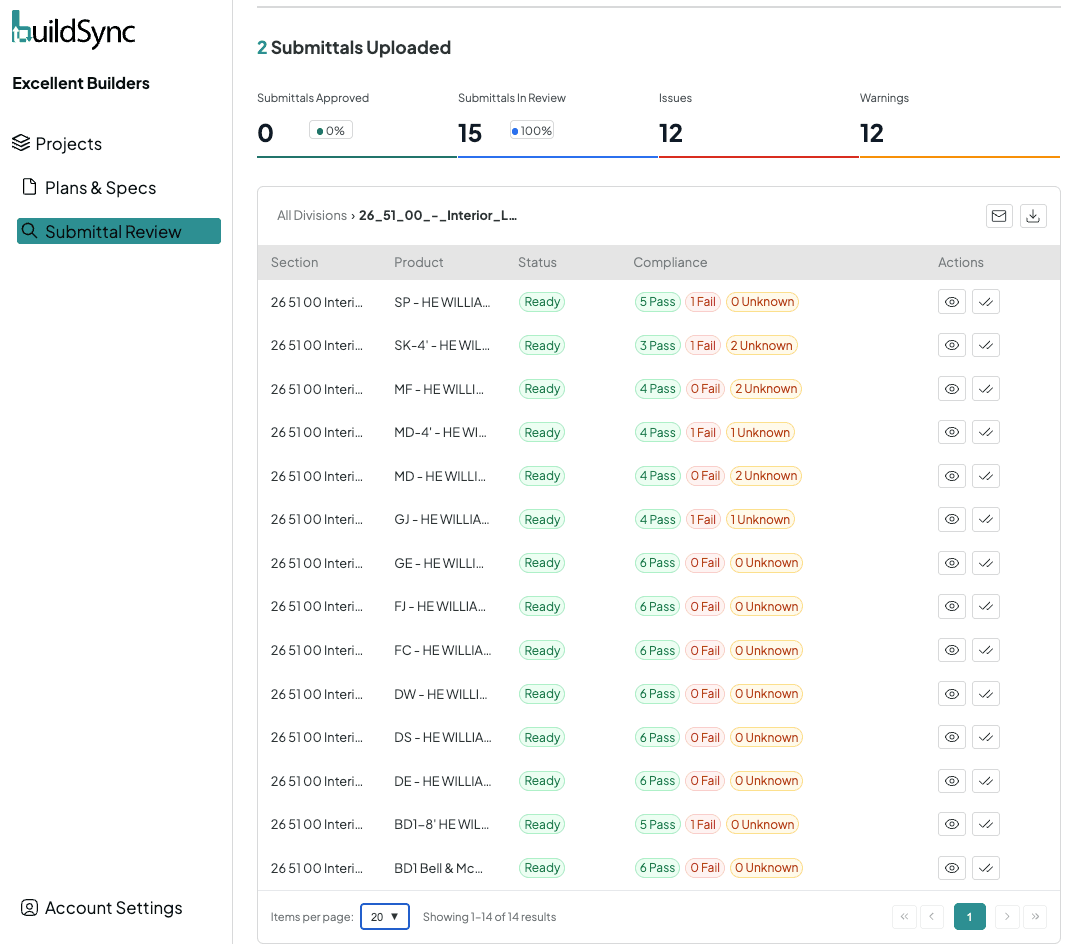
Caption: BuildSync Submittal Review Product breakdown
Systematic review approaches eliminate the knowledge gap problem. BuildSync knows exactly what to check in specifications and where to find it in submittals - checking every requirement regardless of reviewer experience level.
That raises a fair question about whether that consistency comes at the cost of junior PE development, since less-experienced reviewers are leaning on the same system as veterans.
Challenge #4: Incomplete or Poor-Quality Submittals from Subcontractors
Common issues:
Issue | What It Looks Like |
Unmarked Cut Sheets | No indication of which product applies where |
Missing Compliance Documentation | Certifications, test reports, performance data not included |
Generic Submittals | Standard manufacturer catalogs rather than project-specific documentation |
Incomplete Information | Missing critical data needed to verify compliance |
Poor Organization | Submittals difficult to review |
The impact:
RFIs back to subcontractor requesting clarification
Resubmissions and associated delays in approval timeline
Design team frustration with inadequate documentation
Incomplete project closeout documentation
The solution:
Use AI to generate complete, project-specific submittal packages automatically (BuildSync's submittal package generation pulls exactly what's needed from manufacturer data and project specifications - eliminating unmarked cut sheets and missing documentation)
Conduct pre-construction submittal meeting establishing crystal-clear requirements
Provide submittal checklist template to subcontractors
Conduct thorough GC preliminary review to catch incomplete submittals before they waste design team's time
Track subcontractor performance and provide specific, actionable feedback
Challenge #5: Volume Overwhelm During Peak Periods
The reality: Large commercial projects generate 1,000-2,000 submittals, with the vast majority hitting during the early project phase (first 3-6 months). Project Engineer bandwidth simply cannot keep up with this volume using manual review processes.
The compounding problem - a vicious cycle:
High volume forces rushed reviews
Rushed reviews miss issues → Higher rejection rates
Higher rejections → More resubmissions
More resubmissions → Even higher volume
Higher volume → Even more rushed reviews
The impact:
Quality inevitably suffers when teams are overwhelmed
Some submittals get rubber-stamped to clear the backlog
Critical approvals delayed because everything is stuck in the queue
Team morale suffers under unsustainable workload
Real-world example: Monteith Construction faced exactly this problem - a small team managing a massive submittal log on complex commercial projects. Their solution was integrating BuildSync as the first checkpoint in their workflow:
BuildSync is the first stop a submittal makes in our workflow once it is turned in by a subcontractor. The report and markup generated by BuildSync then helps our reviewer navigate through the submittal as they perform their own review prior to sending the submittal off to the architect and engineer.
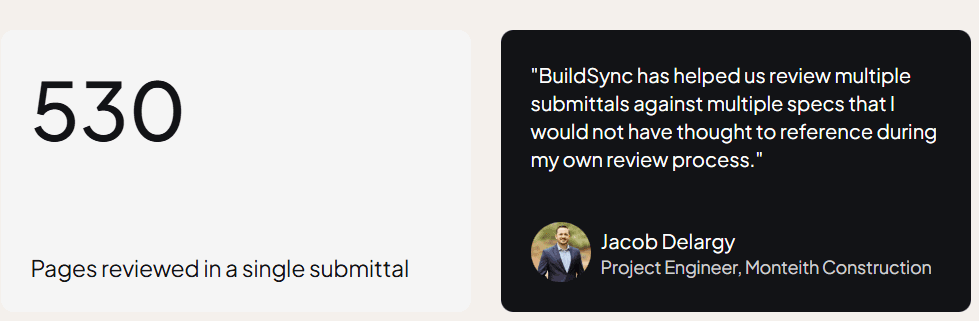
The results were immediate and measurable. On a particularly challenging 530-page A/V submittal - the kind that would normally consume days of PE time - BuildSync processed it systematically while the team focused on coordination and higher-level review.
We have seen an improvement in our review times and acceptance rates. BuildSync's ability to review product data submittals has allowed us to focus more attention and energy to larger submittals and shop drawings.
Perhaps most importantly, BuildSync caught specification cross-references that the team wouldn't have thought to check manually:
BuildSync has helped us review multiple submittals against multiple specs that I would not have thought to reference during my own review process.
How Much Does a Submittal Rejection Cost? The Real ROI Analysis
Let's do the math you haven't done yet.
Each rejected construction submittal costs an average of $805 in direct costs (administrative burden, coordination time) plus indirect costs of 2-4 weeks added to the timeline. For a mid-sized project with 500 submittals and typical 30% rejection rate, total rejection costs exceed $120,000 annually, plus schedule impacts that can lead to liquidated damages.
Breaking Down the Cost per Rejection
Direct costs per rejection ($805 average):
PM/PE time coordinating resubmission: 4-6 hours
Subcontractor time revising and resubmitting: 6-8 hours
Design team time conducting re-review: 2-4 hours
Administrative processing and documentation: 2-3 hours
Communication overhead (meetings, emails, calls)
Indirect costs (harder to quantify but often more significant):
Timeline delay: 2-4 weeks per rejection cycle
Schedule compression affecting downstream trades
Procurement delays and potential expediting fees
Potential overtime costs from compressed schedules
Relationship strain with design teams
Risk escalation toward liquidated damages
Tom Port, BuildSync Co-founder:
We regularly hear from clients that BuildSync has reduced their submittal review cycles from weeks to hours. That speed really matters, because design teams often hold procurement until reviews are complete, and any delay there can cascade across the schedule. It’s incredibly rewarding when customers tell us that BuildSync is the reason their deadlines didn’t slip.
Real Project Cost Analysis
Mid-Sized Commercial Project Parameters:
Total submittals: 500
Industry average rejection rate: 30%
Rejected submittals: 150 (30% of 500)
Baseline costs with 30% rejection rate:
Direct costs: 150 rejections × $805 = $120,750
Average timeline delay per rejection: 3 weeks
Total cumulative delay impact: 450 weeks of delays across all submittals
With rejection rate reduced to 5% using BuildSync:
Rejected submittals: 25 (5% of 500)
Direct costs: 25 rejections × $805 = $20,125
Direct cost savings: $100,625
Timeline impacts reduced by 83.3%
Additional ROI from Time Savings
Time investment analysis:
500 submittals × 5 hours average manual review time = 2,500 hours total
With time savings from BuildSync: 1,875-2,000 hours saved
At PE burdened rate of $75/hour: $140,625-$150,000 in labor cost savings
Total Annual Project Savings: $241,250–$250,625
This doesn't account for the value of redirecting that PE time to proactive coordination, constructability reviews, value engineering, problem-solving, or mentoring - all higher-value activities than tedious data extraction.
The Hidden Costs
PE Burnout and Turnover: When project engineers spend 50-60% of their time on tedious manual submittal review, burnout is inevitable. Replacing a burned-out PE costs $50,000-$75,000 in recruitment, onboarding, and lost productivity.
Schedule Liquidated Damages Risk: If submittal-related delays push the project past substantial completion date, liquidated damages can be $2,000-$10,000 per day on commercial projects. Even a few critical rejections can trigger six-figure exposure.
What are Submittal Review Best Practices?
Implement these five proven strategies to improve your submittal review process, reduce rejection rates, and reclaim time for higher-value work.
1. Start Early and Prioritize Ruthlessly
Submit early packages immediately after contract award. Prioritize long-lead items that have substantial manufacturing timelines: chillers, generators, elevators, custom switchgear. Don't wait for design team formal requests. Build minimum 2-3 week schedule buffer for potential rejections.
Long-lead procurement on a data center build starts while the building is still on paper, so power and cooling packages move to the very front of the queue.
Critical path items requiring immediate attention:
Chillers: 20-26 weeks lead time
Generators: 24-32 weeks lead time
Custom air handlers: 14-18 weeks lead time
Elevators: 20-26 weeks lead time
Switchgear: 26-40 weeks lead time
Why it matters: Long-lead equipment has manufacturing lead times of 20-40 weeks. Every week of submittal approval delay compounds directly into schedule risk. Prioritize critical path items first, then batch similar submittals together (all lighting at once, all HVAC equipment together) for review efficiency.
2. Establish Crystal-Clear Submittal Requirements at Pre-Construction
Conduct a dedicated submittal review meeting during the pre-construction phase. Define precisely what documentation is required: marked cut sheets, compliance matrices, and specific certifications. Explain substitution procedures and equivalency documentation requirements clearly. Provide a submittal checklist template to all subcontractors. Clarify review timelines, responsibilities, and quality assurance protocols. During pre-construction, establish a submittal schedule template that outlines the timeline for each phase of equipment delivery and approval, ensuring all stakeholders understand critical path dependencies and review windows for long-lead items.
Why it matters: Clear expectations up front dramatically reduce incomplete submittals and associated rejection rates. Subcontractors know exactly what's required for approval - you are on the same page. Maintain a comprehensive submittal log in your project management software tracking status, dates, and identifying which subcontractors consistently submit quality work. That log should trace back to the submittal register built during pre-construction, since it defines the full scope of what's required before a single item gets tracked.
Each of these outcomes, whether "No Exceptions Taken," "Approved as Noted," "Revise and Resubmit", triggers different next steps and timeline implications.
3. Conduct Thorough GC Preliminary Reviews (Most Critical Step)
Actually review submittals thoroughly - don't rubber-stamp them. Check for complete documentation before submitting to design team. Verify basic specification compliance systematically. Catch obvious issues early in the process. Use equipment-specific checklists to ensure consistency. Document detailed review notes for design team reference.
Why it matters: Thorough GC review catches issues before they reach the design team, completely eliminating the rejection cycle. This single step delivers the highest return on investment for process improvement.
Time investment comparison:
Manual thorough review: 4-8 hours per complex submittal
With BuildSync automated review: 30-60 minutes reviewing AI-generated comprehensive findings and making final determinations
4. Create Equipment-Specific Review Checklists
Develop detailed checklists for each common equipment type your projects encounter. List project-specific requirements extracted directly from YOUR specifications (not generic checklists). Include common rejection reasons discovered on past projects for that equipment type. Reference exact specification section numbers for each requirement.
Checklist examples:
RTU Checklist: Capacity, efficiency ratings, refrigerant type, electrical specifications, physical dimensions, sound ratings, coil coatings, control system compatibility, required certifications (20+ specific items from your mechanical specifications)
Lighting Checklist: Lumens, CCT, CRI, mounting type, lens configuration, dimming compatibility, DLC Premium listing (12+ items from electrical specifications)
Why it matters: Checklists ensure complete consistency across different submittal reviewers. This helps systematically train junior PEs on what matters and guarantees nothing critical gets forgotten or overlooked. Share proper documentation across all team members and update regularly based on lessons learned.
Check out our free MEP submittal checklist here:

5. Adopt Construction Specific AI for Systematic Technical Review
Manual review processes don't scale effectively for large projects with 1,000+ submittals. AI can systematically check every requirement without fatigue, distraction, or knowledge gaps. Technology frees your team for coordination, problem-solving, and work requiring human judgment.
The results: 70-80% time savings and rejection rates below 5%. The technology is proven, reliable, and delivering measurable results on projects right now.
The approach isn't 'trust the AI blindly.' BuildSync provides the technical analysis; your team reviews the findings and makes final determinations. Think of it as a tireless junior PE who systematically checks every specification without getting fatigued - but you're still the engineer of record making the calls
BuildSync provides seamless integration with Procore workflows, automatically pulling submittals and specifications and generating detailed compliance reports without manual data entry or workflow disruption.
Check out our expert review of 9 best construction submittal software for a better idea of how submittal software works.
For the picture beyond submittals, our guide to AI construction tools and where each one fits covers takeoff, scheduling, and site documentation as well.
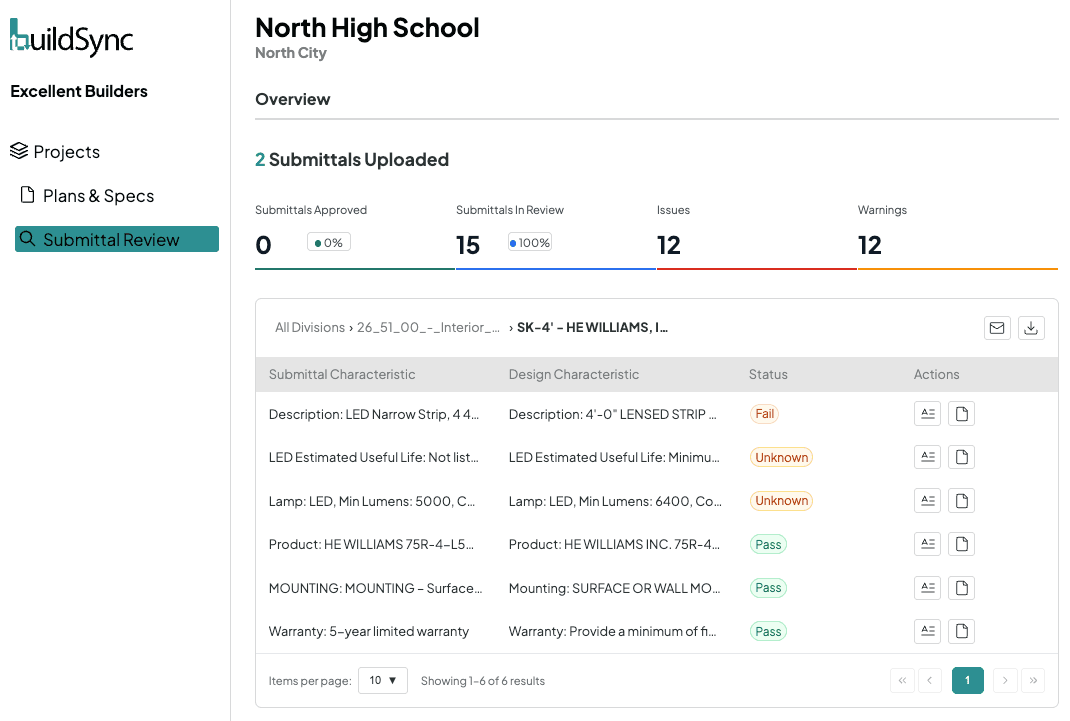
Caption: BuildSync Characteristic Technical Requirement Comparison
Why it matters: This is the only solution that actually fixes the math problem. It's not about working harder or being more diligent. It's about using technology that can handle the scale and complexity of modern submittal review. The AI handles extraction and comparison systematically; your team handles judgment, coordination, and decision-making.
Transform Your Construction Submittal Review Process
Construction submittal reviews represent one of the most time-intensive, detail-critical processes in project delivery. The traditional manual approach - extracting data from 70-page manufacturer cut sheets and cross-referencing against dense technical specifications - simply doesn't scale for modern commercial construction projects with thousands of submittals.
The industry reality: High rejection rates adding weeks to construction timelines, overwhelmed project teams drowning in backlog, and strained relationships with design teams have become normalized.
But this doesn't have to be your reality.
Construction teams across the country are adopting AI-powered submittal review to fundamentally transform this process. By automating technical extraction, specification comparison, and compliance verification through effective document management, forward-thinking teams are achieving dramatic results:
Rejection rates consistently below 5%
70-80% time savings on otherwise manual review work
Submittals processed in hours instead of days or weeks
PEs freed up for coordination, problem-solving, constructability reviews, and valuable work
Systematic coverage of every specification requirement without exception
Consistent quality regardless of volume, reviewer experience, or time pressure
Your Next Step
If you're using Procore: See how BuildSync integrates seamlessly into your existing workflow in a 30-minute demo. Zero training required for your team - BuildSync becomes an actor in your submittal workflow and delivers detailed compliance reports without disrupting anything you're currently doing.
If rejection rates are killing your schedule: Stop letting submittal rejections add weeks to your timeline. See how BuildSync catches non-compliance before it reaches the design team - with specific examples from projects like yours.
If your PEs are drowning in submittals: Try BuildSync on your three most complex submittals - the ones that would normally take 6-8 hours to review manually. See the comprehensive analysis BuildSync delivers in hours, not days.
No long sales pitch. Just see it working on your actual submittals.
Frequently Asked Questions About Construction Submittal Reviews
What is the difference between submittals and RFIs?
While both are essential construction documents, submittals and RFIs serve fundamentally different purposes in the construction process. Understanding this distinction is critical for effective project management. Submittals are proposed solutions for approval. Their purpose is to obtain approval for specific products, materials, or installation methods before procurement and installation. They answer the question: "Here's what we want to install - is this acceptable per contract documents?" The direction of flow goes from the contractor proposing to the design team for approval, typically happening before procurement and throughout pre-construction and construction phases. RFIs, or Requests for Information, serve as clarification questions. Their purpose is to obtain clarification on unclear, missing, contradictory, or ambiguous information in contract documents. They answer the question: "The drawings and specifications don't agree - what do you actually want here?" The direction of flow goes from the contractor questioning the design team for clarification, and they're issued whenever ambiguity, conflict, or missing information is discovered. Possible outcomes include written clarification, revised drawings, supplemental instructions, or change order. These two document types often relate to each other in practice. RFIs frequently precede submittals. If specifications conflict with drawings about equipment type or location, the contractor must issue an RFI for design team clarification before submitting specific equipment for approval. The key fundamental difference is that submittals propose specific product solutions seeking approval, while RFIs ask questions seeking clarity about ambiguous design requirements. Both are critical for construction project success, but they serve distinctly different functions.
Is AI submittal review actually reliable?
How long does BuildSync take to review a submittal?
Does BuildSync work with our project management software?
Related reads for you
Discover more articles that align with your interests and keep exploring.


