Construction Technology & Innovation
/
Feb 26, 2026
CSI Division 22: Plumbing Specifications and Codes Explained
Understand Division 22 plumbing codes for submittal reviews. Covers spec sections, common requirements, and compliance checkpoints for MEP projects.

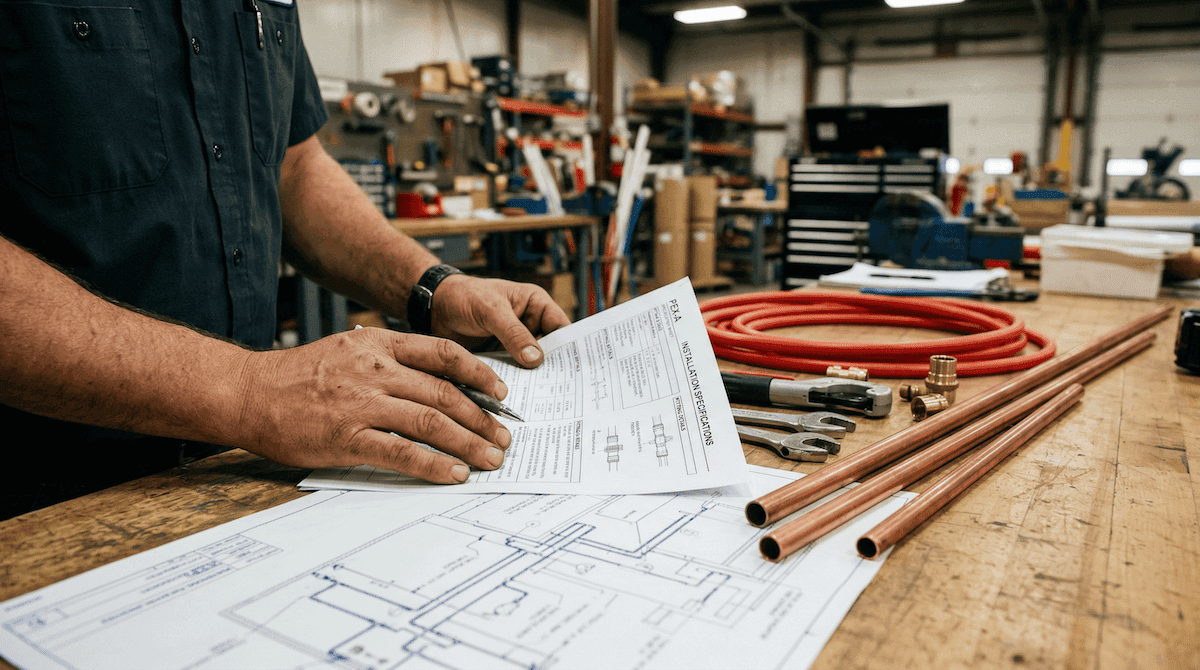
You're staring at a 40-fixture plumbing submittal. The Division 22 plumbing specification section runs 80 pages. You need to verify GPF ratings, check manufacturer approvals, confirm ADA compliance, and validate backflow preventer certifications - all before this submittal reaches the design team. Four hours later, you're only halfway through the fixture schedule. That kind of submittal review time is typical for data-heavy divisions, and understanding the benchmarks helps teams plan realistic turnaround windows instead of guessing.
This is the reality of working with plumbing CSI code specifications. Division 22 plumbing provides the framework for organizing plumbing requirements, but understanding that framework and actually verifying compliance against it are two very different challenges.
This guide covers both: what construction Division 22 contains, how it's structured, and, critically, how modern construction teams are solving the manual review bottleneck.
Section 1: Introduction to CSI Division 22 – Plumbing
What Is CSI MasterFormat Division 22?
CSI Division 22 - Plumbing is the Construction Specifications Institute's standardized section for organizing all plumbing-related specifications, covering everything from domestic water systems and drainage to plumbing fixtures, plumbing equipment, and specialized plumbing applications.
The Construction Specifications Institute was founded in 1948 to address the chaos of post-war construction documentation. By 1963, CSI had developed the Master Specification System with 16 major divisions. In 2004, responding to industry complexity and the demands of modern construction, CSI expanded MasterFormat to 50 divisions, with plumbing receiving its own dedicated division.
Standardized construction specifications matter because they create a common language. When a plumbing contractor in Phoenix and an architect in Boston both reference "22 42 13," they're talking about the same thing: commercial water closets. This standardization reduces miscommunication, minimizes errors, improves submittal organization, facilitates Building Information Modeling (BIM), and speeds up the review process - when done correctly.
Why Plumbing Is Separated from HVAC in CSI MasterFormat
Division 22 plumbing is separated from HVAC in CSI MasterFormat because the two disciplines involve fundamentally different systems, trades, licensing requirements, and code compliance - plumbing focuses on water supply, drainage, and waste management (Division 22) while HVAC handles heating, cooling, and ventilation (Division 23).
The separation reflects reality on construction projects. Plumbing contractors hold different licenses than HVAC contractors. Plumbing systems follow the International Plumbing Code or Uniform Plumbing Code, while mechanical systems follow the International Mechanical Code. The trades use different materials, require different testing procedures, and submit different types of documentation during the construction submittal review process.
This matters for submittal organization. When a mechanical contractor submits an air handler (Division 23), it's reviewed by mechanical engineers. When a plumbing contractor submits fixture schedules (Division 22 plumbing), it's reviewed by plumbing engineers or the architect. Mixing these under one division would create confusion about who reviews what.
Division 22 Structure:
Overview of Section Categories
Division 22 plumbing organizes plumbing specification sections into a hierarchical structure using six-digit numbering. Understanding this structure is important for organizing submittals and locating requirements in project specifications.
Section Number | Section Name | What It Covers | Common Submittal Items |
22 01 00 | Operation and Maintenance | O&M manuals, warranty documentation | Maintenance procedures, warranty certificates |
22 05 00 | Common Work Results | Sleeves, seals, hangers, supports, valves | Support systems, seismic bracing |
22 10 00 | Plumbing, Pipin,g and Pumps | Water supply, drainage, storm systems | Pipe materials, pump specifications |
22 30 00 | Plumbing Equipment | Water heaters, treatment systems | Water heater specs, backflow preventers |
22 40 00 | Plumbing Fixtures | Water closets, lavatories, urinals, sinks | Fixture schedules, faucet specs |
22 60 00+ | Special Plumbing Systems | Gas piping, laboratory, pool systems | Specialized equipment data |

Section 2: Plumbing Fixtures and Equipment
Common Plumbing Fixtures and Their Specification Requirements
What are the common plumbing fixtures included in Division 22 plumbing specifications? Water closets, lavatories, urinals, sinks, service sinks, and emergency fixtures comprise the core plumbing fixtures specified in most commercial building projects, each with detailed performance and compliance requirements.
Water Closets (22 42 13)
Water closet specifications define mounting type (floor-mounted or wall-hung), flush volume, and compliance requirements. High-efficiency toilets use 1.28 gallons per flush (GPF), while standard fixtures use 1.6 GPF maximum per EPAct standards. ADA-compliant plumbing fixtures require 17-19 inch seat height from the finished floor.
Specifications typically call out approved manufacturers - often three to five brands like Kohler, American Standard, or Toto. The spec defines flush valve type (manual, sensor-operated, or dual-flush), bowl configuration (elongated or round), and material standards. Vitreous china must meet ASME A112.19.2 standards for water absorption and structural integrity.
Lavatories and Sinks (22 42 16, 22 42 33)
Lavatory specs address mounting (countertop, wall-hung, or pedestal), flow rates, and accessibility. Faucet flow rates are limited to 2.2 gallons per minute (GPM) maximum, with high-efficiency aerators at 0.5 GPM. Sensor-operated faucets require specific response times and battery backup specifications.
Material requirements vary by application. Porcelain lavatories dominate commercial restrooms. Stainless steel sinks serve food service and laboratory applications with specific gauge requirements (typically 18 or 20 gauge). Solid surface materials appear in healthcare settings where infection control matters.
Urinals (22 42 19)
Urinal specifications define flush volumes from 0.125 GPF (waterless) up to 1.0 GPF for standard plumbing fixtures. Wall-hung urinals require mounting heights of 24 inches from rim to floor for standard installations, 17 inches for barrier-free installations per ADA requirements. Flush valve specifications must address vandal resistance and sensor reliability in high-traffic applications.
Service Sinks and Specialty Fixtures
Service sinks (22 42 43) include mop basins for janitor closets and heavy-duty sinks for equipment rooms. Specifications define materials (cast iron, terrazzo, or molded stone), capacity, and faucet configurations. Emergency fixtures like eye wash stations and safety showers (22 62 00) require specific flow rates, tempering valves to limit water temperature, and alarm systems per ANSI Z358.1 standards.
Specialized Fixtures for Laboratory and Healthcare Facilities
Laboratory and healthcare facilities require specialized plumbing fixtures beyond standard commercial applications. Healthcare facilities require clinical sinks with hands-free operation, scrub sinks with knee or foot controls, and decontamination fixtures. Specifications address infection control through materials that resist bacterial growth, touchless operation, and special drainage requirements to prevent cross-contamination.
Laboratory plumbing fixtures include cup sinks resistant to chemical exposure, specialized drainage for acid waste systems, and emergency showers with specific flow rates and activation mechanisms. Industrial applications use heavy-duty service sinks, wash fountains serving multiple users simultaneously, and specialized hose bibs for equipment cleaning.
Plumbing Equipment Specifications
Water Heaters (22 30 00 series)
Water heater specifications define capacity in gallons, recovery rate (gallons per hour at specified temperature rise), and efficiency metrics. Electric water heaters list Energy Factor (EF) ratings. Gas-fired heaters specify both thermal efficiency and recovery efficiency.
Storage tank specifications include material (glass-lined steel or stainless steel), working pressure ratings, and insulation R-values. All water heaters require temperature and pressure relief valves sized per ASME standards, expansion tanks for closed systems, and mixing valves where outlet temperatures exceed safe limits.
Water Treatment and Control Equipment (22 35 00)
Backflow preventers protect potable water systems from contamination. Specifications call out device type - Reduced Pressure Zone (RPZ), Double Check Valve Assembly (DC), or Dual Check Valve Assembly (DCVA) - based on hazard level. All devices require certification by organizations like ASSE International or USC Foundation for Cross-Connection Control and Hydraulic Research.
Pressure reducing valves, mixing valves, and tempering devices require specification of inlet and outlet pressure ranges, flow capacity, temperature control accuracy, and materials compatible with water quality. Many jurisdictions mandate specific certifications like ASSE 1016 for automatic compensating valves or ASSE 1017 for temperature-actuated mixing valves.
Material Choices and Considerations for Fixtures and Equipment
Plumbing fixture materials must balance durability, aesthetics, maintenance requirements, and cost. Vitreous china dominates commercial restrooms due to proven durability and ease of cleaning. Stainless steel serves commercial kitchens and laboratories where chemical resistance and sanitation matter. Healthcare increasingly specifies antimicrobial coatings on plumbing fixtures and solid surface materials that eliminate crevices where bacteria can harbor.
All materials contacting potable water must comply with NSF/ANSI 61, which limits lead content and leaching of other contaminants. This affects not just plumbing fixtures but faucets, valves, and pipe materials. Specifications must explicitly call out this compliance - it's not automatically assumed.
The co-founder of BuildSync, Tom Port, on specs that get missed most often:
The specs that get missed most in plumbing submittals are the unglamorous but critical details; pressure ratings, temperature limits, approved connection methods, and required listings. They’re often scattered across multiple spec sections, so it’s easy to assume compliance based on the cut sheet alone. When they’re missed, the result is rejected submittals, rework, schedule slippage, and sometimes material that has to be pulled out after installation. On a high-volume project, those small misses snowball into serious cost and margin impact.
When a plumbing submittal gets rejected, the status code, whether it's "No Exceptions Taken" or "Revise and Resubmit", tells you whether you need a full specification recheck or just minor clarification.
Section 3: Piping, Valves, and Fittings
Types of Piping Materials and Their Applications
Domestic water supply piping (22 11 00) uses copper tubing in three wall thicknesses: Type K (thickest, underground service), Type L (standard for most applications), and Type M (thinnest, permitted by some codes for branch lines). Specifications define which type applies where, joining methods (sweat, compression, or press connections), and material standards (ASTM B88).
CPVC (chlorinated polyvinyl chloride) offers a cost-effective alternative for hot and cold water distribution systems, with temperature limitations around 180°F and pressure ratings decreasing at higher temperatures. PEX (cross-linked polyethylene) tubing dominates residential and light commercial applications due to flexibility, freeze resistance, and reduced labor for installation.
Sanitary waste and vent piping (22 13 00) predominantly uses cast iron or PVC. Cast iron provides fire resistance and sound dampening - critical in occupied building spaces. Service Weight cast iron serves standard applications, while Extra Heavy cast iron handles heavy-duty or high-rise installations. PVC and ABS dominate single-family residential and light commercial applications where noise transmission is less critical.
Here’s a table showing the different pipe types and applications:
Material | CSI Section | Applications | Temperature Limit | Joining Methods | Key Standards |
Copper Type K | 22 11 00 | Underground service | 400°F | Sweat, press | ASTM B88 |
Copper Type L | 22 11 00 | General water supply | 400°F | Sweat, compression, press | ASTM B88 |
Copper Type M | 22 11 00 | Branch lines (permitted) | 400°F | Sweat, press | ASTM B88 |
CPVC | 22 11 00 | Hot/cold distribution | 180°F | Solvent-weld | ASTM specifications |
PEX | 22 11 00 | Residential, light commercial | 200°F | Crimp, clamp, expansion | ASTM F876/F877 |
Cast Iron (Service Weight) | 22 13 00 | Sanitary waste/vent | N/A | No-hub, hub-and-spigot | ASTM A74 |
PVC/ABS | 22 13 00 | DWV systems | 140°F | Solvent-weld | ASTM D2665/D2661 |
Valves and Their Role in Controlling Water Flow
General-duty valves (22 05 23) control and isolate water flow throughout plumbing systems. Gate valves provide full-flow shut-off with minimal pressure drop when open. Ball valves offer quarter-turn operation for quick shut-off. Globe valves throttle flow for applications requiring regulation rather than just isolation. Check valves prevent backflow automatically.
Specialty valves serve specific functions. Pressure reducing valves maintain downstream pressure within safe operating ranges for plumbing fixtures and plumbing equipment. Pressure relief valves protect against overpressure conditions. Tempering and mixing valves blend hot and cold water to deliver safe outlet temperatures.
Backflow preventers warrant special attention in specifications. RPZ assemblies provide maximum protection with testable check valves and an intermediate zone venting to the atmosphere. DC assemblies offer a lower level of protection for low-hazard conditions.
All backflow preventers require certification by ASSE International or equivalent bodies, and specifications must call out the appropriate device for each application's hazard level.
Fittings and Installation Requirements
Fittings connect, branch, and redirect piping systems. Copper fittings use sweat (soldered), compression, or press connections depending on application and accessibility for maintenance. Threaded fittings serve steel pipe systems. Solvent-weld fittings join PVC, CPVC, and ABS piping. PEX systems use crimp, clamp, or expansion fittings.
Proper installation requires attention to support and hanger spacing (22 05 29). Copper tubing requires support every 6-8 feet horizontally, depending on pipe size. Cast iron hangers must account for weight - a 4-inch cast iron pipe can weigh 15 pounds per foot when filled. Seismic bracing specifications (22 05 48) define lateral and longitudinal bracing requirements in seismic zones.
Section 4: Plumbing System Design and Coordination
Phases of Plumbing System Design
Schematic design establishes basic system concepts, preliminary fixture counts, and water supply source adequacy. Design development refines fixture locations, calculates pipe sizes, selects plumbing equipment, and begins coordination with structural and architectural requirements.
Construction documents produce final specifications organized by Division 22 plumbing sections, detailed drawings showing pipe routing and plumbing equipment locations, fixture schedules listing every fixture with tag numbers and specifications, and submittal requirements defining what contractors must provide for review. This phase defines what gets reviewed during submittal reviews.
Collaboration and Coordination Among Design Professionals
Plumbing design requires constant coordination with design professionals across disciplines. Architects provide fixture locations and finishes while defining accessibility requirements. Structural engineers approve pipe penetrations through beams and slabs while calculating loads for roof-mounted plumbing equipment.
Mechanical engineers coordinate utility room layouts and resolve conflicts where plumbing and HVAC piping compete for ceiling space. Electrical engineers provide power for water heaters, pumps, and controls.
Common coordination challenges include ceiling space conflicts in corridors, wall thickness limitations for in-wall fixture carriers, floor penetrations impacting structural members, and equipment room sizing for maintenance access. Early coordination with design professionals and other design professionals prevents expensive field changes.
BIM and Digital Design Tools
Revit MEP and similar platforms model plumbing systems in three dimensions, enabling automatic clash detection before construction begins. Models include fixture families with embedded parameters matching specification requirements - GPF ratings, flow rates, mounting dimensions, and manufacturer information.
BIM coordination tools like Navisworks identify conflicts between disciplines before they reach the field. When properly implemented, BIM links fixture schedules to specification sections, enabling automated verification that modeled plumbing fixtures match specified requirements - a capability BuildSync's automated submittal reviews extend into the submittal review process.
Compliance with Plumbing Codes and Regulations
Plumbing codes establish minimum requirements for health and safety in building construction. The International Plumbing Code (IPC) and Uniform Plumbing Code (UPC) serve as base codes, with states and municipalities adding amendments. Division 22 plumbing specifications must meet or exceed code minimums while incorporating project-specific requirements like enhanced water efficiency or specialized healthcare standards.
Code compliance affects fixture unit calculations, pipe sizing, venting configurations, backflow prevention requirements, and accessibility provisions. Specifications reference specific code editions - "in accordance with 2021 IPC Section 608" - to establish the governing standard. All plumbing installations require inspection and approval by the authority having jurisdiction before receiving a certificate of occupancy.
Section 5: Construction and Installation
Roles in Plumbing Installation
The plumbing contractor prepares submittal packages, procures materials meeting specifications, installs plumbing systems per plans and specs, tests completed systems, and provides operation and maintenance documentation.
The general contractor reviews submittals for completeness before forwarding them to design professionals, coordinates between trades, manages the construction schedule, and performs quality control oversight.
Design teams conduct detailed technical review of submittals against specifications, respond to RFIs when clarification is needed, perform site observations during critical installation phases, and provide final acceptance after testing. Inspectors verify code compliance through rough-in inspections, final inspections, and testing witnessing.
Importance of Proper Installation Per Division 22 Plumbing Specifications
Specification compliance isn't optional - it's contractual. Non-compliant installations void plumbing equipment warranties, fail inspections blocking certificate of occupancy, create liability issues if systems don't perform as intended, and may violate building codes exposing the owner to legal risk.
Common installation deficiencies include wrong fixture flow rates (1.6 GPF plumbing fixtures installed where 1.28 GPF specified), non-approved manufacturers, improper pipe support spacing, missing backflow prevention devices, and incorrect ADA heights for accessible plumbing fixtures. Catching these during submittal review costs hours. Catching them during final inspection costs weeks and thousands of dollars.
Common Challenges in Plumbing System Construction
The submittal rejection bottleneck affects every plumbing construction project. Industry average rejection rates hover around 30% - more than one in three submittals come back requiring revision. Each rejection cycle adds 2-4 weeks to the project timeline. At $805+ per rejection in direct costs, a 500-submittal project faces $120,000+ in rejection costs alone.
Why such high rejection rates? Incomplete product data from manufacturers, missing certifications (NSF, IAPMO, ASSE), non-compliant plumbing fixtures submitted hoping they'll be approved, long lead times forcing substitutions after initial approval, and inadequate technical review before submission to GCs all contribute.
Installation challenges compound submittal issues. Coordination with other trades competing for ceiling and wall space, plumbing equipment sequencing when multiple systems need the same access points, and testing logistics requiring temporary water service and waste disposal all create potential delays.
Tips for Effective Submittal Management in Plumbing Projects
How do you organize plumbing specifications using Division 22?
Organize by following the six-digit CSI section numbering (for example, 22 42 13 for commercial water closets), grouping related plumbing fixtures and plumbing equipment together, and using consistent formatting per SectionFormat standards with Part 1 (General), Part 2 (Products), and Part 3 (Execution) for each section.
Best practices for submittal preparation include starting early during the buyout phase to identify potential issues, creating comprehensive fixture schedules with all required data, highlighting compliance points in product data so reviewers can quickly verify requirements, including all required certifications upfront, and organizing submittals by Division 22 plumbing sections for clarity.
Pre-submission review catches problems before they become rejections. Verify the manufacturer appears on the approved list. Check all GPF/GPM ratings against specifications. Confirm material specifications match. Validate ADA compliance for accessible plumbing fixtures. Ensure certifications are current and cover the specific models submitted.
For a walkthrough of assembling a plumbing submittal package tag by tag, this guide covers the fixture schedule, certifications, and the gaps that most often trigger rejection.
Traditional manual review takes 4-8 hours per complex plumbing submittal package. Project engineers extract requirements from 80-page specification sections, cross-reference 40+ plumbing fixtures against the fixture schedule, verify flow rates across dozens of fixtures, check material specifications for pipes and valves, track down manufacturer certifications, and document everything for the submittal package.
Modern construction teams are automating this technical heavy-lifting. AI-powered submittal review software extracts requirements from Division 22 plumbing specifications automatically, compares submittal data against requirements characteristic by characteristic, flags non-compliance before submission to design professionals, generates detailed compliance documentation, and integrates with existing project management workflows.
The same technology starts even earlier in the process: how AI generates a submittal package from the spec section covers reading Division 22 requirements and matching product data before a package ever reaches a reviewer.
Results speak clearly: teams using automated submittal review achieve 5% rejection rates compared to the 30% industry average, save 70-80% of manual review time, and process submittals in hours instead of days.
Conclusion
Division 22 plumbing provides the standardized framework construction needs to communicate plumbing requirements clearly. Understanding the structure - from common work results through plumbing fixtures, plumbing equipment, and specialized systems - helps teams organize specifications, prepare submittals, and coordinate across disciplines on building projects.
But structure alone doesn't solve the real challenge: verifying compliance. Manual review of Division 22 plumbing specifications against submittal data remains time-intensive and error-prone. Project engineers spend hours cross-referencing fixture schedules, hunting through cut sheets for certifications, and validating GPF ratings - tedious work that still results in 30% rejection rates industry-wide.
The construction teams reducing rejections to under 5% have one thing in common: they've automated the technical heavy-lifting. By extracting requirements from plumbing specifications automatically and comparing them against submittal data systematically, they catch non-compliance before it causes rejections. They save hundreds of hours annually. They keep projects moving forward.
Division 22 plumbing gives construction the language. Modern submittal review technology makes that language actionable.
Ready to reduce your Division 22 plumbing submittal rejection rate from 30% to under 5%?

Frequently Asked Questions
What are the most critical compliance checkpoints in Division 22 plumbing?
Critical checkpoints include water efficiency requirements (GPF for plumbing fixtures, GPM for faucets), ADA compliance (mounting heights, clearances, operating forces), approved manufacturer verification, required certifications (NSF/ANSI 61 for potable water contact, ASSE standards for valves, IAPMO listings), material specifications for pipes and plumbing fixtures, backflow prevention device selection and certification, and pressure/temperature ratings for plumbing equipment and valves.
What certifications are required for Division 22 plumbing products?
How does Division 22 address water efficiency requirements?
Related reads for you
Discover more articles that align with your interests and keep exploring.


