Construction Technology & Innovation
/
Aug 17, 2026
What Is a Delegated Design Submittal?
Learn what delegated design means in construction, who holds responsibility, and how AIA A201 and C404 define the contractor's and design team's roles.


A delegated design submittal is a construction submittal where the contractor's own design professional, not the architect, produces the final design for a specific element and stamps it.
That distinction is worth getting right from the start: the architect sets performance criteria and design intent, and the contractor's licensed engineer works out how to meet them. That single shift changes who carries design responsibility, what a reviewer can actually check, and where liability sits if something fails.
For GCs and PMs running submittal review, this matters because a delegated design submittal doesn't get reviewed the same way a standard product data sheet does. Knowing which one you're looking at, before you start comparing it against specs, saves a lot of confusion later and helps address potential challenges before they reach the design team.
What Is a Delegated Design Submittal, Exactly?
A delegated design submittal contains design drawings and calculations prepared by a design professional working for the contractor or subcontractor, submitted to satisfy performance specifications the architect wrote into the contract documents. Common examples include structural steel connections, curtain walls, pre-engineered trusses, fire protection systems, and specialty mechanical systems.
The construction contract typically doesn't hand over full design authority for these elements. Instead, the architect or engineer of record defines performance and design criteria, things like load capacity, fire rating, or system output, and the contractor's responsibilities include hiring a delegated designer, often a civil engineer or structural engineer, to produce a compliant design that meets those criteria. The base design stays with the architect. The specific element's engineering gets delegated.
When asked how the presence of delegated design work changes the way a reviewer should approach a submittal, Tom Port, the co-founder of BuildSync, says:
You have to be really clear about what you’re checking. We can tell you that the spec requires X and the delegated design package states Y, or that something the spec calls for appears to be missing. What we can’t tell you is whether the engineering calculation behind Y is correct. That’s the responsibility of the engineer stamping the design.
Delegated Design vs. Design-Assist: A Different Kind of Confusion
Delegated design and design-assist both shift work from the architect toward the contractor side, but they split responsibility differently. Design-assist brings a contractor or specialty subcontractor into the design process early, offering input on constructability, cost, and sequencing, while the architect or engineer of record retains full design authority and produces the final documents.
Delegated design goes further: the contractor's own licensed design professional produces and stamps the final design for that element, not just early input on someone else's design.
The practical difference shows up in who signs the drawings. In design-assist, the architect's stamp still covers the element. In delegated design, the delegated designer's stamp does, and that shift in signature is what moves professional liability along with it.
Is a Delegated Design Submittal the Same as a Shop Drawing?
Shop drawings show how a contractor plans to fabricate or install something the architect already designed. Delegated design submittals include the actual engineering, calculations, and design decisions for an element the architect intentionally left open. Every delegated design submittal typically includes shop drawings as part of the package, but not every shop drawing involves delegated design.
This distinction matters for how a GC's compliance review is scoped. A shop drawing review checks fabrication intent against a completed design and how it addresses construction means at the job site. A delegated design submittal review has to account for engineering that didn't exist until the contractor's design professional created it, alongside any other submittals covering adjacent scopes.
What Are the Design Responsibilities Under a Construction Contract?
AIA A201-2017, Section 3.12.10.1, is the standard reference point for how delegated design responsibility gets divided between the parties involved.
Party | Responsibility | Limit |
Architect | Specifies performance and design criteria for the delegated element (span, load, fire rating) instead of a finished design | Does not produce the design itself |
Contractor | Retains a properly licensed design professional to produce the actual design and stamp the drawings and calculations | Bears responsibility for the delegated designer's work |
Architect (review stage) | Reviews the resulting submittal for conformance with the information given and the design concept expressed in the contract documents | Limited purpose only; not an engineering check or re-run of calculations |
AIA also publishes C404-2021, a standalone agreement a contractor can use to formally engage a consultant for delegated design services. Design responsibility this specific benefits from its own contract, one that establishes clear procedures and communication between the parties, rather than a footnote inside a general agreement.
Because the architect's review is limited by design and by contract language, the design professional actually stamping the drawings carries meaningful professional liability insurance exposure. Contractors typically confirm that coverage before a delegated designer starts work, not after a submittal gets flagged.

How Is Delegated Design Different From a Deferred Submittal?
These two get confused constantly, and the confusion causes real scheduling problems. Delegated design is defined by who does the engineering; a deferred submittal is defined by when it gets submitted, and an item can be either, both, or neither.
Delegated Design | Deferred Submittal | |
Defined by | Who does the engineering | When it gets submitted |
Core question | Is a contractor-retained design professional producing the design? | Is the item submitted to code officials after the main permit set? |
Timing | Can go in with the initial permit set if the design is ready | By definition, comes after the initial permit application |
Common examples | Structural steel connections, curtain walls, mechanical systems | Fire protection systems, pre-engineered trusses |
The two frequently overlap. Fire protection systems and pre-engineered trusses are common examples of items that are both deferred and delegated. But a delegated design element can go in with the initial permit set if the delegated designer's work is done early enough, and a deferred submittal doesn't automatically involve delegated design at all.
The owner and design team benefit when everyone on the project uses these terms precisely, since mixing them up tends to stall approval further down the line. For a closer look at how the timing side works, including permit sequencing and code officials' review, see our guide to deferred submittals in construction.
Common Delegated Design Scopes on Commercial Projects
The elements most often delegated on commercial projects share a pattern: they require specialized engineering the architect's own team typically doesn't perform in-house, and the final selection depends on a manufacturer or fabricator's specific product line.
Structural steel connections: connection design for the overall project's steel frame, stamped by the fabricator's structural engineer
Curtain walls: full system design including structural attachment, thermal performance, and water management
Fire protection systems: hydraulic calculations and sprinkler layout, typically design-build by the fire protection subcontractor
Mechanical systems: select HVAC components where the specification defines performance criteria rather than a specific manufacturer and model
Pre-engineered metal buildings and trusses: structural design based on the manufacturer's engineered product line
When asked which trade's delegated design packages cause reviewers the most trouble, and why the same issues keep recurring across projects, Tom Port, the co-founder of BuildSync, says:
What we tend to see is that the difficulty increases with the complexity of the package and the number of requirements it touches. When you have performance criteria spread across multiple specification sections, that’s where it becomes much easier for a reviewer to miss something.

What Can a Compliance Review Actually Verify on a Delegated Design Package?
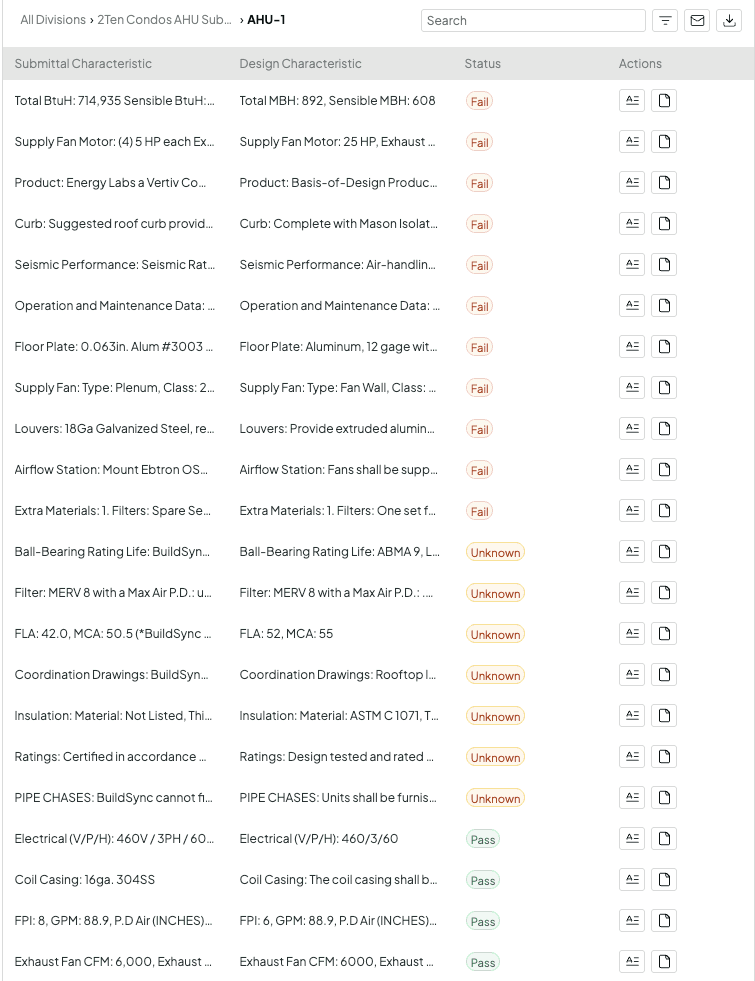
A compliance review can verify that a delegated design submittal's stated values match spec requirements; it cannot verify that the underlying engineering is correct.
A GC's or subcontractor's submittal review, whether manual or AI-assisted, is checking a different thing than the engineer of record's review, and the two shouldn't be treated as interchangeable. Other professionals on the project, superintendents, owner's reps, code officials, are relying on that distinction being clear too.
A compliance review CAN verify | A compliance review CANNOT verify |
The submittal states the performance criteria the specifications require | Whether the underlying engineering calculation is correct |
The stamped design professional's information is present | The delegated designer's professional judgment |
Stated values, load ratings, fire ratings, and dimensions match what the construction documents call for | The architect's limited design-concept check, which remains a separate step |
Catching a curtain wall submittal that's missing a required wind load calculation, or a fire protection package that references the wrong hazard classification, before it goes to the architect saves a review cycle.
But verifying that a submittal states a load capacity is not the same as verifying the calculation behind that number is correct, and a reviewer shouldn't rely on a compliance check to catch that. That responsibility sits with the delegated designer's stamp and, within its limited scope, the architect's review.
BuildSync's technical characteristic extraction works well for the first category: confirming stated performance criteria against spec requirements, flagging missing information, and surfacing where a submittal's numbers don't match requirements, the kind of gap that drives up the cost of a rejected submittal. It's a first-pass compliance check, not a substitute for the engineering itself.
When asked where automated compliance checks end and the engineer of record's review begins for delegated design items, Tom Port, the co-founder of BuildSync, says:
We see our role as making sure the right information gets in front of the engineer. BuildSync can identify what the specifications require, what the delegated design package is telling us, and flag where something is missing or doesn’t align. But we’re not an engineer and we’re not trying to validate the calculations behind that design. That professional judgment has to remain with the licensed design team.
Jacob Delargy, Project Engineer at Monteith Construction, described a related benefit when reviewing complex submittals against overlapping specification sections:
"BuildSync has helped us review multiple submittals against multiple specs that I would not have thought to reference during my own review process."
That kind of cross-reference matters most on exactly the packages, like delegated design submittals, that touch several specification sections at once.
Frequently Asked Questions
Who typically pays for delegated design services?
The contractor typically bears the cost of retaining a delegated designer, and that cost is usually built into the subcontractor's bid rather than billed separately to the owner. AIA C404-2021 lets the contractor formalize this as a direct agreement with the delegated design consultant, which keeps compensation terms separate from the general contract.
Can a general contractor reject a delegated design submittal?
Can the architect of record still be liable if a delegated design element fails?
Related reads for you
Discover more articles that align with your interests and keep exploring.


