Industry Insights
/
Sep 22, 2026
Data Center Construction Challenges & How to Fix Them
Data center builds face brutal timelines and complex MEP scopes. See the biggest data center construction challenges and delays and how to solve them.

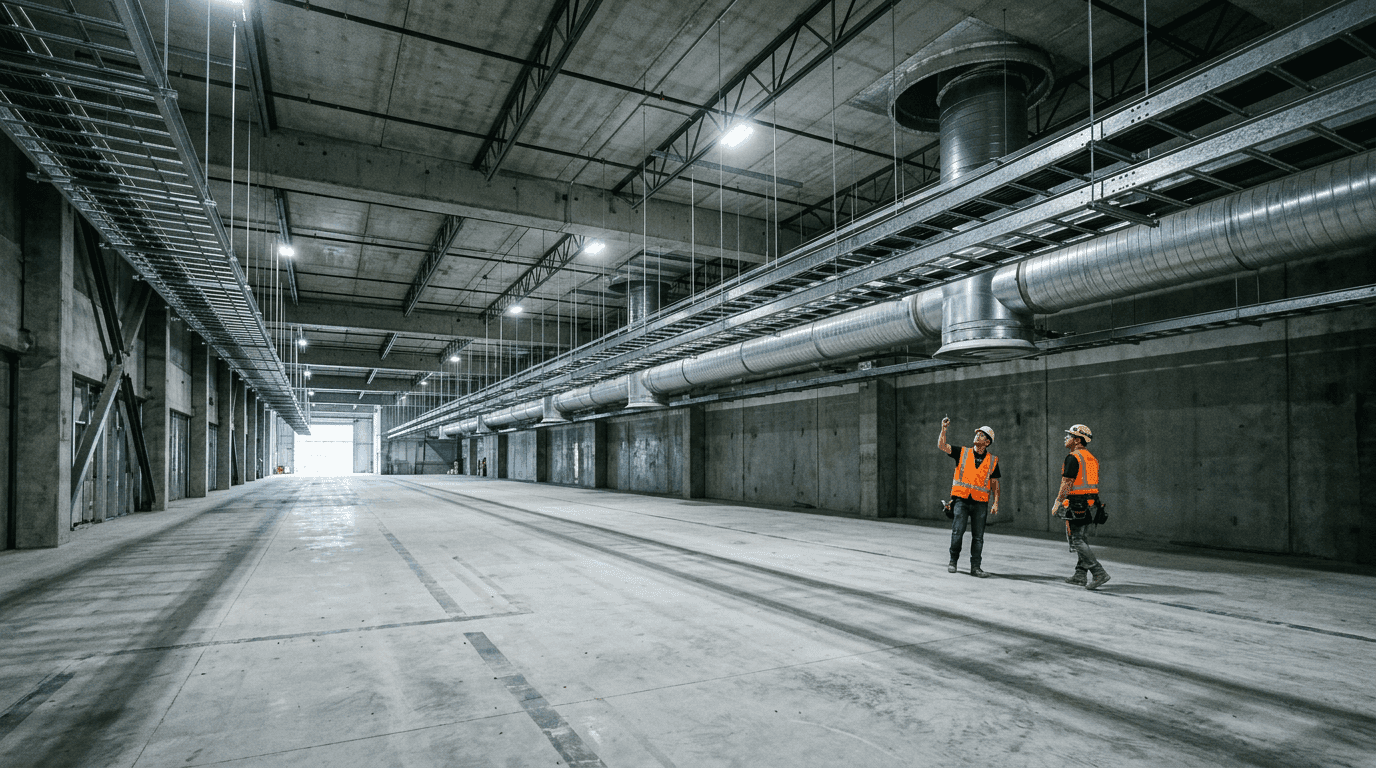
Data center construction challenges rarely come down to a single reason. Power availability, long-lead electrical gear, dense MEP scopes, trade sequencing, zoning laws, and community opposition all pull at the same schedule, and nearly all of them are locked in before a general contractor mobilizes.
The variable still in play once construction starts is how fast equipment gets approved for fabrication, and it gets less attention than anything else on the job.
Almost every published account of why these builds run late points at constraints nobody on the project team can touch. The approval window is the exception.
What causes the most data center construction delays?
Most data center construction delays trace back to three clocks running at different speeds. The first two are largely fixed. The third is not.
Clock | Set by | Can the project team move it? |
Utility | Interconnection queues, grid capacity, energization schedule | No |
Manufacturing | Transformer, switchgear, generator, and UPS lead times | Only by ordering earlier |
Approval | Submittal review and design team turnaround | Yes |
Demand is what keeps the utility clock slow. The Department of Energy report on U.S. data center energy use found that data center load growth tripled over the past decade and is projected to double or triple by 2028, which is why utilities across the digital economy are triaging every proposed data center on their books.
The manufacturing clock runs on supply chain constraints for transformers, switchgear, generators, and UPS equipment, where lead times are still measured in seasons rather than weeks.
What the construction industry counts as a delay, and what it misses
The construction industry measures delay in field days lost. On a data center, the expensive delays happen long before anyone breaks ground. CBRE's North America data center trends report for H1 2026 found that power availability and infrastructure delivery timelines are the most decisive factors in site selection, and that local opposition has become a serious obstacle, with community resistance and zoning delays stalling projects across North America.
The same report also found that MEP equipment constraints are pushing ready-for-service fit-out dates from weeks to several months, with conversions from air cooling to liquid cooling running past six months.
The key challenges data centers can't engineer away
Environmental concerns feed the same constraint. Water consumption, carbon footprint, and the operational costs that show up as higher utility bills for nearby ratepayers have turned approval hearings into a genuine schedule item, and sustainability targets now shape the design through on site generation, solar panels, and grid-interactive controls. Enterprise, colocation data centers, and hyperscale campuses all face the same evolving landscape, and all of them have limited control over it.
Data center growth is also outrunning the physical infrastructure that has to support it. Emerging technologies arrive on a compute cycle measured in months while substations, transmission rights-of-way, and the manufacturing base that builds power supplies move on a cycle measured in years.
Labor runs on the same mismatch. Sites get chosen for energy availability rather than labor availability, a single campus can require several thousand workers where a few hundred once sufficed, and the experienced project engineers who review technical submittals are the scarcest people on that list. Review capacity can't be hired out of the problem. None of that is solvable by the team assembled to build the thing.
New data centers absorb those conditions as given. The ones that still hit their dates tend to differ in a single place: what happens to the paperwork in between.
Why "release to fabricate" is the date that decides data center projects
Release to fabricate is the date that governs a data center schedule, because no piece of long-lead equipment can be ordered against a specification until its submittal is approved. Submittal review sits upstream of the manufacturing clock rather than parallel to it.
On a typical commercial build, the cost of a rejected submittal runs about two weeks of schedule. On a data center program, two weeks can cost a production slot, and the next slot may be a quarter away.
That's the mechanism nobody puts in the delay analysis, and it's how most data center construction delays start: a document problem converts into a manufacturing problem, which converts into an energization problem, which converts into a missed revenue date for the operator.
Political risks, public opposition, and utility timelines sit outside the project team's influence. Approval velocity does not. It's the one link in the chain where a week of discipline buys back a week of schedule, and on a program carrying this much investment, that compounds across every building in the phase.
When asked how early in the submittal process you can usually tell that long-lead electrical and mechanical equipment will get kicked back, and what warning signs reveal it, Tom Port, the co-founder of BuildSync, says:
With long-lead equipment, you can usually tell pretty early in the review whether a submittal is at risk of being rejected.
The tell is rarely the whole package; it’s a handful of critical characteristics that don’t line up with the specification. On electrical equipment, that might be voltage, fault-current ratings, or breaker requirements; on mechanical equipment, it could be capacity, efficiency, refrigerant, or coatings. If those fundamentals are wrong or missing, you know there’s a good chance the package is coming back before you’ve finished reviewing every page.
Why do templated data center buildings still get submittals rejected?
Repeat campus builds generate rejections because the design repeats and the specification doesn't. Data center buildings are the most standardized product in commercial construction, so teams assume the package approved at the last site still complies at this one, and most of the time they're close to right. Then the deltas surface.
The deltas repeat from site to site, which is what makes them worth checking before a package moves.
What looks identical | What changes between sites | Where it breaks the submittal |
Electrical distribution | Voltage class, available fault current | Equipment ratings, breaker coordination |
Mechanical equipment | Ambient design temperature | Capacity selection, efficiency ratings |
Structural attachment | Seismic design category | Bracing, anchorage, seismic certification |
Enclosure and coatings | Coastal or industrial exposure | Coil coating, corrosion resistance |
Acoustics | Local amendments after neighbors voice concerns | Sound data, equipment substitutions |
Closeout requirements | Warranty duration, attic stock quantities | Unknowns at review, disputes at closeout |
The building looks identical and the specification isn't.
Copy-forward submittals fail on exactly these characteristics, and they fail late, because reviewers give a familiar package less scrutiny than a new one. Retrofits raise the stakes further, since new equipment has to land inside existing infrastructure that's already carrying live cloud services and machine learning workloads, where operational disruption has serious consequences for the tenant.
How cooling systems and IT infrastructure inflate submittal review volume
Data centers require more verification per square foot than almost any other building type, because the physical infrastructure supporting the IT infrastructure is the building. A single air handler submittal can carry 60 or more individual characteristics to check, and a lighting package can contain 14 or more distinct fixtures, each with its own tag. Those numbers come from ordinary commercial work.
Now layer on what modern infrastructure for high performance computing equipment adds: redundancy systems at N+1 or 2N, liquid cooling loops with coolant distribution units and water quality requirements, switchgear, paralleling controls, generators, fuel systems, BMS points lists, and security measures protecting sensitive information and data storage.
The PNNL/ASHRAE/NEMA AI Data Center Energy Performance Framework covers how energy consumption, water usage, and commissioning interact across these systems, and every one of those interactions eventually becomes a submitted document that someone has to verify.
The mechanical scope alone compounds fast. Anyone reviewing that work should know the HVAC submittal characteristics under Division 23 cold, because refrigerant type, motor efficiency, coil coatings, and attic stock are where these packages break.
The electrical side runs heavier still. Division 26 electrical submittals carry more individual characteristics per package than almost any other division, and transformers on data center work add K-factor ratings and harmonic mitigation that standard commercial specs leave out.
Why "unknown" is riskier than "fail" for data center operations
An ambiguous characteristic is more dangerous than a failed one. Failures are visible, cheap to correct, and get resolved with a phone call to the vendor. Ambiguous items get waved through.
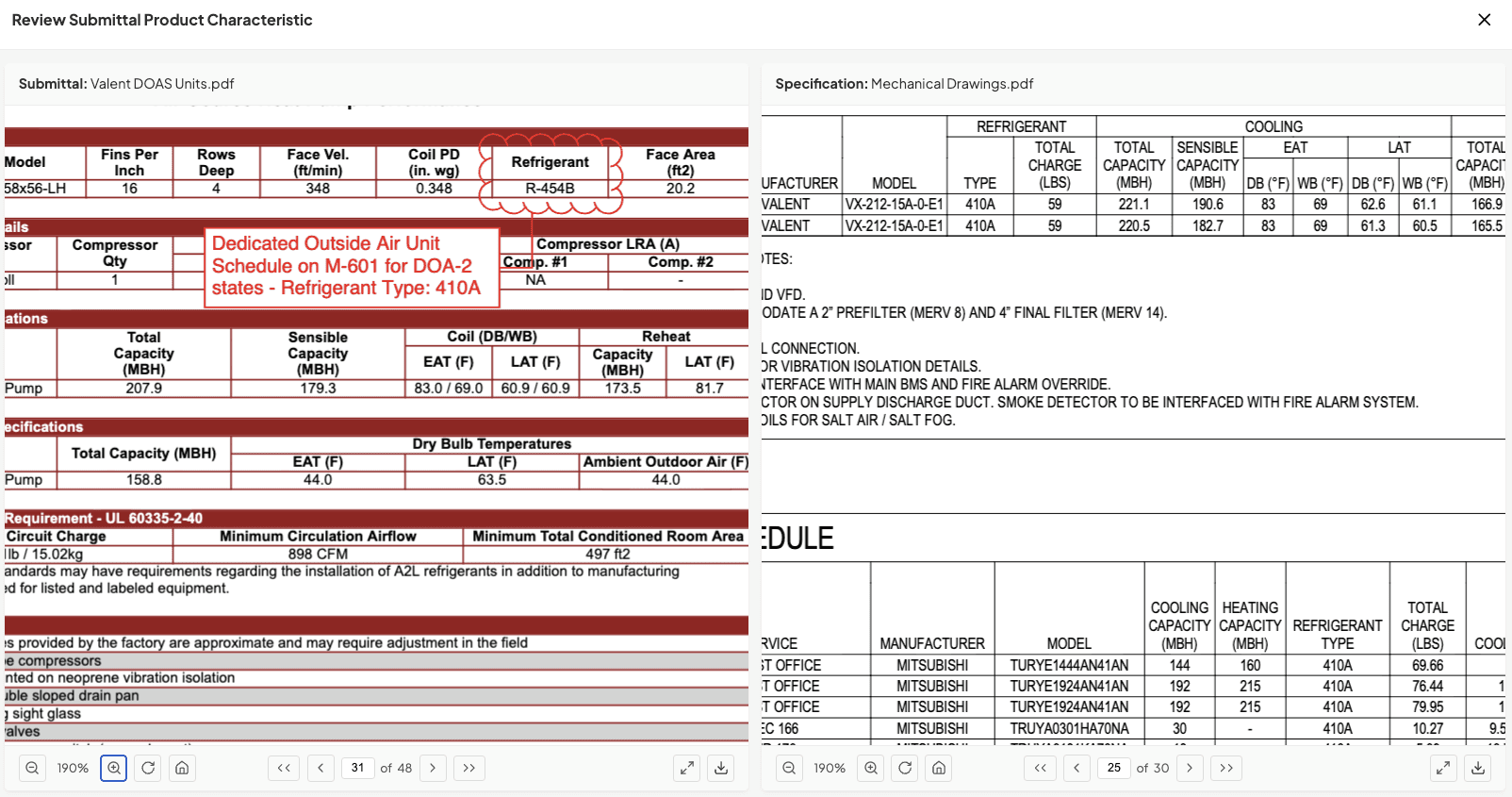
An unknown is what happens when the submittal states a coil coating without confirming it's the corrosion-resistant type the spec requires, or lists a standard manufacturer warranty when the spec calls for 10 years from substantial completion, or omits spare parts entirely.
None of that reads as wrong. It reads as fine until commissioning, when the deficiency surfaces against a live energization date and stops being a paperwork problem. By then the cost lands on operational continuity and retention money instead of on a review cycle.
When asked how the best project managers handle submittal unknowns differently from those who treat them like everyone else, and what they do with the list of unresolved items, Tom Port, the co-founder of BuildSync, says:
“The best project managers don’t treat an unknown as a pass. They treat it as something that still needs to be closed out before the submittal moves forward. They’ll go back to the vendor, get the missing information, and document the answer rather than assuming the product complies. That discipline matters because an outright failure is obvious; an unknown is much easier to miss and can become a much more expensive problem later in the project.”
How to compress the approval window in data center construction
Four moves shorten the approval window without lowering the standard of review.
Sequence long-lead submittals first. Switchgear, transformers, generators, chillers, and CDUs move ahead of finishes on the submittal schedule regardless of when the trades install them.
Settle spec precedence in writing. Decide upfront how conflicts between the equipment schedule and the spec body resolve, so they get handled by rule instead of by RFI.
Review at characteristic level, not document level. Rejections originate at individual characteristics, so that's the resolution the review has to run at.
Check every drawing revision against approved submittals. A 50% CD change can invalidate an approval without anyone noticing, which is why construction drawing change detection between revision sets belongs in the workflow rather than in someone's memory.
Careful planning at this level gives teams greater control over the one stretch of schedule they own.
Request a demo. See how BuildSync fits into a data center submittal workflow.
How artificial intelligence fits into AI infrastructure submittal review
Artificial intelligence earns its place in submittal review by doing the extraction work that human reviewers run out of time for, then showing where every determination came from.
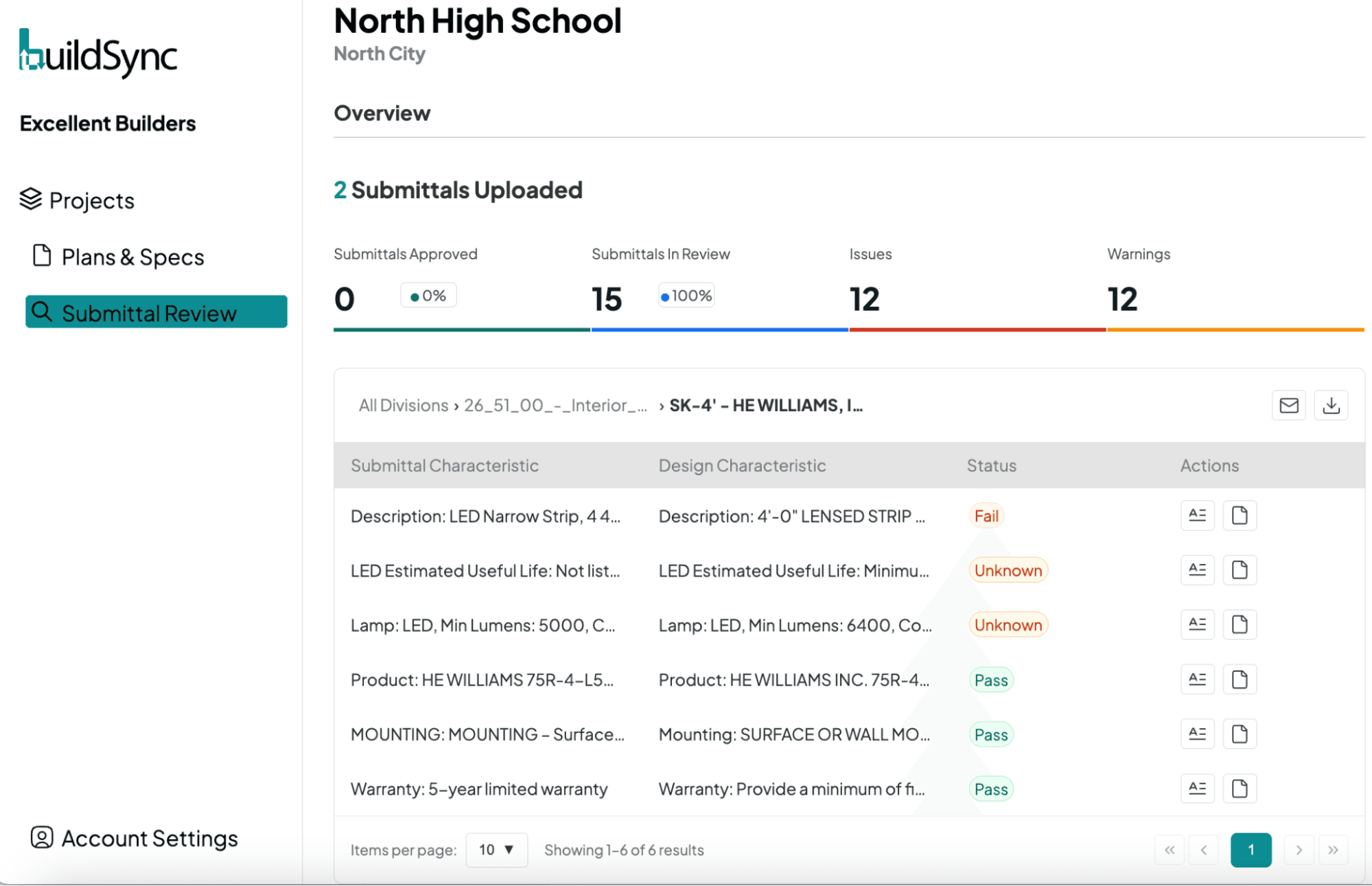
BuildSync breaks a submittal down to the product level, pulls every technical characteristic, and checks each one against the plans and specifications, flagging pass, fail, or unknown with a link to the exact page in both documents.
That's deep technical analysis rather than document routing, and for teams already running Procore it happens inside the existing workflow, with BuildSync acting as a reviewer in the submittal chain.
Skepticism about that is reasonable. Nobody should hand a compliance decision to software on trust alone, which is why every finding traces back to a source page a reviewer can open in seconds. Trust but verify, applied to a document set nobody has time to read twice.
The results hold up on document-heavy scopes. Fountain Electric cut a 500-page lighting submittal review from days to hours and cut its submittal rejection rate from 40% to 20%. At Monteith Construction, project engineer Jacob Delargy reviewed a 530-page submittal against multiple spec sections his manual process wouldn't have referenced, and the team reports 70% faster reviews.
None of that replaces judgment. It gives the reviewer a head start on documents that would otherwise eat a week.
Book a demo or start a free trial on your most complex data center submittals.
Frequently asked questions
How long does it take to build a data center?
There's no reliable standard duration, because energization rather than shell construction sets the finish date. Site work and structure can move fast, while the utility connection and the long-lead equipment behind it often cannot. Teams that plan backward from the energization date hold their schedules better than teams that plan forward from groundbreaking.
Do modular designs reduce data center construction delays?
What causes data center commissioning delays?
Related reads for you
Discover more articles that align with your interests and keep exploring.


