Construction Technology & Innovation
/
Aug 17, 2026
What Is a Good Submittal Rejection Rate?
What counts as a good submittal rejection rate depends on who's asking. See the benchmarks for GCs and subs, and how the best teams hit 5% or lower.


A good submittal rejection rate sits under 10% for most construction projects, with the best teams in the industry getting below 5%. The construction industry average sits around 30%, so if your submittal rejections are anywhere near that number, you have real room to improve. But "good" depends on who's asking.
A general contractor and a subcontractor are catching different submittal issues at different stages of the submittal process, and a $75M contractor and a $400M contractor are managing very different volumes of project submittals. The rest of this guide breaks down what good actually looks like by role and by project size, and what moving toward it takes.
Construction professionals rarely agree on a single benchmark because the submittal process itself varies so much by trade and by how strict review tends to run.
Do GCs and Design Teams Define "Good" the Same Way?
No, because they're checking for different kinds of compliance at different stages. A general contractor reviewing submittals before they reach the design team is checking for a different kind of compliance than a subcontractor building the submittal package in the first place. Both stages produce submittal rejections, but they're not catching the same things:
GC preliminary review checks for completeness and obvious mismatches against contract documents.
Design team's technical pass goes deeper against project specifications, code, and design intent.
That's part of why a single industry-wide number doesn't tell the whole story.
Subcontractors have their own version of this benchmark. A mechanical or electrical contractor building a submittal package from scratch is trying to minimize how often the GC sends it back before it ever reaches the design team, an earlier, narrower rejection cycle than the one a GC tracks across an entire project.
Electrical contractors in particular tend to deal with more line items per submittal package, since panel schedules, fixture cut sheets, and load calculations all have to line up with the specification at once. A sub aiming for a "good" rate is really asking a different question than a GC: how do I keep my own submittal preparation from creating rework before anyone downstream sees it?
Company culture plays into this too. Some owner and design team pairings run a tight, collaborative submittal process with frequent informal check-ins before formal submission. Others treat every deviation from project requirements as grounds for a formal revise and resubmit. Neither approach is wrong, but it does mean the same submittal, on the same equipment, could land in different places on the rejection-rate spectrum depending on how the design team responds to minor deviations versus material ones.
Tom Port, co-founder of BuildSync, put it this way when asked how he calibrates a "good" rejection rate for different clients:
That’s a difficult question to answer because GCs and subcontractors are measuring rejection rates at different points in the process. But having had hundreds of these conversations over the years, I’d say anything under 10% would generally be considered good. Ultimately, whether you’re a GC or a sub, the goal is the same: reduce unnecessary rework and prevent submittal issues from impacting the project schedule.
The takeaway: don't benchmark against a generic industry number without asking what kind of submittal, whose review stage, and what type of construction project you're comparing against.
Submittal Rejection Rates by Company Size and Construction Industry Benchmarks
Role isn't the only variable that moves the benchmark. Company size changes the math too, mostly through volume and complexity, and rejection rates climb with the number of specialized systems a project involves.
A small contractor working on straightforward institutional projects can hit low rejection rates with basic process discipline. A large contractor running several projects with complex systems or specialized MEP equipment has more surface area for a submittal issue to slip through.
On a typical commercial project, the submittal count alone can run into the hundreds, so even a small percentage-point improvement in submittal rejection rates translates into real hours saved for project engineers.
Project Size | Typical Rejection Rate | Good Target | Best-in-Class |
Small contractor ($50M–$100M) | 30–35% | 10–15% | Under 5% |
Mid-size contractor ($100M–$300M) | 30–35% | 10–15% | Under 5% |
Large contractor ($300M–$500M+) | 30–40% | 15% | Under 5% |
Each rejected submittal isn't free. BuildSync's survey-based cost analysis puts submittal rejections cost at a weighted average of $805 per rejection. That figure covers several stacked costs:
Administrative time to reprocess the rejection
Schedule coordination with subs and vendors
Occasional critical-issue outliers that push the average up
Project delays on anything sitting on the critical path
Direct costs are only part of the picture. Labor costs climb every time a project engineer has to reopen a submittal that already cleared one full manual review, and that submittal rework competes with the other things project teams are supposed to be doing, like coordinating installation instructions on the project site or tracking submittals against the master submittal schedule.
A contractor running multiple projects at once feels this compounding effect the most, since a rejection cycle on one project causes schedule delays that pull attention away from another.
How Do I Reduce Submittal Rejection Rates and Avoid Project Delays?
Two changes catch the bulk of avoidable submittal rejections on most projects, without requiring new software or a change to your submittal workflow:
Documented preliminary review at initial submission. Review before submittal documents leave your office, not after.
Standardized submittal package format. Reviewers shouldn't have to hunt for information, and this alone prevents rejected submittals from piling up mid-project.
The pattern behind most non compliant submittals is depressingly simple: wrong manufacturer, missing certification, a product data sheet that doesn't match what the spec actually calls for. Since product data submittals carry the bulk of that risk, knowing what belongs on the form before it's submitted heads off most of these rejections.
A structured comparison against the specification section, done once before submission, catches most of it and helps reduce rework before anything reaches the design team, whether the document in question is a product data sheet or a set of shop drawings.
For a fuller breakdown of process-level fixes, including how to sequence a submittal schedule around critical path items so the construction schedule doesn't stall on long-lead equipment, see our guide to improving the construction submittal review process.
That kind of quality control step is exactly how the best teams reduce submittal rejection rates without adding headcount, since fewer submittal rejections at this stage means less rework downstream for everyone.
How Do I Improve Our Submittal Approval Rate?
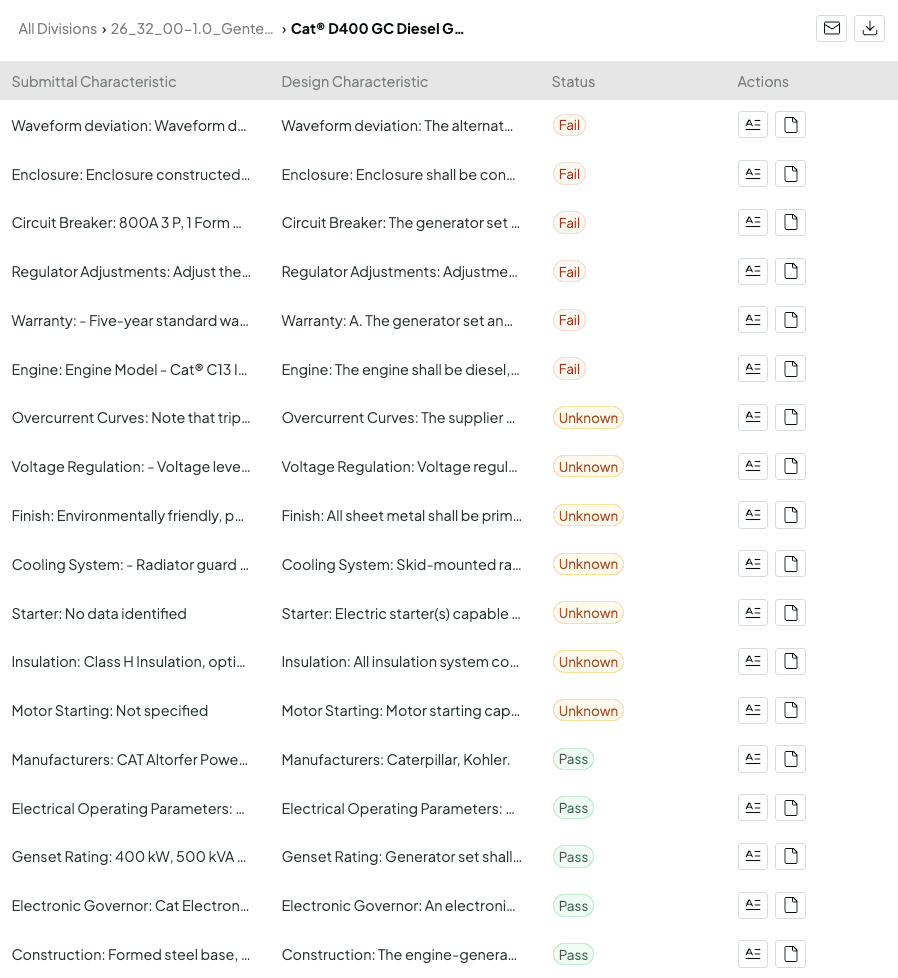
Catch technical non-compliance before the design team ever sees the submittal. That's the single biggest lever for improving your approval rate. A submittal can be complete and on time and still get rejected because a refrigerant type, a light transmittance value, or a warranty term doesn't match the spec.
This is where most manual review effort on submittal documents breaks down. Project engineers cross-referencing 70-page product data sheets against dense specification requirements, one line item at a time, are doing detailed and exacting work under real time pressure. Something gets missed.
On complex systems like air handling units or curtain wall systems, that "something" might be one line out of sixty technical data points, and it's often the difference between final approval and another rejection cycle.
When asked what separates teams that plateau at around a 15% submittal rejection rate from those that consistently get below 5%, Tom Port, the co-founder of BuildSync, says:
The biggest difference is consistency, which in practice can be very hard to achieve. Teams that fall below 5% have a repeatable process to check every submittal against the project requirements before it moves downstream.
At 15%, you’re already doing a lot right, but getting that last 10% usually means making the review process more systematic so you’re not relying on an individual reviewer to catch every detail.
Submittal review rarely improves on its own. Something in the review process has to change, whether that's who checks the submittal first, how thoroughly they check it, or what tools project engineers use to check it faster.
If tooling is the lever, our review of AI construction tools by use case covers what is available and what each category actually improves.
The Road to 5%: What Improvement Looks Like Over Time
BuildSync customers tend to follow a predictable trajectory. It's not instant. It's process discipline plus better technical review, compounding over a few submittal cycles:
Day 1: Most start around a 30% rejection rate, matching the construction industry average.
30 days in: Submittal rejections typically drop to 15%.
120 days in: Most customers are below 5%, with project timelines noticeably steadier as a result.
Monteith Construction saw this play out on a hospital renovation project. Daniel Recktenwald, PM at Monteith, described the shift plainly:
"Before BuildSync we were moving through submittals like quicksand, often overwhelmed and missing problems. After BuildSync, submittals have become something that is part of your day and not your whole week."
Monteith's team saw 70% faster submittal reviews as part of that transition.
When a "Good" Rate Still Isn't Good Enough
A low rejection rate protects your schedule, but it doesn't automatically protect you from the one submittal that gets approved when it shouldn't have. This is the rare but expensive edge case: a submittal clears review, gets installed, and turns out not to actually meet contract requirements.
Now you're looking at replacement costs, not just a rejection cycle. Part of why this happens is that architect review under standard AIA contract language is limited to conformance with design concept, not a guarantee of every dimension, quantity, or performance detail, which stays the contractor's responsibility.
When asked why a low submittal rejection rate alone isn't enough to reassure a GC that nothing is slipping through, Tom Port, the co-founder of BuildSync, says:
This is also why trust but verify matters more than the rejection rate number itself. Every technical data point BuildSync flags links back to the exact page in the submittal and the exact requirement in the specification, so project teams can check the source before signing off during design review. A good number without a verification habit behind it is still a risk on critical path equipment.
Want to see where your rejection rate actually stands? Book a demo and run it against a few of your toughest submittals.
Frequently Asked Questions
Is a 0% submittal rejection rate realistic or even a good goal?
No. A 0% rejection rate usually means reviewers are approving things they shouldn't, not that every submittal is flawless. Design teams occasionally reject submittals for legitimate reasons like specification clarifications or value engineering opportunities the architect wants to explore, so some rejections are a normal part of a healthy approval process.
Does a low rate mean good design team review, or just that problems show up later in as built drawings?
How is submittal rejection rate different from submittal approval rate?
Do common submittal challenges differ by trade in the construction submittal process?
Related reads for you
Discover more articles that align with your interests and keep exploring.


