Construction Technology & Innovation
/
Sep 22, 2026
The Data Center Construction Process, Step by Step
From site selection to commissioning, here's the full data center construction process and the steps most likely to cause delays if submittals slip.


The data center construction process moves through seven steps: site selection, design and engineering, preconstruction and long-lead procurement, submittal review for critical equipment, site preparation and shell construction, MEP installation, and commissioning and handover.
Much of the schedule risk on these jobs sits in Step 4. A data center building exists to house power and cooling equipment, and none of that equipment gets released, set, or tested until its submittal is approved.
Plenty of guides list the data center construction process steps and how long each one takes. This guide follows the equipment approvals that decide whether those durations hold up.
Why does the data center construction process depend on equipment approvals?
It depends on equipment approvals because, in most data centers, the bulk of the cost and schedule risk sits in the power and cooling equipment inside the shell. Data center construction involves far more electrical systems, HVAC systems, and backup systems per square foot than a typical commercial construction project, and data center owners expect every one of those critical systems to work the first time it's tested.
Demand for digital infrastructure is growing fast. A Department of Energy report on data center electricity use found that data centers used about 4.4% of U.S. electricity in 2023 and could reach 6.7% to 12% by 2028.
Artificial intelligence, data analytics, and data processing workloads are pushing energy usage and rack density up at the same time, which puts more pressure on power distribution and cooling systems.
For project managers and project engineers, that growth shows up as submittal volume. Every UPS, generator, switchboard, and cooling unit has to be approved against the specs before it can be released for fabrication.
Data center construction process steps at a glance
The seven steps overlap in practice. This table orders them by the equipment approvals each one depends on, rather than by strict field sequence.
Step | What happens | Submittal risk that gates it |
1. Site selection | Power availability, fiber connectivity, zoning, permitting | Utility-side equipment that must be specified early |
2. Design and engineering | Tier level, rack density, cooling approach, specs | Conflicts between equipment schedules and spec sections |
3. Preconstruction and procurement | Submittal register, buyout, fabrication slots | Release dates tied to approval dates |
4. Submittal review | GC checks equipment data against plans and specs | Rejections on long-lead power and cooling gear |
5. Site preparation and shell | Foundations, pads, structural elements, envelope | Pads and supports sized from approved equipment data |
6. MEP installation | Power, cooling, fire protection, network infrastructure | Design changes that invalidate approved submittals |
7. Commissioning and handover | System testing, load testing, closeout | Installed equipment that doesn't match what was approved |
Step 1: Site selection, power availability, and permitting
Owners start by defining the facility's purpose, IT capacity, and budget, and those decisions set the power load a site has to support. That's why site selection starts with power availability. The key considerations owners weigh include:
Utility capacity and how soon the local utility can deliver it
Fiber connectivity to carrier networks
Water supply for cooling
Land for future expansion
Local zoning, which is getting stricter in many markets
For general contractors, the factors that matter most are the ones that turn into procurement problems later. If the site needs a new substation or utility upgrade, some of the longest-lead equipment on the job gets defined before design is finished.
Step 2: Design and engineering for hyperscale, enterprise, and colocation data centers
Data center design sets the tier level, rack density, cooling approach, and redundancy model. The Uptime Institute Tier Classification System is the common reference. Tier III facilities are concurrently maintainable, and Tier IV adds fault tolerance.
The facility type shapes the specs:
Hyperscale data centers built for cloud service providers repeat the same equipment across large campuses, often with liquid cooling for high-density racks.
Enterprise data centers serve a single organization, such as government agencies or banks handling sensitive data, and tend to carry strict physical security and biometric access controls requirements.
Colocation data centers build shared power and cooling infrastructure for multiple tenants, with capacity reserved for future growth.
Edge data centers are smaller and often use modular systems to speed deployment.
Design also sets the submittal requirements. Each energy efficiency rating, sound level, and warranty term in the specs becomes something a submittal has to prove. If the equipment schedule on the drawings says one thing and the spec section says another, the conflict stays hidden until a reviewer catches it.
Step 3: Preconstruction and long-lead procurement on data center construction projects
Data center construction requires procurement to start while the building is still on paper. Good project management at this stage follows a clear sequence:
Build the submittal register straight from the specs.
Flag every long-lead item.
Tie each long-lead item to its required-on-site date in the construction schedule.
Supply chain disruptions make this harder. Utility Dive reported that lead times for larger transformers run 80 to 120 weeks, citing Wood Mackenzie data. Generators, switchgear, and UPS systems face similar pressure.
Many manufacturers won't lock in a fabrication slot until the submittal is approved. A delivery date depends on an approval date, and the approval date depends on how clean the first submission is.
Step 4: Submittal review for power and cooling systems
Most write-ups of the construction process leave this step out, even though it's where many data center schedules slip. Before a submittal goes to the design team, the GC's PM or PE should check it against the plans and specs. On a data center project, that review covers some of the densest equipment data in commercial construction.
What does a data center equipment submittal have to prove?
A data center equipment submittal has to prove that every technical characteristic of each unit meets the plans and specs. The list varies by type of critical infrastructure:
Power systems: UPS systems, backup generators, switchgear, and power distribution units, with ratings, capacities, runtime, certifications, and listings
Cooling systems: computer room air handlers, chillers, and other cooling units, with airflow, capacity, efficiency, refrigerant type, sound ratings, and controls
Life safety and monitoring: fire protection components and building management system points
Closeout items: warranty terms, spare parts, and attic stock
BuildSync has found that a single air handling unit submittal can include 60 or more characteristics to verify. A PE checking those by hand, across dozens of equipment types, spends hours cross-referencing before making any judgment calls.
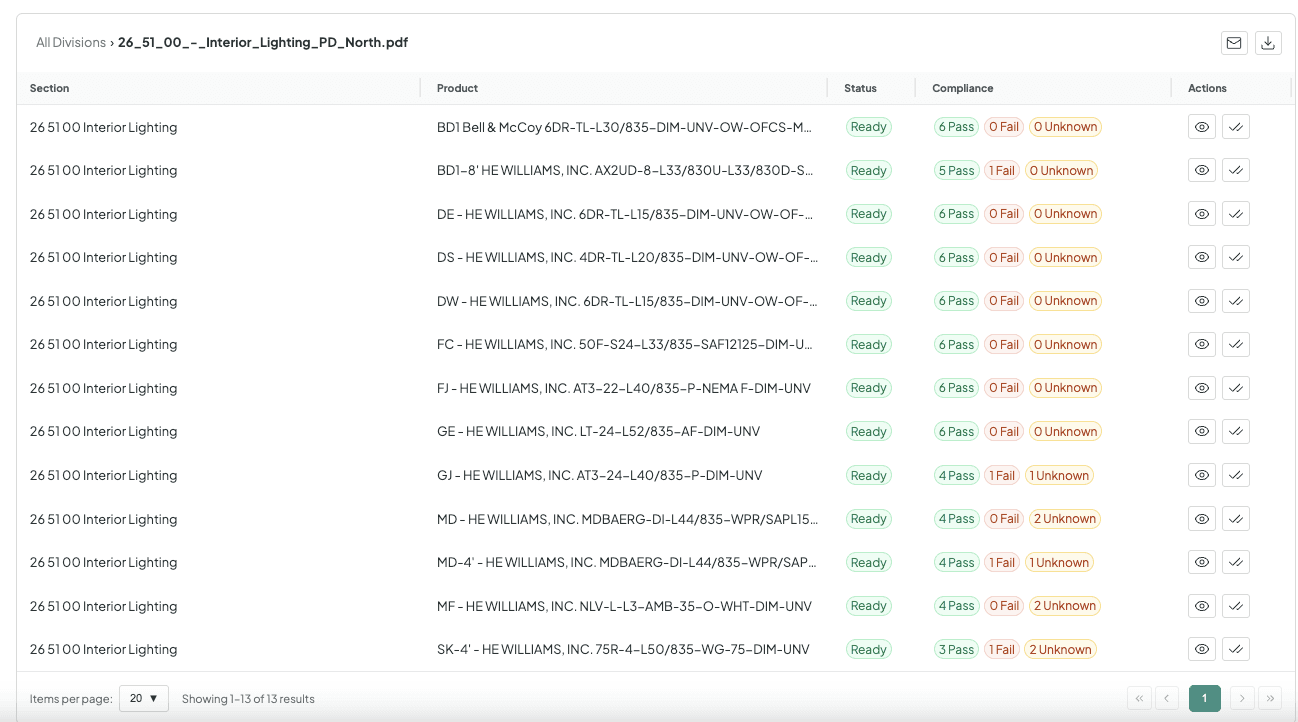
How one missed characteristic repeats across a data center building
In a building designed around redundant systems (N+1 or 2N), the same equipment tag often appears many times over. If the submitted CRAH has the wrong coil coating, or the UPS has the wrong runtime, the error applies to every unit on that tag.
Each of those rejections carries a real cost. BuildSync's research, based on outreach to more than 6,000 construction professionals, puts the average cost of a rejected submittal at $805. Each rejection also adds 2+ weeks to the timeline. On long-lead gear, those weeks can push a fabrication slot back, and the delay carries into every step that follows.
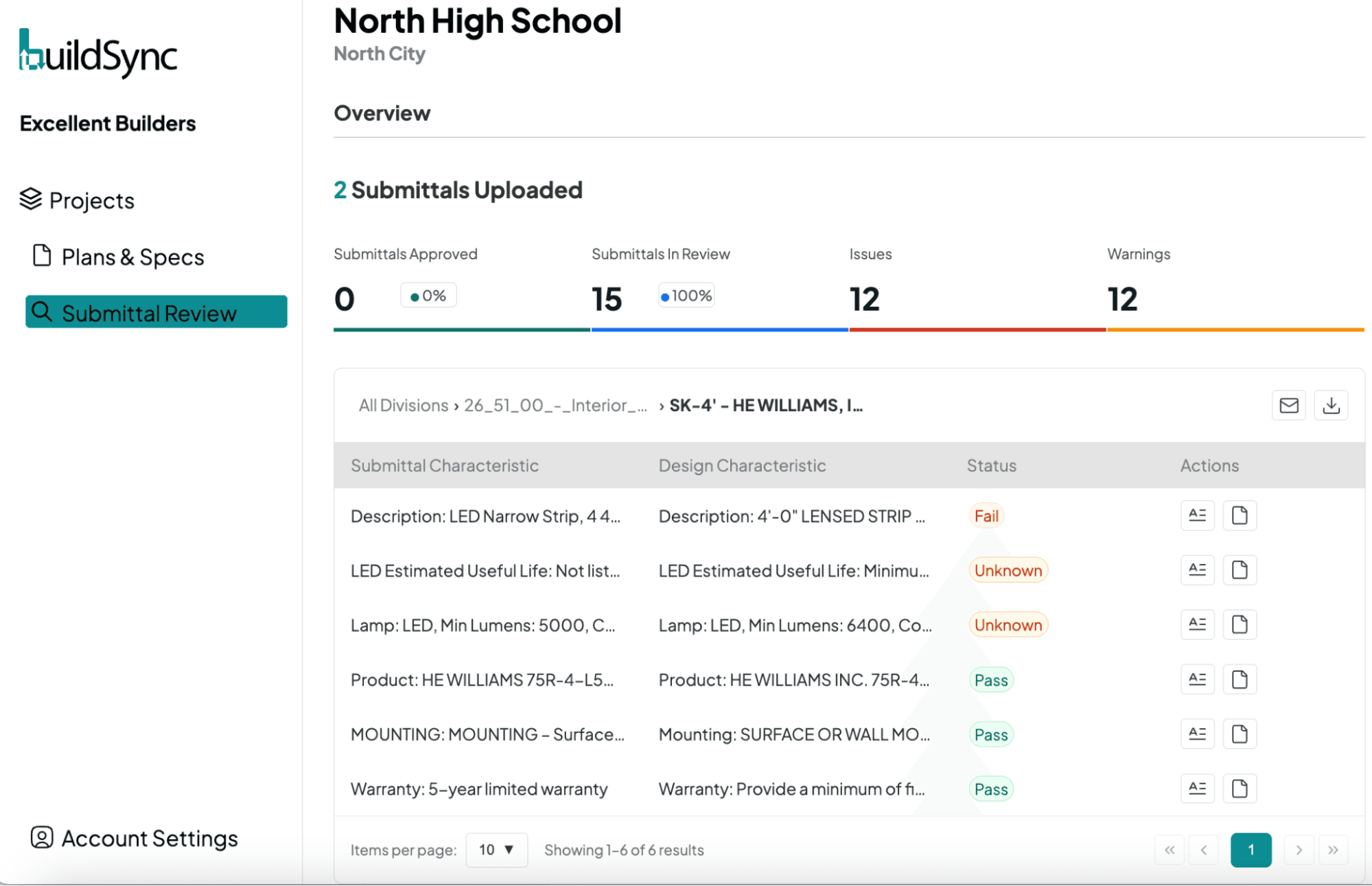
Want to see how BuildSync handles your most complex equipment submittals? Book a demo.
Step 5: Site preparation, shell construction, and the building structure
Site preparation, foundations, and shell construction follow a familiar sequence. Two things set data centers apart: the equipment loads and the precision required.
Housekeeping pads, generator foundations, and roof or grade supports are sized from equipment dimensions and weights. If crews build those structural elements from preliminary data and the approved unit turns out heavier or larger, someone has to demo and re-pour concrete. Tying pad and support details to approved submittal data protects the building structure from rework during the construction phase.
Step 6: MEP installation and white space fit-out in the construction process
MEP installation is where power distribution, cooling, fire protection, security infrastructure, fiber optic cabling, networking equipment, and storage systems all come together. Crews install what was approved, so a mistake in an approval turns into a mistake in the field. Once power and cooling are live, teams install racks, cable the network infrastructure, and test connectivity before the white space moves to commissioning.
Mid-project design changes add another layer of risk. Data center construction trends such as higher rack densities and the shift to liquid cooling can reshape a design mid-project. If the engineer resizes the cooling, submittals that were already approved may no longer match the drawings. BuildSync's drawing change detection compares drawing revisions and flags which approved submittals the changes affect.
When asked what PMs should re-check first on already-approved submittals when the design changes mid-project, and what can happen if they don't, Tom Port, the co-founder of BuildSync, says:
The first thing I’d recheck is whether the approved equipment still meets the revised design criteria, capacity, airflow, electrical load, dimensions, controls, and any other requirements affected by the change. An approval is really only valid against the design it was reviewed against. If the drawings change and nobody reviews those approved submittals again, you can end up installing equipment that was compliant six months ago but no longer matches the current design. At that point, you’re finding the problem in the field or during commissioning, when it’s far more expensive to fix.
Step 7: Commissioning and handover of the construction project
Commissioning is where the team proves system performance, usually through a mix of tests:
Integrated systems testing confirms that power and cooling work together.
Load testing puts systems under realistic demand.
Failover tests show whether system integration holds up when a component fails.
Commissioning also verifies the submittal record. Commissioning agents compare installed equipment against approved data, so any unit that doesn't match its approval turns up here, where it costs the most to fix.
Data centers rely on the same records for years after handover, using them to optimize energy consumption and track power usage effectiveness, the ratio of total facility power to IT power. Closeout then collects O&M manuals, as-built drawings, and warranties, spare parts, and attic stock. All of it should trace back to approved submittals, and it's what the operations team works from after handoff.
When manual review can't keep pace with the center construction process
Checklists and experienced reviewers still matter. The center construction process for a data center, though, produces thousands of characteristics across redundant equipment, on a schedule with little room for resubmittals.
Skepticism about AI reviewing that equipment is reasonable. Tom Port, BuildSync's co-founder, has spent over a decade building AI products and treats that caution as a fair starting point. Teams need to see results on their own submittals before trusting them, and BuildSync's free trial and pilots are set up for that.
How BuildSync reviews data center equipment submittals
BuildSync works through each submittal in three stages:
It breaks the submittal into individual products.
It extracts every technical characteristic for each product.
It checks each characteristic against the plans and specs.
Every characteristic gets one of three statuses, each with a stated reason:
Status | What it means | Next step for the PM or PE |
Pass | The characteristic meets the plans and specs | Spot-check the source pages |
Fail | The characteristic doesn't meet the plans and specs | Resolve with the sub or vendor before the design team sees it |
Unknown | The information needed to decide isn't in the submittal or the specs | Get clarification from the sub or vendor |
If the plans and specs contradict each other, BuildSync flags both requirements and notes the more stringent one, which gives the PE what's needed to write an RFI. Every determination links to the exact source page, so reviewers can check the work.
Teams on Procore can use the Procore submittal integration, where BuildSync acts as a reviewer in the existing workflow and pulls in plans, specs, and referenced RFIs on its own. Teams not on Procore can drag and drop files instead.
Results from contractors using BuildSync
Contractors are already using BuildSync on large submittals. Fountain Electric ran a 500-page lighting submittal through it, and Patrick Bloodsworth, Shared Services Manager, said: "I was able to only spend 2-3 hours on submittals instead of 2-3 days."
Monteith Construction has used it on two projects. On a hospital renovation, submittal reviews ran 70% faster. On a $100M+ school build, Project Engineer Jacob Delargy worked through a 530-page submittal.
The PE still makes the call on every item. BuildSync takes on the data extraction so the team's time goes to decisions.
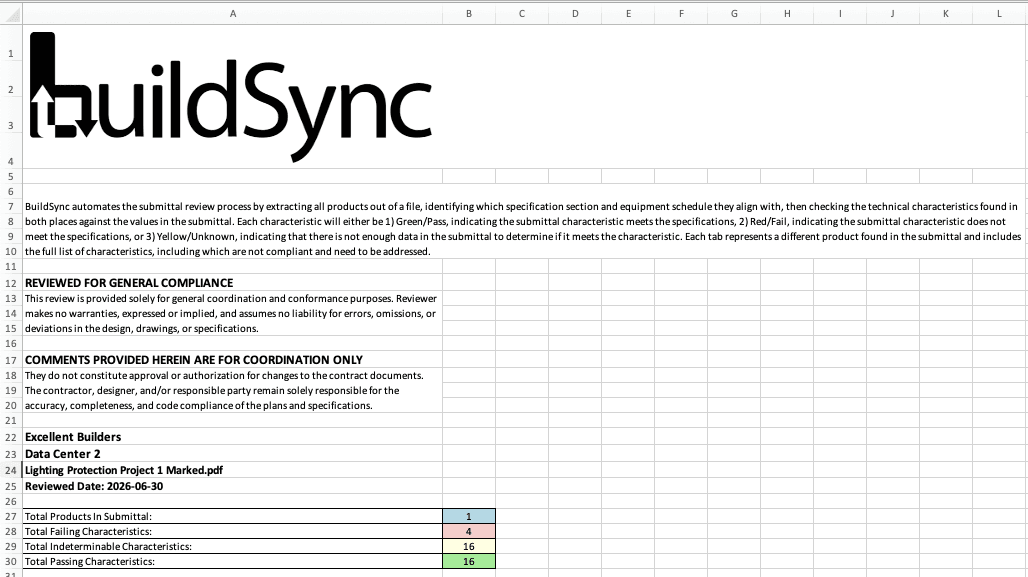
Try BuildSync free on your toughest equipment submittals.
Frequently asked questions about data center construction
How long does the data center construction process take?
There's no standard duration, since timelines vary widely with project scale, location, and power availability. The field work is often shorter than the lead-up to it. Utility interconnection, permitting, and long-lead electrical equipment tend to set the pace, which is why schedules for large campuses are built around power availability first.
Does design team approval relieve the contractor of responsibility?
Can AI submittal review handle shop drawings on data center projects?
Related reads for you
Discover more articles that align with your interests and keep exploring.