Construction Technology & Innovation
/
Jun 30, 2026
Division 26 Construction: The Complete Electrical CSI Code Guide
Master Division 26 electrical CSI codes: specs, subsections, and the compliance mistakes that get submittals rejected. A complete guide for PMs and contractors.


Imagine a lighting submittal covering 80 fixture types. Every fixture tag has its own photometric requirement, lens type, and dimming protocol buried somewhere in a 70-page cut sheet. The reviewer checks a few. The frosted lens specification for one fixture type goes unselected. Nobody catches it. The wrong product arrives on site weeks after the design team approved it, and by then the schedule impact is already compounding.
Div 26 submittals carry more individual technical characteristics per package than almost any other division, and they move fast.
Understanding how Division 26 is structured, what its subsections require, and where compliance gaps consistently appear is the difference between a clean first-time approval and a rejection cycle that costs two weeks and $805 per submittal. Division 26's volume also affects what a good rejection rate benchmark looks like at the division level, since a package this complex tends to run higher than a project's overall average.
What Is Division 26 in Construction?
Division 26 electrical is the section of CSI MasterFormat dedicated to all electrical systems on a construction project. It covers power distribution, lighting, grounding, bonding systems, wiring devices, transformers, generators, and the conduit and wire infrastructure that connects them.
On mission-critical builds, Division 26 carries much of the long-lead gear that drives the data center construction process, including switchgear, UPS systems, and backup generators.
Before MasterFormat 2004, this work lived under Division 16. The updated system gave electrical its own dedicated division, which improved specification clarity and made it easier to coordinate Division 26 specs with adjacent mechanical and low-voltage divisions. Some project specs and older firms still reference Division 16 numbering, so teams should confirm which edition their project specs follow at the outset.
Understanding how MasterFormat divisions are structured across the full numbering system helps teams navigate project specs before the first submittal arrives.
How Division 26 Is Organized: Key Subsections
Division 26 uses a six-digit numbering system. The first two digits identify the division (26), the next two identify the section group, and the final two identify the specific section.
Section Group | Coverage |
26 05 00 | Common work results: conduit, wire, cable, fittings, grounding, bonding systems |
26 09 00 | Instrumentation and control for electrical systems |
26 20 00 | Low-voltage distribution: panelboards, switchboards, transformers |
26 24 00 | Switchboards, switchgear, and distribution equipment |
26 29 00 | Motor starters and controllers |
26 30 00 | Facility power-generating equipment (generators) |
26 40 00 | Electrical and cathodic protection |
26 50 00 | Lighting: interior, exterior, emergency systems |
Sections 26 05 00, 26 20 00, and 26 50 00 account for the largest share of submittals on a typical commercial building project.
What Division 26 Submittals Actually Require
26 05 00 Common Work Results
Submittals here cover conduit types and sizes, wire gauge and insulation ratings, cable assemblies, grounding conductors, and bonding systems. Specs frequently call out conduit material specifically (EMT, rigid, PVC) and prohibit substitutions without written approval. Installation methods for conduit runs, including support spacing and bend radius requirements, must match what the spec calls for.
Teams responsible for reviewing these submittals should walk the installation guidelines before approving product data, since a conduit system that meets material specs but violates the installation method requirements creates field problems post-approval.
26 09 00 Instrumentation and Control
Control submittals for lighting and power systems require a sequence of operations documentation alongside product data. A submittal that addresses equipment but omits the control narrative is incomplete and will come back.
26 20 00 and 26 24 00 Distribution and Switchgear
Panelboard and switchboard submittals require voltage, phase, amperage ratings, short circuit current ratings (SCCR), and bus ratings. Transformers are among the most frequently rejected submittal types in Division 26 electrical work.
Specs routinely call out KVA rating, impedance, efficiency at full and partial load, and temperature rise, and reviewers miss at least one of these on initial pass more often than expected. Transformer applications in healthcare and data center projects carry additional requirements around K-factor ratings and harmonic mitigation that standard commercial specs don't always include.
Missing either one is a common source of delays on data center builds, where a rejected transformer submittal can push fabrication past the manufacturer's next open slot.
26 50 00 Interior and Exterior Lighting
Every fixture type on the lighting schedule has its own technical requirements: lumens per watt, color temperature (CCT), color rendering index (CRI), mounting configuration, lens type, dimming compatibility, and DLC listing tier. Specs increasingly require DLC Premium rather than standard, and that distinction is easy to miss when a data sheet covers 20 fixture variants on one page.
The Technical Characteristics That Fail Most in Division 26
Several data points account for a disproportionate share of Division 26 rejections.
Lighting fixtures
Frosted lens selections not checked on the fixture schedule. DLC Standard submitted where DLC Premium is specified. Dimming protocol listed as 0-10V where specs require DALI. CCT submitted outside the specified range by 100K. These feel like small details on a walk-through of the cut sheet. Every one generates a "Revise and Resubmit."
Transformers
The most common miss is efficiency. NEMA Premium efficiency or DOE 2016 compliance is called for in most updated commercial specs, and a transformer that meets DOE 2010 standards won't pass. Temperature rise class (150°C vs. 220°C) is another routine mismatch.
Panelboards and distribution equipment
SCCR values that don't match the available fault current on the electrical drawings. FLA, MCA, and MOP data that conflict with the panel schedule. These aren't submittal errors; they're coordination failures that surface during review.
Generators
Fuel type, standby vs. prime power rating, and transfer switch compatibility require confirmation against the specs. Acoustic enclosure specs are frequently called out and frequently omitted. Facilities teams responsible for long-term maintenance of generator systems also benefit from O&M documentation being included at the submittal stage, since specs for commercial projects increasingly require it.
The Cross-Division Coordination Problem
Division 26 doesn't review cleanly in isolation. Electrical systems are downstream of mechanical, and the coordination gaps between Division 26 and Division 23 are a consistent source of rejections teams don't see coming.
Motor starters, VFDs, and HVAC control systems live at the intersection of both divisions. Voltage, phase, MCA, and MOP in the Division 26 submittal must match the electrical requirements on the equipment submitted under Division 23.
When a mechanical reviewer approves an AHU without flagging the electrical data, and the electrical reviewer processes the panelboard without cross-referencing the mechanical schedule, both submittals can pass individually and still create a field conflict.
When asked about the root cause for a Division 26 rejection, Tom Port says:
The surprising thing is that most Division 26 rejections aren't caused by major design mistakes. They're usually caused by one technical requirement hidden somewhere in hundreds of pages of documentation. That's why these reviews are so difficult manually. It's not that reviewers don't know what they're looking for, it's that there are simply too many individual characteristics to compare against the specifications.
Divisions 27 and 28 present a similar issue. Both rely on Division 26 conduit infrastructure, and specs for low-voltage cable pathways are sometimes written into Section 26 05 33 rather than Division 27, where the installer expects to find them. Teams that run Division 26 and Division 27 submittals through separate reviewers without a shared coordination pass routinely catch this problem at the wrong phase.
Why Division 26 Generates More Submittal Volume Than Any Other Division
A $100M commercial project may have 50 Division 23 submittals. It may have 300 Division 26 submittals. Lighting schedules are the reason.
A single fixture type might appear under 40 different equipment tags. The specs require tag-by-tag compliance review. The electrical subcontractor submits one data sheet covering all variants. That's technically one submittal, but it requires dozens of individual compliance passes to confirm each tag's fixture type, lens configuration, and mounting detail match what the lighting schedule requires.
Jacob Delargy, PE and Project Engineer at Monteith Construction, described what happens when volume overwhelms a team's manual review capacity on a $100M+ school project:
"BuildSync has helped us review multiple submittals against multiple specs that I would not have thought to reference during my own review process."
Monteith processed a 530-page A/V submittal on that project with BuildSync acting as the first compliance pass in their workflow.
Building a Division 26 Review Process That Scales
Start with the lighting schedule
Pull Section 26 51 00 from the project specs during pre-construction and build a fixture-by-fixture review checklist. Lumens, CCT, CRI, DLC tier, lens type, and dimming protocol for each fixture type.
This checklist becomes the guide for every lighting submittal that follows. Tracking Division 26 submittals against that checklist within a structured submittal review process keeps the log clean and prevents items from falling through. Every fixture and equipment tag on that checklist should already exist as a line item in the project's submittal register, since the register defines the complete Division 26 scope before any submittal package is prepared.
For the actual mechanics of assembling the electrical submittal package, this guide walks through gathering cut sheets, calculations, and certifications into a submission that is more likely to clear review on the first pass.
Set up a cross-division coordination pass for MEP equipment
Any equipment under Division 23 that requires an electrical connection needs a parallel review against the Division 26 specifications. Voltage, phase, and SCCR need to run through both specs before either submittal goes to the design team.
Run grounding and bonding systems as a separate review
Bonding systems submittals under 26 05 26 are technically specific. NEC 250 requirements for conductor sizing, listed bonding fittings, and NFPA 70 grounding conductor standards all require verification. Missing a bonding requirement is the kind of miss that surfaces at inspection, not during review.
Tom Port says:
Don't review the PDF, review the fixture tags. Most Division 26 lighting packages contain multiple fixture types with different specification requirements. Treating each fixture type as its own review dramatically reduces the chances of missing a small technical mismatch that leads to a 'Revise and Resubmit.
When AI-Powered Review Meets Division 26
The volume problem in Division 26 is exactly where manual review breaks down. A reviewer working through a 200-page lighting fixture submittal across 80 fixture types will miss characteristics. That's a capacity problem, not a competence problem.
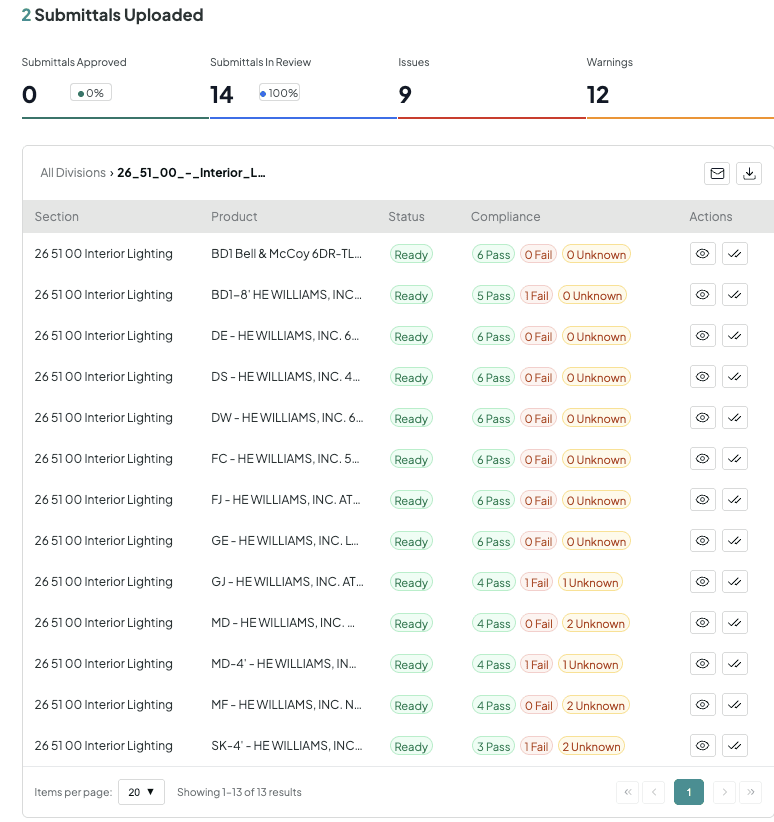
BuildSync handles Division 26 electrical submittals by breaking each package down to the product level first. A lighting submittal covering 14 fixture types gets separated into 14 individual compliance passes, each checked against the relevant spec section and equipment schedule.
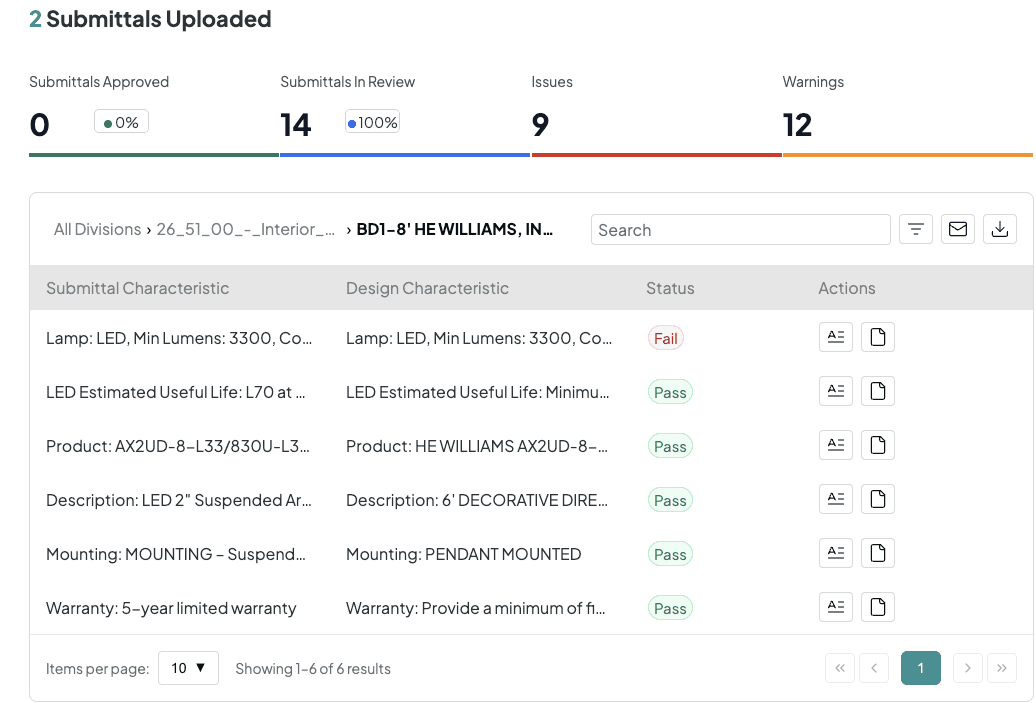
Lens configuration, DLC tier, dimming protocol, and photometric performance are extracted from the submittal and compared against the project specifications. Where the spec requires a specific characteristic and the submittal is silent, BuildSync flags it as unknown with a specific reason, giving the reviewer a concrete question to take back to the sub rather than a vague rejection.
For each determination, reviewers can pull up the source documents side by side: the submittal page on the left, the spec requirement on the right. That capability matters especially in Division 26, where a single missed lens spec or an incorrect DLC tier restarts the entire review cycle.
Ready to cut Division 26 rejection rates on your next commercial project? See BuildSync in action.
Frequently Asked Questions
What is the difference between Division 26 and the old Division 16?
Division 16 was the electrical section under MasterFormat's original 16-division structure, updated in 2004 when CSI expanded to 50 divisions. Division 26 covers the same electrical scope within a more granular six-digit numbering system that allows for cleaner cross-referencing across divisions. Some project specifications still reference Division 16 section numbers, so teams working with older spec templates should confirm which edition applies before beginning submittal preparation.
Does Division 26 cover low-voltage systems like data cabling and fire alarm?
How do substitution requests work for Division 26 electrical products?
Related reads for you
Discover more articles that align with your interests and keep exploring.


