Construction Technology & Innovation
/
Jun 30, 2026
Submittal Register: What It Is and How It Works
A submittal register is your project's single source of truth for submittal status. Here's what it is, what to track, and where most teams let it break down.


On most construction projects, the submittal register is the first document the project team builds and the one they trust the least by month three. It starts as a clean, complete list of every submittal the specifications require. Then submittals start moving, dates slip, and the register quietly drifts out of step with what is actually happening on the job.
So what is a submittal register, and why does something this simple cause so much trouble? At its core, a submittal register is the master list of every construction submittal a project requires, pulled from the contract documents before construction begins. It tells the general contractor and design team what has to be submitted, reviewed, and approved, and it anchors the entire construction submittal process.
This guide covers what the register is, what belongs in it, how it differs from the submittal log and submittal schedule, and where teams let it break down.
What a Submittal Register Is in the Construction Submittal Process
A submittal register is a structured list of all the submittals required on a construction project, organized by specification section. Each line is one required submittal item: a product data sheet, shop drawings, a material sample, or other technical documentation a subcontractor or contractor must submit for review and approval before that scope of work proceeds.
The register answers one question for the whole team: what does this project actually require us to submit? It is built from the project specifications, not invented by the project manager.
Every spec section that calls for product data, shop drawings, physical samples, or compliance certifications generates one or more entries. Guidance from AIA Contract Documents frames shop drawings, product data, and samples as the contractor’s representation of how the work will conform to the contract documents, which is exactly what the register plans for and tracks.
Think of the register as the source of truth that every other tracking tool inherits from. The submittal log, the submittal schedule, and the transmittal log all reference items that originate on the register. Get the register wrong, and every downstream document inherits the same gap.
What Belongs in a Good Submittal Log and Register
A good submittal log and register starts with the right fields. The goal is a clear picture of every submittal item, who owns it, and where it stands, without forcing the project team to dig through email or 200-page specifications to answer basic questions. At minimum, the register should capture:
Field | What it captures |
Specification section | The spec section that requires the submittal, tying each item back to the contract requirements. |
Submittal description and type | Product data, shop drawings, material sample, or another submittal type. |
Responsible subcontractor or contractor | Who prepares and submits the package. |
Due date | Submission dates that protect procurement lead times and keep work proceeding on schedule. |
Status | Submittal statuses such as not started, submitted, under review, approved, or revise and resubmit. |
Ball-in-court | Who owns the next action: the general contractor, the design team, or the sub. |
On most construction projects, this lives in a spreadsheet or inside project management software. A simple construction submittal log template handles the day-to-day tracking, but the register itself, the complete list of required submittal items, has to be right first.

Submittal Register vs. Submittal Log vs. Submittal Schedule
The register, the log, and the schedule are not the same document, and treating them as interchangeable is where document control starts to slip. Each has one job:
Document | Its job | The question it answers |
Submittal register | Defines scope | What does the project require us to submit? |
Submittal schedule | Defines timing | When does each submittal need to move? |
Submittal log | Defines status | Where does each submittal stand right now? |
Transmittal log | Defines the record of exchange | What was sent, and when? |
The distinction that matters most in practice: the register is comparatively stable, while the submittal log is dynamic. The register says a submittal is required; the log records what happened to it, including when it was submitted, who reviewed it, whether it was approved or returned, and how many review cycles it took. A good submittal log keeps the entire team on the same page about what is outstanding and what is cleared, but it can only track items the register already named.
How to Create a Submittal Register From Project Specifications
To create a submittal register, start with the project specifications and work section by section. The requirements live in two places: Division 01 (specifically the submittal procedures section, typically 01 33 00) sets the project-wide rules, and each technical specification section lists the specific submittals that section requires. CSI’s MasterFormat system is what organizes those specifications into the divisions and sections you read through. The process looks like this:
Read the Division 01 submittal procedures to capture project-wide rules for format, quantities, and review and approval timelines.
Go through each technical specification section and pull every required submittal: product data, shop drawings, samples, compliance certifications, and related documents.
Log each item on the register with its spec section, type, and responsible subcontractor.
Assign due dates that work backward from procurement and installation, so long-lead items get flagged early.
The format is the easy part. The reading is what takes the work. A commercial project can carry hundreds of submittal items spread across dozens of specification sections, and missing one means a required submittal never gets tracked at all.
The stakes rise during preconstruction on data center projects, where the register is built straight from the specs so every long-lead power and cooling item can be tied to a required-on-site date.

Where Submittal Registers Break Down on a Construction Project
Most submittal register problems trace back to one of three failures, and none of them are fixed by better status tracking:
The register is incomplete from day one. When one person manually combs through the specifications to build it, required submittals get missed. A spec section buried on page 140 calls for a product sample or a compliance certification, it never makes the list, and no one notices until the design team asks for it.
The register drifts. Submittals move, dates change, and the log stops matching reality. The project team loses the clear picture that the register was supposed to give them.
The register tracks existence, not compliance. It can tell you that a submittal was submitted and approved. It cannot tell you whether the product data inside actually met the project requirements. That gap is where rejections and field problems start, because a submittal can clear the log and still not match the specifications.
Tom Port, the co-founder of BuildSync, says:
I'd take a register that's slightly out of date over an incomplete register every time. You can update dates and statuses. You can't track something that was never identified in the first place. Once a required submittal is missed during the spec review, it often stays invisible until someone asks for it weeks later, and by then it's usually affecting procurement or the schedule.
When a Register Isn’t Enough: Verifying Compliance Requirements
A register and a log tell you what is required and where it stands. They do not tell you whether a submittal meets the specifications, and that is the difference between a tracked submittal and a compliant one.
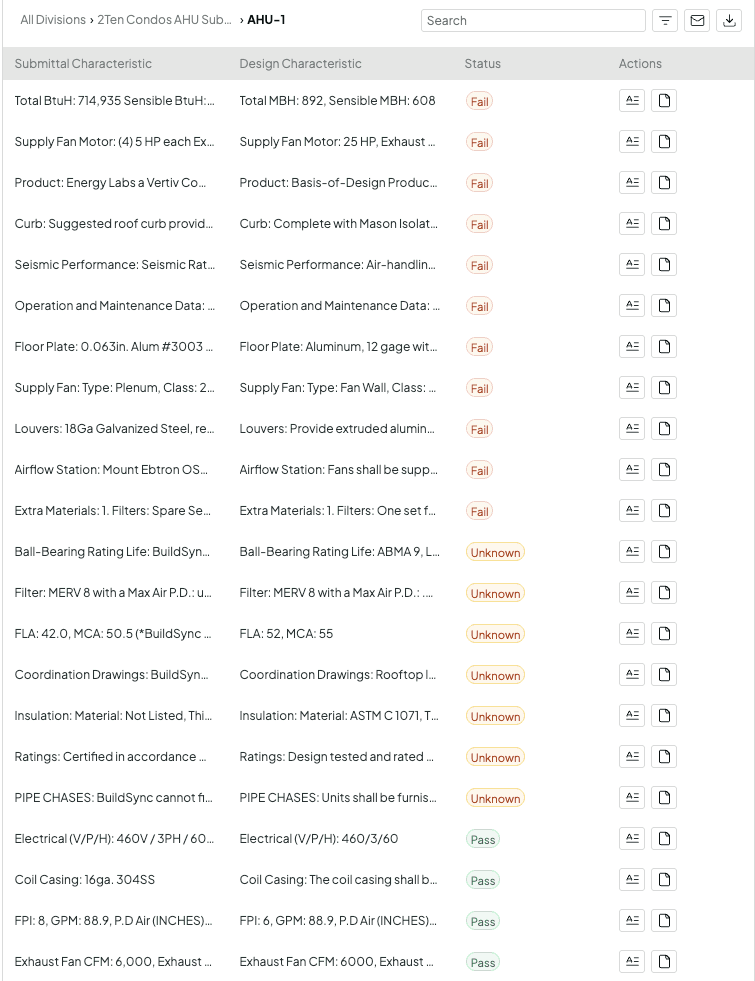
This is where AI-powered submittal review changes the math. Instead of stopping at “received and logged,” BuildSync extracts the technical characteristics from each construction submittal and checks every one against the project specifications, then marks each as pass, fail, or unknown with a link to the exact source in both the submittal and the specs. The register tells the team a submittal exists. Deep technical analysis tells them whether it actually complies.
The teams that feel this gap most are the ones running large registers with small staffs. Jacob Delargy, a project engineer at Monteith Construction, hit exactly that on a $100M+ school build: a small team managing a large submittal log, some of them new to the industry, working through a single submittal that ran 530 pages.
Running it through BuildSync surfaced specification requirements he would not have thought to reference on his own. That is the point: the register tells you what to check, and the technical analysis tells you whether each submittal actually passed.
Tom Port says:
There's a big difference between document control and technical review. Document control answers, 'Did we receive the submittal?' Technical review answers, 'Does it actually comply with the specification?' That's where most of the risk lives. A submittal can be complete, submitted on time, and still fail because one technical requirement doesn't match the contract documents.
Build the Register, Then Verify Every Submittal
Your register tells you what every construction submittal requires. BuildSync tells you whether each one actually meets the specifications before it reaches your design team.
Request a demo or contact the BuildSync team to see it on your next project.
Frequently Asked Questions
Why is a submittal register essential for project schedule management?
A submittal register is essential because it ties every required submittal to a spec section and a due date, so the project team can sequence submissions against procurement and installation lead times. Without it, long-lead items get submitted late, approvals stack up, and project delays cascade through the schedule. It gives the general contractor and project manager a single view of what has to move and when.
Who is responsible for maintaining the submittal register?
How early in a project should the submittal register be created?
Related reads for you
Discover more articles that align with your interests and keep exploring.


