Construction Technology & Innovation
/
Apr 17, 2026
Construction Closeout Submittals: Complete Guide & Checklist
The complete construction closeout submittals guide. Get a full checklist covering lien waivers, as-builts, O&M manuals & more. Close projects faster with BuildSync AI.


The physical work on a construction project is done. But in construction closeout, the work isn't finished. The punch list is closed. Subs have demobilized and moved on to their next job.
But the closeout documents aren't assembled, retainage is still on the table, and suddenly the project manager is spending weeks tracking down O&M manuals from vendors who stopped returning calls months ago. This is how most projects end, and it's almost entirely preventable.
The construction project closeout process has a reputation for being painful. It doesn't have to be. Most of the pain at project closeout is the result of decisions, and missed decisions, made during the project.
Understanding what's required, who's responsible, and why these problems usually originate months before the final walkthrough is what separates teams that handle construction closeout cleanly from those still chasing paperwork long after substantial completion.
What Are Construction Closeout Submittals?
Construction submittals are the documentation assembled at the end of a construction project to demonstrate compliance with the contract, transfer operational knowledge to the owner, and protect all parties from future disputes. They're distinct from the submittals exchanged throughout the project, which cover product data, shop drawings, and samples submitted for the design team's review.
Closeout documents represent the final stage of a construction project's paper trail. They confirm that installed equipment and systems match the approved specifications, that all warranties and certifications are in place, and that the facility has what it needs to operate.
Without complete closeout documents, the facility team is left guessing. Without complete closeout documents, the GC can't release retainage, the owner can't take meaningful possession of the completed structure, and nobody has a clean historical record to reference when something needs repair or renovation years down the road.
From a contract perspective, the obligation to deliver construction closeout documents is embedded in Division 01 of the project specifications. How those project specifications define scope and format will vary by project, but the requirement is universal across commercial construction projects.
Why Closeout Submittals Are Required and Who Is Responsible
Construction closeout documents are required because contractual obligations don't end when physical work ends. The general contractor is ultimately accountable for assembling the owner's project closeout package, even when the bottleneck is a subcontractor who hasn't delivered their portion of the documentation.
The chain of responsibility works like this:
Subcontractors and suppliers compile their respective warranty documentation, maintenance manuals, and compliance records, then submit them to the GC.
The GC reviews, organizes, and assembles the full package before delivering it to the owner.
The design team reviews the construction closeout documents to confirm that what's been submitted meets the project requirements specified in the contract documents.
The financial stakes in the closeout process are significant. The closeout process cannot conclude until the full package is delivered and accepted. Final payment, including retainage release, is typically conditional on delivering a complete closeout package. Incomplete or inaccurate documentation can hold up payments, trigger disputes, and damage relationships with owners and project stakeholders.
When a sub provides a standard one-year warranty and the specifications require ten years, that's not just an administrative oversight. It's a compliance failure with potential legal and financial consequences. Understanding your contractual obligations around closeout documentation is not optional.
The Complete Construction Closeout Submittal Checklist
What follows is a working construction closeout checklist organized by category. Use this construction closeout checklist as a starting point for construction project closeout planning. Project-specific requirements vary, so treat it as a baseline, not an exhaustive list.
For a standalone version you can track against your own projects, download the BuildSync Closeout Checklist here.
Legal and Financial Documents
These are the documents that protect the owner from financial risk and release the remaining contract balance. They must be airtight before final payment is processed.
Lien Waivers
Conditional and unconditional lien waivers from all subcontractors, sub-subcontractors, and material suppliers. These legal documents confirm that all parties in the payment chain have been paid. Collecting lien waivers throughout the project makes final lien waivers at closeout a formality, not a scramble. Don't sign unconditional final lien waivers until payment is in hand.
Final Payment Application
Submitted by the general contractor, reflecting the reconciled contract sum, approved change orders, and any final adjustments.
Consent of Surety
From the bonding company, authorizing final payment and release of retainage where required.
Final Affidavit / Sworn Statement
Confirms that all subcontractors and suppliers have been paid. Required before final payment is released on most commercial projects.
Record Documents
Record documents capture the completed project as built, not as originally designed. They're critical documents for the owner's long-term facility management and are among the most commonly incomplete items at closeout.
As-Built Drawings
Also called record drawings. Updated sets reflecting every field change made during construction, including where underground utilities were actually routed, how equipment was actually positioned, and any deviations from the original building plans. Final as-built drawings are produced by the design team using the contractor's redline markups as input. Incomplete or inaccurate redlines delay this process and are one of the most common reasons closeout drags past substantial completion.
Change Order Log
A complete record of every approved change order documenting completed work, including cost and schedule impact. This log is the paper trail for any scope changes that affected the final contract sum.
RFI Log
All requests for information submitted during the project, along with responses from the architect or engineer. These serve as a formal record of any clarifications or modifications to the contract documents and are frequently referenced during warranty disputes.
Approved Submittal Log
A documented record confirming that all required submittals were received, reviewed, and approved during the construction process. This log connects directly to the O&M manuals and warranty documentation that make up the rest of the closeout package.
Operation and Maintenance Manuals
Operation and maintenance manuals are compiled documents containing manufacturer instructions, maintenance procedures, technical specifications, and product data for all building systems and equipment.
Technical specifications from the project specs are the reference point for verifying that what's been installed is what was required. On commercial projects, the O&M package can run to multiple binders or a substantial digital archive. What goes into it depends on scope, but at minimum it should cover every major piece of equipment and every system on the project.
HVAC equipment: air handlers, boilers, chillers, VAV systems, exhaust fans, controls.
Plumbing and piping systems: pumps, fixtures, backflow preventers, water treatment. Much of the documentation in this section carries forward from the plumbing submittal package, including manufacturer data, certifications, warranty information, and operation and maintenance instructions.
Electrical systems: switchgear, panels, emergency generators, UPS systems, lighting controls.
Building envelope systems: roofing, glazing, waterproofing.
Specialty systems: fire suppression, security, elevators, medical gas (where applicable).
The O&M manuals component is where closeout and ongoing building operations connect. An owner whose facilities team has clear, complete operation and maintenance manuals can manage preventive maintenance, troubleshoot problems, and extend equipment life. An owner without them is guessing.
Warranties and Guarantees
Warranty records are one of the most legally significant items in the closeout package. It establishes the warranty period for each system and piece of equipment, identifies who is responsible for warranty service, and creates the baseline record for future disputes.
Manufacturer warranties confirming coverage for completed work and installed systems, confirming coverage terms and duration as specified in the contract specifications.
Contractor and subcontractor workmanship warranties for installed systems.
Roofing, waterproofing, and specialty warranties, which often carry longer terms and specific maintenance requirements that must be met to keep the warranty valid.
Certificates, Permits, and Inspection Reports
This category confirms that the completed project meets all regulatory requirements and has been formally accepted by the authorities having jurisdiction.
This category confirms that the completed project meets all regulatory requirements and has been formally accepted by the authorities having jurisdiction.
Certificate of Occupancy
The official certificate issued by the local building authority confirming that the building complies with building codes and is approved for its intended purpose. Without it, the owner cannot legally occupy the building.
The certificate of occupancy is often the trigger for several other closeout milestones, including final payment and retainage release. The application typically requires completed final inspections, commissioning reports, and a certificate of substantial completion. Schedule final inspections early. Late final inspections are one of the most common causes of certificate of occupancy delays.
Certificate of Substantial Completion
Issued once the project is sufficiently complete for the owner to take beneficial occupancy. The certificate of substantial completion formally establishes the date from which warranty periods begin to run and marks when retainage obligations begin to resolve. On multi-phase projects, a certificate of substantial completion is issued for each phase, and each one sets the warranty clock for that scope. Tracking these dates across phases is essential. Construction closeout on earlier phases cannot be considered complete until these records are filed.
Final Inspection Reports
From building officials, fire marshal, health department (for applicable project types), and any other authorities having jurisdiction. Final inspection reports confirm code compliance for structural, mechanical, electrical, and plumbing systems. These should be scheduled well before the target certificate of occupancy date to avoid last-minute delays.
Commissioning Reports
Confirming that all systems have been installed, tested, and verified to be operating per design intent. Final inspections for mechanical, electrical, and building automation systems typically reference these reports, so they need to be complete and accurate before inspections are scheduled.
Test and Balance Reports
For HVAC systems, confirming that equipment operates per design intent. Referenced during final inspections for mechanical systems and required as supporting documentation for the certificate of occupancy application on most commercial projects.
Pressure Test Reports
For plumbing and fire protection systems. Final inspections for these systems require this documentation, and missing or incomplete pressure test reports are a frequent cause of inspection delays.
Owner Training and Attic Stock
These items are frequently overlooked and frequently disputed at closeout.
Owner Training Documentation
When contractors or vendors are required to train the operations team on installed systems, those sessions need to be documented. Training records, sign-in sheets, and any materials distributed serve as proof of contractual fulfillment and a useful reference for operations staff going forward. If training is required by the specifications, undocumented sessions are the same as sessions that never happened.
Attic Stock and Spare Parts
Many specifications require contractors to leave a defined quantity of spare materials on site, including items like fan belts, filters, paint, ceiling tiles, and flooring. If the contract specifications called for spare fan belts and none were delivered, that's a compliance failure. It seems minor until those materials are needed on site and the contractor is no longer available. Document what was left, where it was stored, and confirm it matches what the specifications required.
Tired of chasing closeout documentation at the finish line? See how better submittal reviews earlier in the project change the outcome. Book a BuildSync demo.
Why the Closeout Package Tells the Story of the Whole Project
Here's the part most guides on project closeout don't say clearly enough: the quality of your closeout documents reflects the quality of your submittal review process throughout the project. The two are directly connected.
When a subcontractor submits product data early in a construction project and that data gets rubber-stamped through review, the problems don't disappear. They migrate into the construction closeout phase.
A piece of installed equipment that was never properly verified against the project specifications during review shows up at closeout as a warranty mismatch, a maintenance manual gap, or a spec deviation that the architect or engineer flags during the closeout review. What looked like a submittal review shortcut in month two becomes a weeks-long delay in month fourteen.
Teams that run tight, thorough submittal reviews throughout the project arrive at closeout with a clean compliance record, accurate as built drawings, and a documentation trail that supports the whole package.
Teams that were reactive, or that let the construction closeout process catch them unprepared, spend the final phase of a construction project closeout reassembling information they should have captured the first time.
Tom Port, the co-founder of BuildSync, when asked about the importance of closeout submittals, says:
Closeout is basically a reflection of how seriously you took submittals. If the review process was loose, you feel it at the end, missing docs, warranty issues, spec gaps. If it was tight, closeout becomes admin, not a fire drill.
This isn't an argument for any particular tool or approach. It's a structural observation about how construction projects work. The submittal review process is where the compliance record is built. Closeout is where it's presented.
How Submittal Compliance During Construction Shapes Your Closeout
Document collection shouldn't be a closeout activity. Construction project closeout is most manageable when it's treated as a continuous discipline, not a sprint at the end.
Progressive collection means the closeout package is assembled throughout the project, not scrambled together after substantial completion. In practice, that looks like this:
Instead of... | Do this |
Chasing O&M manuals at closeout | File warranty records and O&M manuals every time a product data submittal is approved |
Updating as-built drawings in bulk at the end | Mark up field changes as they happen |
Assembling the approved submittal log from memory | Maintain it as a running record throughout the construction phase |
By the time substantial completion is reached, the closeout package should be mostly assembled. The final phase is the wrong time to discover missing documentation.
Daniel Recktenwald, project manager at Monteith Construction, described the before-and-after clearly: before BuildSync, the submittal process was 'very slow and cumbersome,' and his team was 'often overwhelmed and missing problems.'
After implementing BuildSync, 'submittals have become something that is part of your day and not your whole week.' On a fast-track hospital renovation, that difference was the margin between staying on schedule and losing critical path time to submittal rejection cycles.
For teams managing high-volume or complex MEP submittals, our construction submittal review checklist is a useful reference for building out a review process that produces a clean compliance record through the project, not just at the end.
Construction Closeout Submittals for Multi-Phase Projects
Multi-phase construction projects require a rolling project closeout strategy that single-phase builds don't face. A multi-phase construction project has multiple substantial completion dates, which means the construction project closeout process must be managed continuously across the life of the project, not treated as a single event at the end.
The most common risk is document expiration. Three things regularly catch teams off guard:
Warranty clocks running early: Warranties issued at Phase 1 substantial completion have been running for 18 months by the time Phase 3 reaches substantial completion.
Compliance review requirements expiring quietly: Certifications issued by the local building authority for Phase 1 infrastructure may have ongoing requirements that are easy to miss when the project team is focused on later phases.
Commissioning reports going stale: Reports for early-phase systems may reference design parameters that were subsequently modified in later phases.
The practical approach is to organize the submittal log and project closeout schedule by phase from the beginning. Each phase should have its own closeout milestones built into the project schedule, with designated review dates and handoff requirements. The general contractor's PM needs visibility into closeout documentation status across all phases simultaneously. At this level of complexity, digital document management is not optional.
What the Assembled Closeout Package Should Look Like
There's no single universal format, but most commercial construction closeout packages are organized either by CSI division (following the MasterFormat structure used in the project specifications) or by building system. System-based organization is often more useful for the owner's facilities team, because their maintenance activities map to systems, not to specification numbers.
At a minimum, a complete closeout package for a commercial construction project should include clearly labeled volumes or sections covering:
Legal and financial documents
Record documents, including final as-built drawings
Operation and maintenance manuals
Warranties and guarantees
Inspection reports and certificates, including the certificate of occupancy
Training documentation
Digital delivery is now standard on most projects. The owner should receive a structured digital archive, with consistent file naming conventions and PDF format for all final documents. Some owners specify naming conventions and folder structure in the contract documents. If they don't, the GC should establish a convention early and apply it consistently throughout the project.
How the Review Process Feeds the Closeout Package
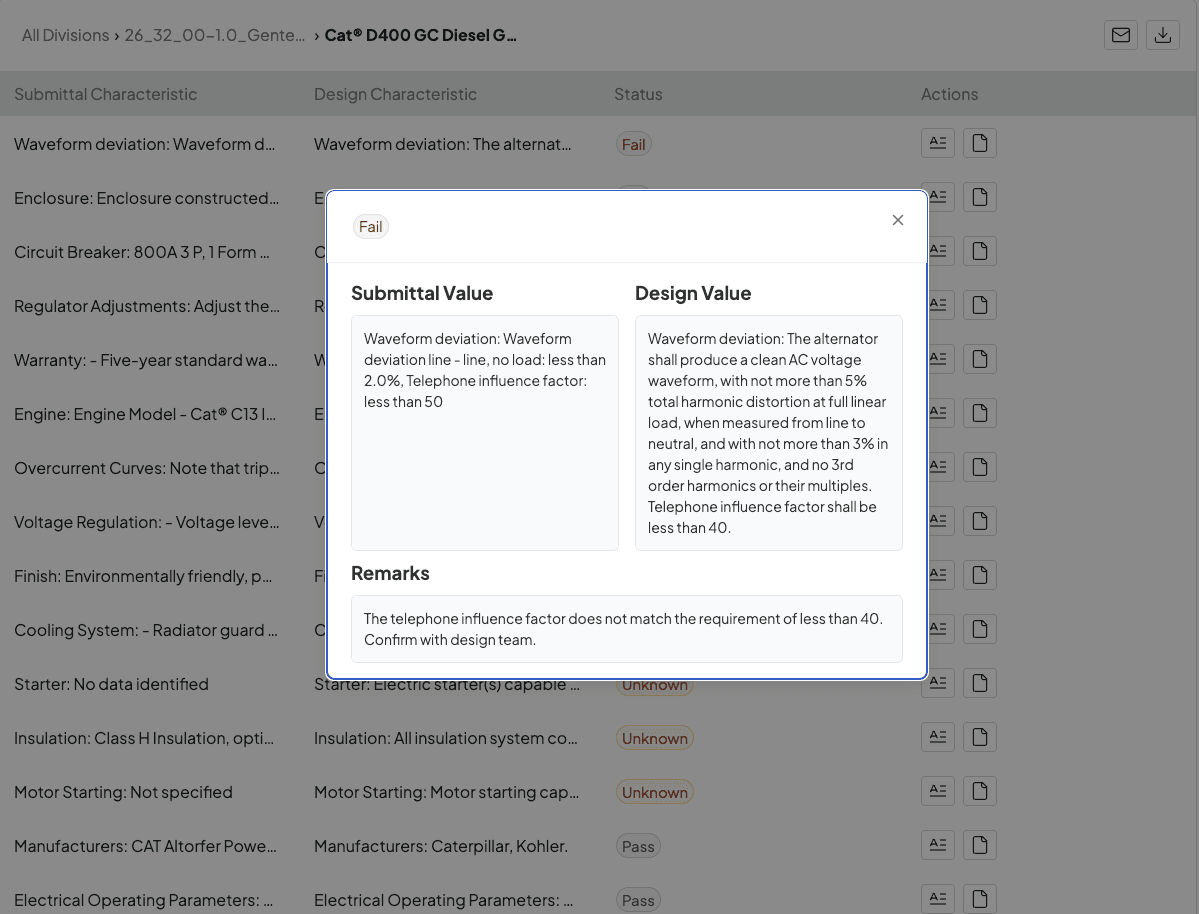
What ends up in that package is a direct reflection of how submittals were reviewed during the project. When BuildSync reviews a submittal, it generates a compliance report showing every technical characteristic extracted, every pass, fail, and unknown, and the source document reference for each.
That documentation, produced systematically throughout the project, doesn't just help the PM respond to rejections faster. It creates a traceable compliance record that feeds directly into the construction closeout documents.
For teams looking at how long submittal reviews actually take and what drives that time investment, the calculation changes significantly when the review process also generates documentation that carries forward to closeout. Time spent doing thorough reviews is time that doesn't have to be spent rebuilding the compliance record at the end of the project.
The best closeout starts on day one. BuildSync helps GC teams run thorough submittal reviews throughout the project, so the compliance record is built progressively, not reassembled at the end. See how it works - book a demo.
Frequently Asked Questions
Why do contractors struggle to complete closeout submittals on time?
Most project closeout problems originate well before the closeout process begins. By the time the final phase arrives, subs have demobilized and documentation that should have been collected progressively is now the subject of a scramble. The construction teams that consistently close on time treat closeout documents as a project-long activity. Submittals feed into the O&M package. As-built drawings stay current. Warranties are tracked against the contract specifications from the start. The construction closeout process rewards that preparation.
What happens if a subcontractor won't deliver their closeout documents?
How should construction project closeout documentation be organized for future reference?
Related reads for you
Discover more articles that align with your interests and keep exploring.


