Construction Technology & Innovation
/
May 29, 2026
BuildSync vs. Traditional Submittal Review: What's the Difference
Traditional submittal review means hours of manual cross-referencing, inconsistent results across your team, and rejection rates that push project timelines out by weeks. Here's what changes when AI handles the technical analysis instead.


A submittal comes back rejected three weeks after you sent it. The flag is buried on page 47 of the spec: a light transmittance value the sub missed, and that your reviewer missed too. Nobody was careless. The submittal process just asked too much of too few people across too many submittals, and something slipped through.
That gap is exactly what BuildSync vs. traditional submittal review comes down to: not speed, not digitization, but whether the expert judgment layer of the construction submittal review process is actually happening on every submittal, every time.
For teams processing large volumes of construction submittals and submittal reviews on active building projects, that question has a real dollar answer.
What the construction submittal process actually looks like
The construction submittal process has not changed much in decades. Subcontractors prepare product data sheets, material samples, and shop drawings, which get submitted to the GC where a project engineer or PM opens the submittals in one window, pulls up the project specifications in another, and starts comparing. The tools vary across construction teams: a submittal schedule and tracking sheet, a printed spec with a highlighter, or some combination of both.
For a two-page equipment submittal that workflow might take 20 minutes. For a complex AHU or lighting package spanning multiple spec sections, reviewing those submittals can eat most of a day, and the tasks involved, pulling characteristics from documents, cross-referencing spec requirements, tracking what passed and what did not, are time-intensive even with good tools.
A construction submittal review template can add structure, but the core constraint stays the same: review quality depends entirely on who's doing it and how much time they have.
Where construction submittals review breaks down (and why it's not a people problem)
The problem with a high submittal rejection rate is rarely that someone is not doing their job. It is structural, and it shows up across construction sites in every segment of the industry. Engineers and general contractors must hold the full technical scope of the building in their head, know which spec sections govern which submitted products, and catch discrepancies across potentially hundreds of submittals. Reviewing construction submittals is busy work when done manually at scale: a junior PE may not yet know a rooftop unit spec typically calls out specific refrigerants, and a PM managing six active construction projects may not have time to work through 70 pages of submitted specs on a diffuser package.
Research from Autodesk and FMI's Construction Disconnected report found that construction professionals spend more than 14 hours per week on non-productive tasks, including hunting through documents and resolving documentation conflicts.
Submittal reviews are one of the biggest contributors to that load across the industry, and the result is inconsistent review quality across teams, contractors, and experience levels on any given construction site. TThat inconsistency can contribute to the 30–40% rejection rate seen across the industry. GCs and subs don't always agree on what a good submittal rejection rate actually looks like, since the benchmark can shift depending on which side of the review you sit on. Better tools and submittal software address the underlying process directly. The industry's rejection problem isn't simply a people problem—it's also a workload, process, and information problem.
What BuildSync does differently with automated submittal reviews
BuildSync is a submittal review software built to automate the technical analysis layer of review: extracting every relevant data point from a submittal, matching it against what the plans and specifications require, and flagging anything that falls outside design intent or contract requirements.
Where tech tools in construction have historically focused on digitizing the paper workflow, BuildSync targets the cognitive labor of reading and judging the submitted documents themselves.
When a user uploads construction submittals into the platform, BuildSync runs a three-step automation process:
Break down to product level: Each submittal is separated into its individual products. A VAV submittal with shared equipment sheets gets split out by tag, so nothing gets evaluated in aggregate.
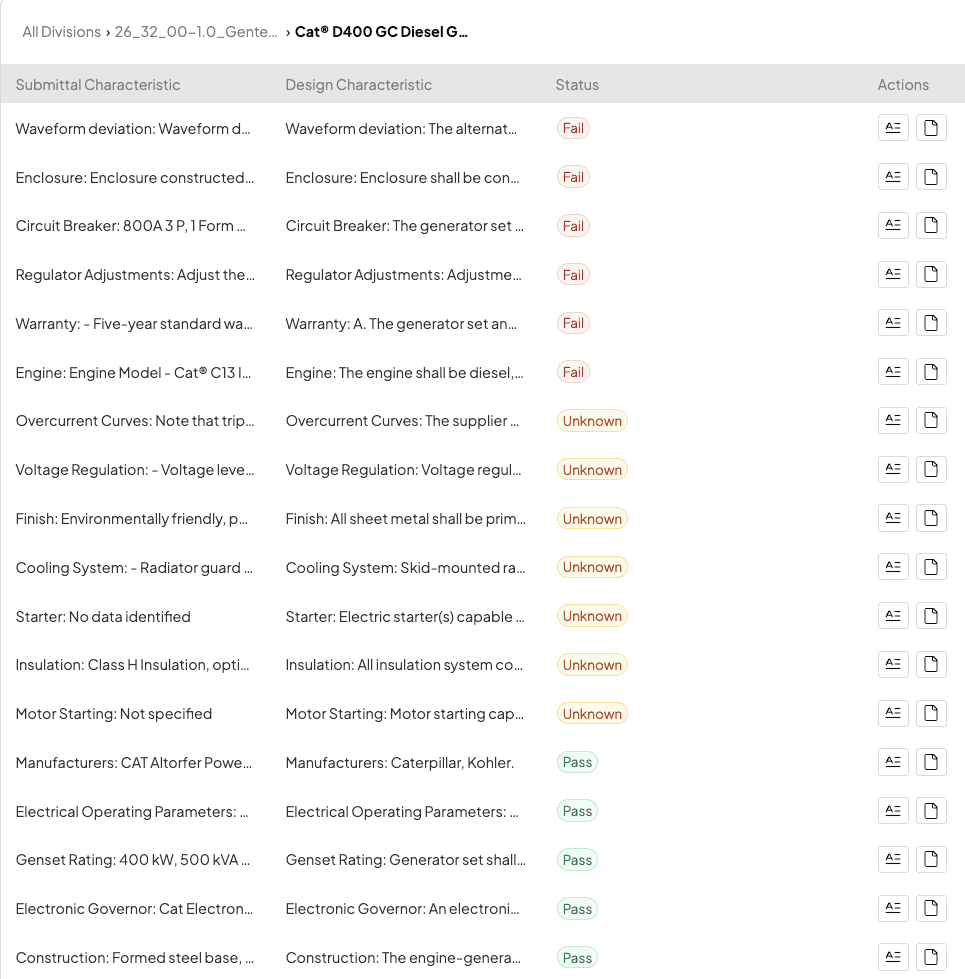
Extract technical characteristics: For each product, BuildSync pulls dimensions, ratings, refrigerant type, coatings, certifications, warranty terms, and more.
Compare against spec requirements: Each characteristic is assigned Pass, Fail, or Unknown. Unknown isn't a failure to read the document; it means the information is missing from the submittals or the drawings, and BuildSync notes why so the reviewer has a specific question to send the subcontractor before anything reaches the design team.
Users get a structured view of every characteristic across every product, without reading through stacks of submittal documents. That workflow consistency is what makes it possible for teams to run submittal reviews at a scale that manual tools cannot match.
The natural follow-up is whether does this kind of tool stunt the learning curve for newer reviewers, or whether seeing the comparison laid out actually speeds it up.
Trust but verify: how BuildSync keeps engineers in control
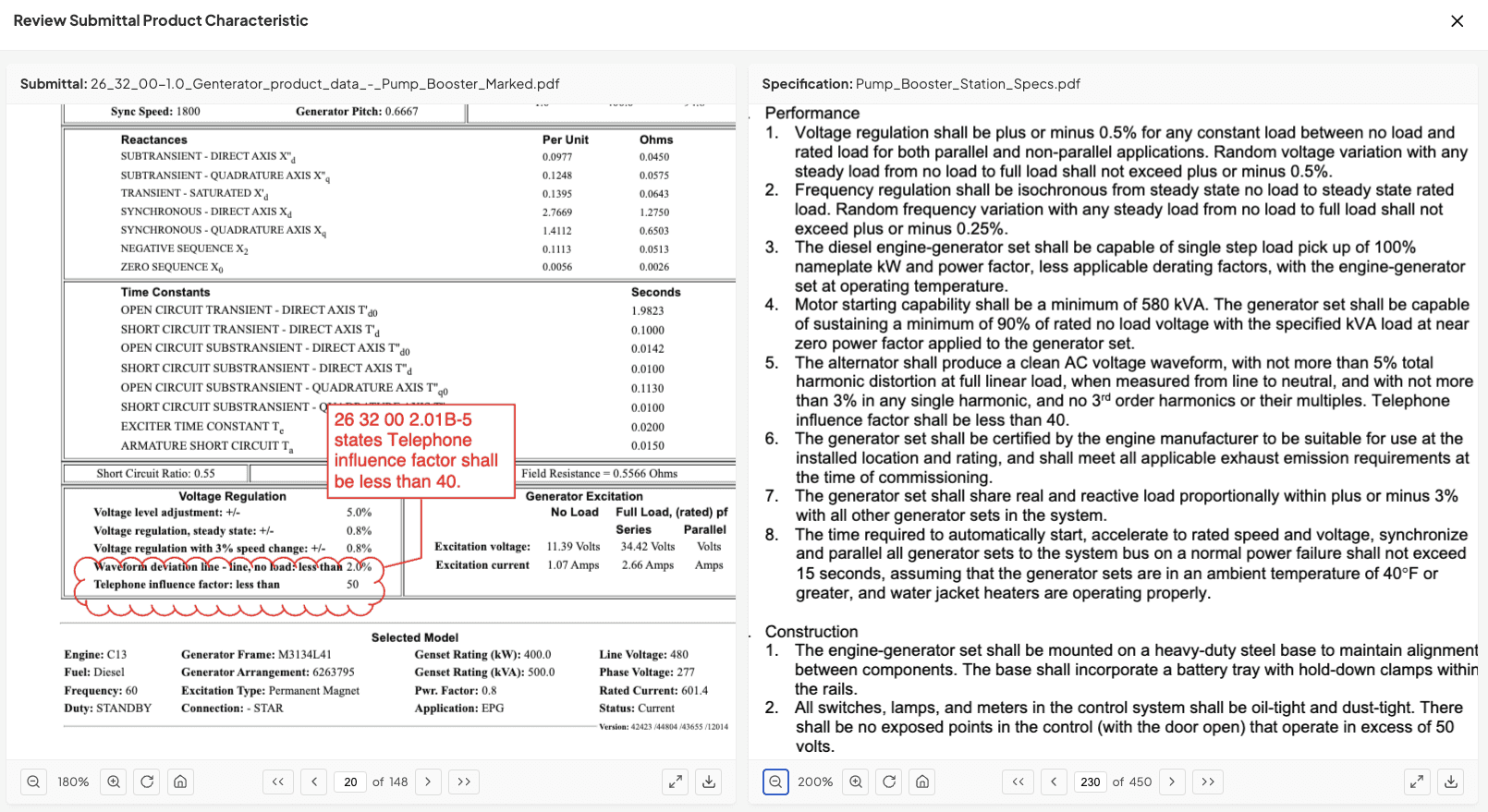
For every technical characteristic BuildSync extracts, users can click through to the original source documents side by side: the submittal page on the left, the relevant spec or drawings page on the right, with the specific value highlighted. There is no hunting through construction documents to confirm a flag, and BuildSync's support team is live in the platform for any questions that need a human answer.
This matters most for newer project engineers. BuildSync does not replace the judgment of a structural engineer or MEP designer, but it gives a PE still building their technical knowledge a guided map of what to look for in the specification.
That spec compliance depth is what otherwise takes years to develop manually. The platform also handles contradictions between plans and specifications: when a schedule and a spec section call for different materials, both characteristics are flagged and the more stringent requirement is identified, giving architects and engineers the information they need to clarify rather than reject.
Tom Port, the co-founder of BuildSync, says:
“Even experienced teams miss highly niche details buried across multiple documents. We see things like a rooftop unit submitted at 208V when the electrical schedule calls for 480V, or a standard NEMA 1 enclosure submitted when the spec requires NEMA 12 for a mechanical room. The issue usually isn’t technical capability, it’s the cognitive load of manually cross-referencing hundreds of characteristics across specs, schedules, and submittals under time pressure.”
The consistency problem that submittal software solves
Saving 70 to 80% of time otherwise spent on manual submittal reviews is significant. But the less-discussed value is what happens to review quality across construction teams over time.
BuildSync normalizes the floor of that review across contractors, teams, and experience levels: the junior PE on their second building project runs the same technical analysis as the 15-year veteran, because the automation is consistent regardless of who initiates it. Without submittal software that enforces this consistency, the floor is set by whoever has the least experience on the job.
Documentation of what was checked, and what was missed, is almost nonexistent. The tools a team uses to process submittals directly determine the approval rate they can sustain across a large submittal log, and industry experience at GCs of every size confirms this gap is real. Automation does not replace the reviewer; it raises the baseline of what every reviewer catches.
The real cost of rejected submittals most project teams don't calculate
Every rejected submittal adds at least two weeks to the project timeline, and for teams processing hundreds of submittals per year it compounds fast. BuildSync's own research, drawn from surveys of more than 6,000 construction professionals, found that each rejected submittal costs $805 on average when weighted across impact levels, from administrative friction on minor rejections to schedule compression and liquidated damages on the worst cases. For a GC processing 2,000 submittals per year at a 30% rejection rate, that works out to $483,000 in avoidable annual costs.
For a GC processing 2,000 submittals per year at a 30% rejection rate, that is over $480,000 in annual rejection costs. AI tools that automate submittal reviews against project specifications drive teams toward a 90-95% first-time approval rate, and customers typically see that improvement within 120 days.
To see what submittal rejections are costing your projects, use the BuildSync ROI calculator.
How Monteith Construction changed their review workflow with BuildSync
Monteith Construction, a commercial GC running building projects from $5M to $100M-plus, was managing a large volume of submittals across multiple active construction projects with engineers at different experience levels.
PM Daniel Recktenwald described it in the Blueprints to Bedside case study: "Before BuildSync we were moving through submittals like quicksand, often overwhelmed and missing problems.
After BuildSync, submittals have become something that is part of your day and not your whole week." His team cut review time by 70% and halved their failure rate. On a large hospital renovation with a compressed schedule, that capacity made the difference between staying on track and falling behind.
What changes when you use BuildSync instead of manual submittal reviews
The difference shows up at every stage of the workflow.
Stage | Traditional review | BuildSync |
Upload | A reviewer sits down and starts reading through submitted documents from scratch | BuildSync begins extracting and comparing immediately; the technical analysis is complete before anyone opens the review |
During review | Reading through 70 pages of construction documents front to back, manually cross-referencing specs | A structured list of characteristics with Pass/Fail/Unknown flags and one-click source verification; job shifts from extraction to judgment |
Output | A pencil-whipped compliance sheet, or nothing at all | A detailed compliance report and a marked-up copy of the submittal with failures annotated directly on the documents |
Architects and contractors who receive submittals with documented compliance reports process them faster and with more trust in the teams that submitted them. On any building site where the schedule is tight, that approval advantage is real: clean submittals move to the front of the review queue.
When asked about the reaction he sees from project managers or engineers who review submittals through BuildSync for the first time, Tom Port says:
“The reaction is usually the same: ‘I didn’t realize how much we were missing.’ Not because their teams were doing a bad job, but because BuildSync surfaces technical characteristics that are incredibly difficult to consistently catch manually across hundreds of pages and multiple spec sections. A lot of engineers tell us the biggest shift is that they stop spending their time hunting for information and start spending it applying judgment.”
Is BuildSync the right submittal software for every use case?
Honestly, it depends. BuildSync is built for complexity: MEP equipment packages, high-stakes long-lead items, construction submittals where missing one technical characteristic has real schedule or cost consequences for building delivery.
The approval bottlenecks on data center builds are a good example, since one missed characteristic on a redundant UPS or CRAH tag repeats across every unit.
A two-page equipment submittal you can clear in five minutes probably does not need automated submittal software at $25 per submittal. On complex HVAC construction submittals in particular, the gap between what manual review catches and what BuildSync surfaces across the submitted documents is most visible.
For a closer look at what mechanical packages require, the HVAC submittal package guide covers what to include and how to structure documentation that gets approved the first time. BuildSync also does not review shop drawings: the platform is built for equipment submittals and product information documents that confirm proposed materials meet design intent and contract requirements.
The tools teams need for shop drawing review are separate, and general contractors or subcontractors who run both workflows typically keep them distinct.
Try BuildSync free on your most complex submittals. Upload your plans and specs, run a submittal, and see the compliance report before you commit. No spam, no mandatory sales call.
Frequently asked questions about BuildSync vs. traditional submittal reviews
Does BuildSync work when a submittal references multiple spec sections at once?
Yes. BuildSync pulls in all relevant spec sections when evaluating submittals, not just the primary division, and captures requirements across multiple sections simultaneously. Jacob Delargy at Monteith Construction noted that BuildSync flagged cross-references to spec sections he would not have thought to check manually when reviewing submittals, reflecting them in the compliance report and final project documents.
How does BuildSync handle contradicting plans and specifications?
Can subcontractors use BuildSync to pre-check their own submittals before sending them to the GC?
Related reads for you
Discover more articles that align with your interests and keep exploring.


