Construction Technology & Innovation
/
Aug 3, 2026
How to Use AI to Generate a Submittal Package
How AI builds a submittal package from your specs: extracting requirements, pulling product data, and assembling a compliant package in minutes, not hours.


Every mechanical and electrical sub knows the drill. A new spec section drops, and before you can order anything, someone has to read all of it, pull out every requirement, and match product data sheets to each one. An AI submittal package builder promises to take that off your plate.
But if you've spent years assembling construction submittals by hand, "let the software do it" sounds like a stretch. Here's what actually happens when AI generates a submittal package, and where you still stay in the driver's seat.
Why the manual submittal process eats your week
The manual submittal process rarely breaks down at assembly. It breaks down at the requirements, because they're buried. A single mechanical spec section can run 40 or 50 pages, and every dimension, rating, material, and certification hides somewhere in that text. Miss one line, the package comes back from the design team rejected, and the whole approval process restarts from zero. The construction submittal process hasn't changed much in decades, and it still punishes a single oversight.
The time cost is real. Industry research from FMI found construction teams lose more than 14 hours a week to non-optimal work, including hours spent hunting down project data like revised drawings and material cut sheets. For a specialty contractor juggling multiple submittals across several construction projects, that's most of a workday gone before any real building happens.
There's a dollar figure too. BuildSync's research across thousands of construction professionals puts the cost of a rejected submittal at $805 on average, once you count the coordination, the resubmission, and the schedule slip. Getting construction submittals right the first time protects your margin.
What an AI submittal package generator actually does
Think of package generation as the review process run in reverse. Instead of checking a finished package against the specs, AI submittal package generation starts from the project specifications and works outward. It reads the requirements first, then builds the package to match. Three things happen under the hood, and none of them cut you out of the submittal process.
It reads the spec section and extracts every requirement
BuildSync reads your spec section and pulls out every submittal requirement on its own: dimensions, materials, performance ratings, certifications, and installation instructions. No combing through 100 pages hoping you caught the one line that matters. The system organizes those requirements the way your contract documents do, by spec section, so nothing drifts out of place.
It matches compliant product data to each requirement
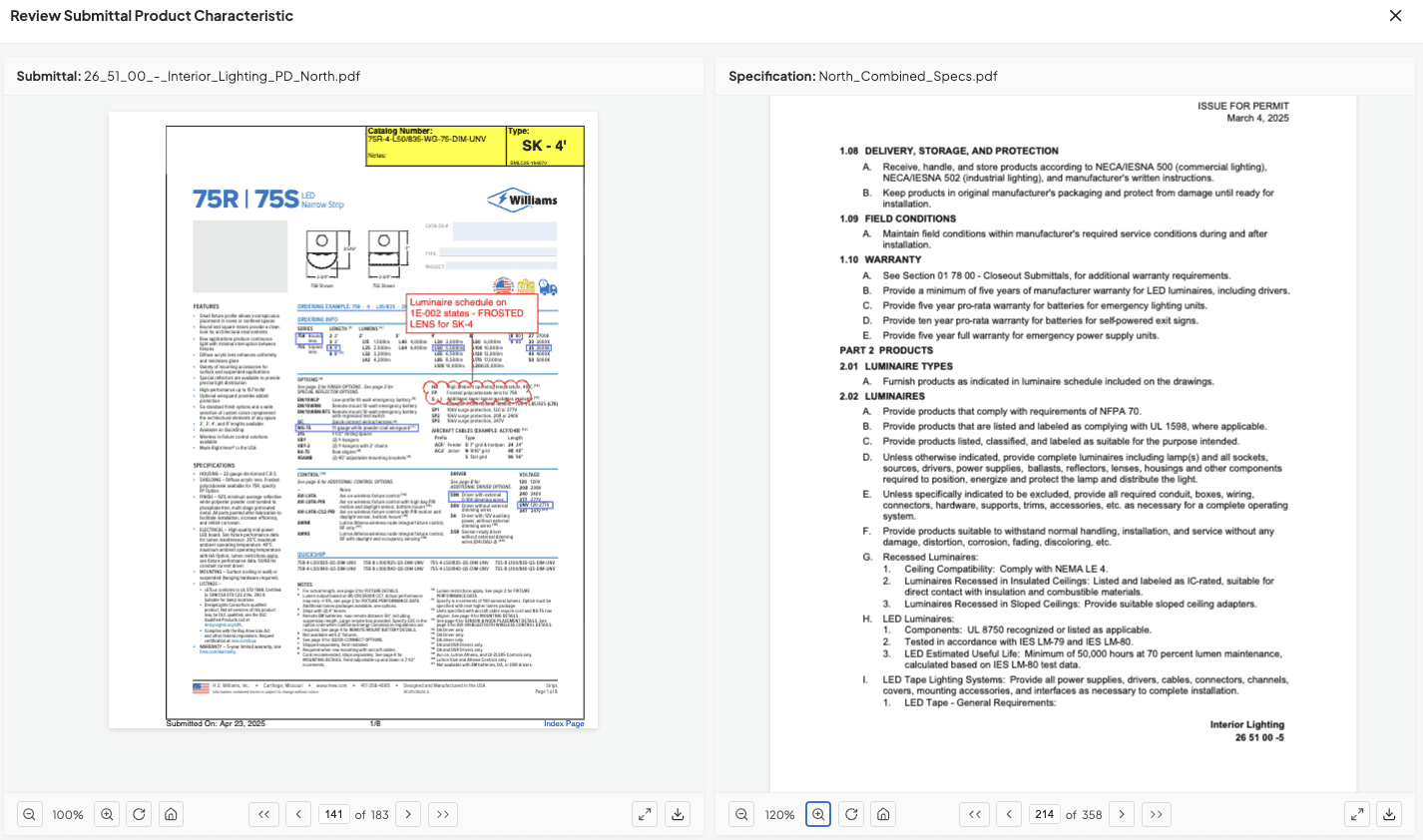
Next, BuildSync cross-references those project requirements against product data, matching cut sheets and technical data to each spec line. You get a set of submittal items that actually meet the requirements, with each product data sheet already checked for the dimensions, ratings, and proposed materials the specs call for. That's the difference between guessing and submitting with proof.
It assembles a review-ready package and hands it back to you
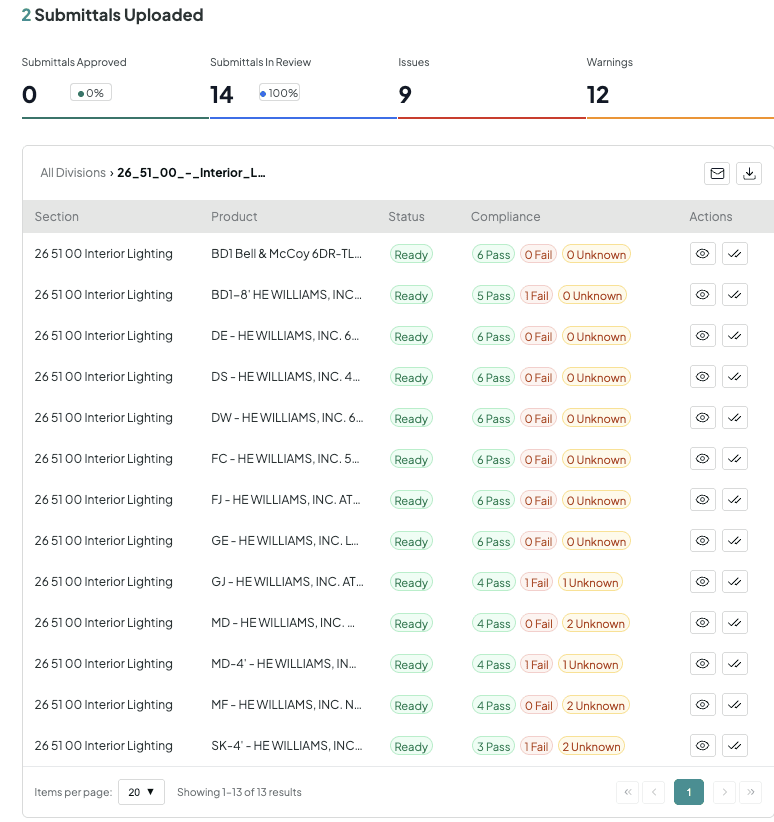
Finally, BuildSync assembles the pieces into a complete submittal package, organized by spec section and ready for review and approval. Here's the part that matters: the package comes back to you, not straight to the general contractor. You're the responsible contractor. You review what the system built, adjust anything your field knowledge tells you to, and send it on for final approval. Trust but verify. The AI does the heavy lifting, and the human keeps the final call.
When asked what safeguards were intentionally built into the generation engine, and why subcontractors still own the final submittal package before it goes out, Tom Port, the co-founder of BuildSync, says:
When we built the generation engine, one thing we were adamant about was that the AI would never make the final decision.
It's there to do the heavy lifting, reading the specs, pulling out the requirements, matching products but the subcontractor is still the expert.
They know the job, they know the customer, and they're the ones signing their name to that package. We wanted AI to save hours of work, not take away accountability.
Where AI generation beats basic submittal software
Plenty of tools call themselves submittal software, but most of them just move files around. They give you a folder, a submittal register, and a place to track submittal status. That helps with managing submittals, but those tools don't read your specs or check a single product against them. Others are tied to a single manufacturer's catalog, so they only compile that vendor's data sheets, not whatever product meets your spec. Either way, you still do all the technical work by hand. To see what a complete, compliant submittal package includes, this guide walks through a real example section by section.
Some subs solve that gap by choosing to outsource that work to a third-party firm instead of building in-house, a decision that comes with its own cost and control tradeoffs.
Deep construction submittal software reads the specs and does the matching, so construction submittals trace back to real requirements instead of best guesses. Package generation is one use case among several, and this guide to AI tools built for construction teams shows where it sits next to takeoff, scheduling, and field documentation software.
A full submittal package can include product data, shop drawings, and material samples, and each piece has to tie to something in the specs.
BuildSync focuses on the product data side, extracting and matching technical characteristics rather than reviewing shop drawings. And when the design changes mid-project, drawing change detection flags which revisions affect packages you've already built, so you're not rebuilding blind.
When asked what critical step most submittal package builders skip that leads to rejected submissions, Tom Port, the co-founder of BuildSync, says:
The industry doesn't have a file organization problem, it has a specification interpretation problem.
That's where the hours disappear, and that's where mistakes creep in. We built BuildSync to understand the spec first, because once you know exactly what's being asked for, building the package becomes much more straightforward.
Does it handle HVAC and electrical construction submittals?
Right now, package generation is strongest for mechanical and HVAC work, with electrical rolling out as the next phase. If you're a mechanical sub building an air handler or RTU package, the system already knows how to read those spec sections and match the equipment. Electrical subs, whose construction submittals often run even longer and more complex, are next in line.
The reason for the phased rollout is accuracy. BuildSync would rather do one trade extremely well than do every trade at 70 percent. For specialty contractors, that means the packages you generate today hold up under a real design team review, not just a demo. On most construction projects, that reliability is what earns the software a permanent spot in your submittal process.
Can you trust an AI-built submittal package?
Yes, but you should verify it, and BuildSync is built for exactly that. Skepticism about AI reading technical documents is fair, because the stakes are high and a bad package damages your standing with the design team and the project owner. So every requirement the system extracts and every product it matches links back to the source, letting you check the work against the actual specs in seconds and ensure compliance before anything ships.
This is also why the human stays in the loop. AI doesn't replace the project engineer or the quality control a good sub brings. It gives you a running head start and a clearer view of design intent, then leaves the judgment to you. The fastest way to believe it is to run your own spec section through it. Upload a real one, see what comes back, and check it line by line.
When asked how a mechanical subcontractor can quickly verify the accuracy of their first AI-generated PVF submittal package, Tom Port, the co-founder of BuildSync, says:
Treat it like a new member of your team. You wouldn't blindly trust their work on day one, but you'd review it. Do the same with BuildSync. Check a few requirements, follow the links back to the spec, and before long you'll realize it's doing the tedious work while you're focused on the engineering decisions.
Try BuildSync free on one of your most complex spec sections, or book a demo to watch package generation work on a live project.
Frequently asked questions
How is generating a submittal package different from a submittal register or log?
A submittal register or submittal log tracks status: what's been sent, what's pending, and what's approved. Generating a submittal package is the upstream work of creating it, reading the specs and matching product data before anything reaches the submittal log. You still keep a register for tracking submittals; AI just fills the submittal log with better-built packages.
What are the benefits of cloud-based construction submittal software?
Do you still need a project engineer if AI builds the submittal package?
Related reads for you
Discover more articles that align with your interests and keep exploring.


