Construction Technology & Innovation
/
Aug 1, 2026
Submittal Package Example: What to Include + Free Template
See a real construction submittal package example, a full breakdown of what goes in each section, and a free template to build packages that get approved.


Most guides on the submittal process hand you a checklist and stop there. This one is different. It walks through a real submittal package example, section by section, so you can see what a complete package looks like before you build or review your own.
The example is a Division 23 rooftop unit package, the kind of mechanical submittal that shows up on most commercial construction projects.
By the end, you'll know what goes in each part of the package, where the costly gaps hide, and how to turn the structure into a repeatable format your project team can reuse.
What goes into a complete construction submittal package
A construction submittal package is the documented proof that a proposed product meets the project requirements before anyone orders equipment or starts work, and it anchors the submittal process.
Most construction submittal packages follow the same backbone, whether the trade is mechanical, electrical, or plumbing. A plumbing submittal package follows that same structure but replaces some trade-specific documents—such as equipment schedules—with fixture schedules and flow-rate data. A complete package typically includes six core components, and well-organized submittal documents move through review faster:
A cover sheet carrying the transmittal details: submittal number, spec section, product and tag, submitting contractor, and date.
A compliance matrix that maps each submittal value against the project specifications.
Product data sheets, the manufacturer's cut sheets, covering the technical specifications for each product.
Certifications and listings that prove the product meets required standards.
Installation instructions, required clearances, and any material samples the spec calls for.
Closeout and extra-materials items, such as spare parts and warranties.
Product data covers off-the-shelf equipment. Shop drawings, by contrast, show how a custom element will be fabricated, so a package may include either or both.
Subcontractors submit shop drawings when a component must be built to order. All of this technical documentation gets organized by spec division, following CSI's MasterFormat, the standard that keeps everyone referencing the same numbering as they manage submittals across the submittal process.

A submittal package, section by section
Here's how those parts come together on an actual submittal. The example is a rooftop unit package under spec section 23, covering two equipment schedules: 17 packaged rooftop units and 24 precedent unitary rooftop units. A general-conformance review of the package checked 19 technical characteristics against the specs. Three passed, two failed, and 14 came back unknown. You can download the full review report to follow along.
DOWNLOAD: BuildSync Rooftop Unit submittal review report (Excel)
The cover sheet and transmittal details
The cover sheet is the first thing a reviewer sees, and it sets the tone. In this example, it carries the specification section, the submission date, and a stamp block where the reviewer signs off on general conformance, a standard practice for design-side review before a submittal moves further down the chain.
Tagging the package to the correct spec section division is what lets a general contractor route it to the right reviewer and keeps approval timelines from slipping. A clean cover sheet also feeds the submittal log, so status updates stay accurate as the package moves through the approval process toward final approval.
Product data and the technical specifications that get missed
The cut sheets carry the technical details a reviewer has to verify: economizer control type, heat exchanger material, casing finish, access doors, drain pans, fan motors, controls, and warranty terms. Across the 41 total units on this package, that's a lot of individual specifications to track by hand.
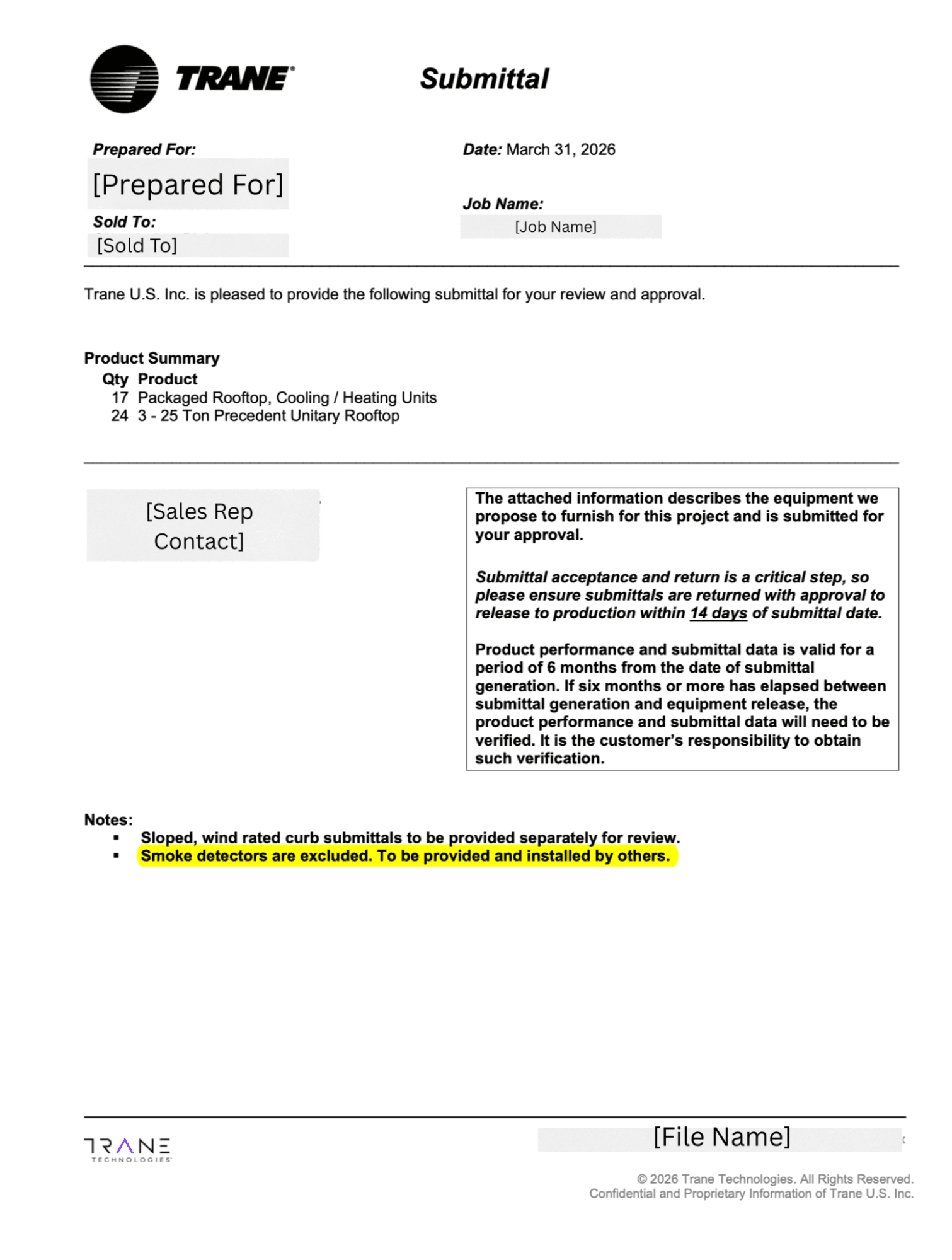
Caption: Product summary page showing the Trane submittal cover, product quantities (17 packaged rooftop units, 24 precedent unitary rooftop units), and submittal terms.
On this package, most characteristics checked line up with the specifications. The two that don't show exactly how a fail hides in plain sight. One unit's economizer is submitted with reference enthalpy control where the specs call for dual enthalpy control with power exhaust. Separately, a heat exchanger is submitted in aluminized steel where the specs call for stainless steel. Both sit buried inside a dense block of bullet-point spec text, not called out on their own, which is exactly how a reviewer moving at speed can miss them.
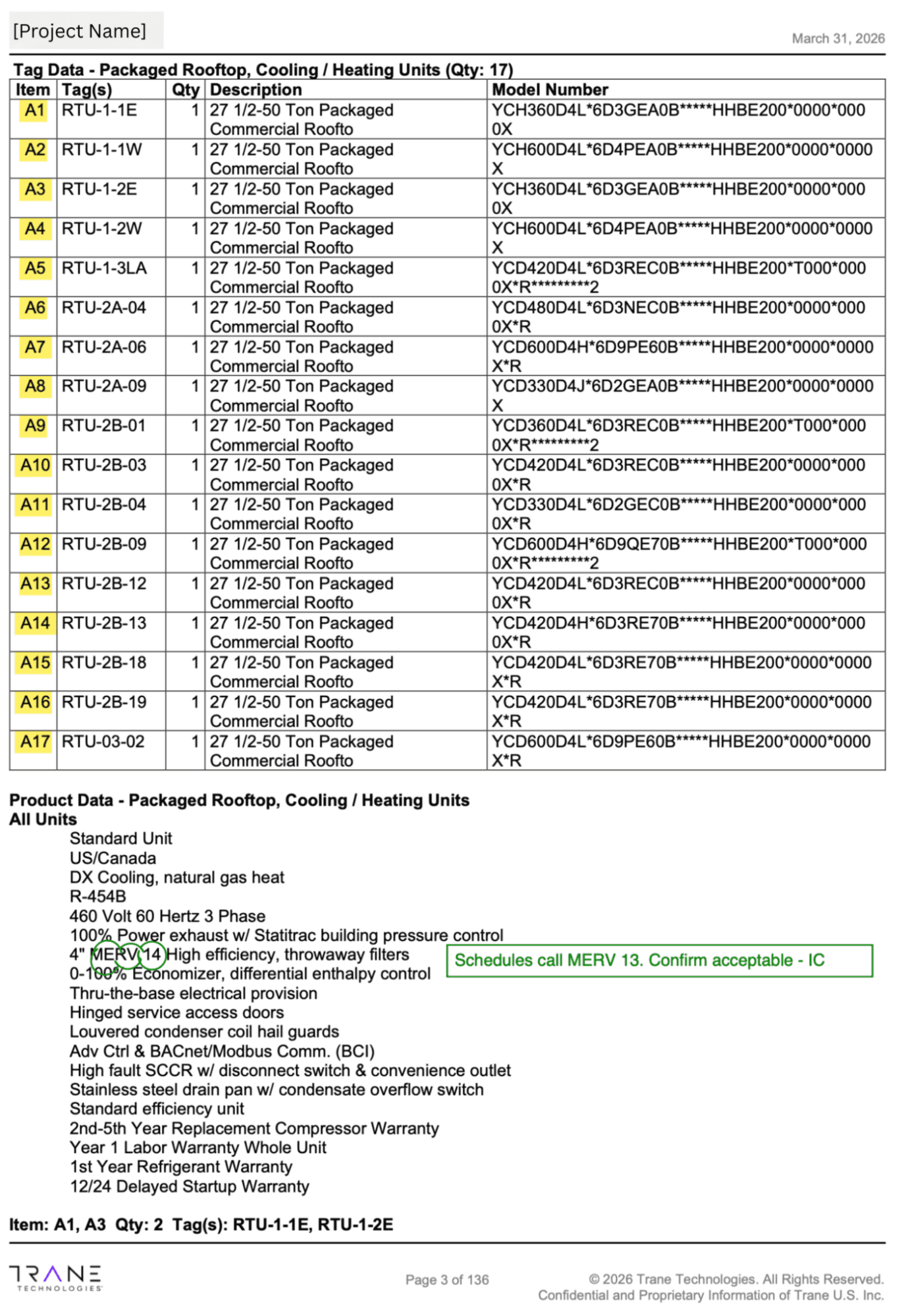
Caption: Tag data and product data page showing the model number table and full bullet-point specification list for the packaged rooftop units.
Certifications, warranties, and the closeout items teams forget
Certifications, listings, and installation instructions round out the relevant documents, and the package should spell out installation methods and any detailed instructions the spec requires. The items most often missed sit at the end, or buried mid-list where a quick read skips past them.
In this example, 14 of the 19 characteristics checked came back unknown, not wrong, just not confirmed. Casing finish, access door hardware, drain pan configuration, fan motor grounding, and disconnect switch ratings all needed a vendor to confirm before the submittal could be signed off with confidence.
None of these are dramatic alone, but each becomes a project closeout headache when it slips through unconfirmed. Logging them against the submittal schedule before submission keeps closeout from becoming a scramble and protects on-time project completion.
Why complete-looking construction submittals still get rejected
A package can look finished and still fail, because looking complete and being compliant are different things. This rooftop unit review came back with three passing characteristics out of 19 checked, which would clear a quick glance. The problems hide in the other sixteen, and they split into two types:
Fails: characteristics that plainly miss the spec, like an economizer submitted with reference enthalpy control where the specs call for dual enthalpy control with power exhaust.
Unknowns: characteristics the documents can't confirm, the ones teams who review submittals skip under deadline pressure. An unknown is really a question for the RFI process, not a pass.
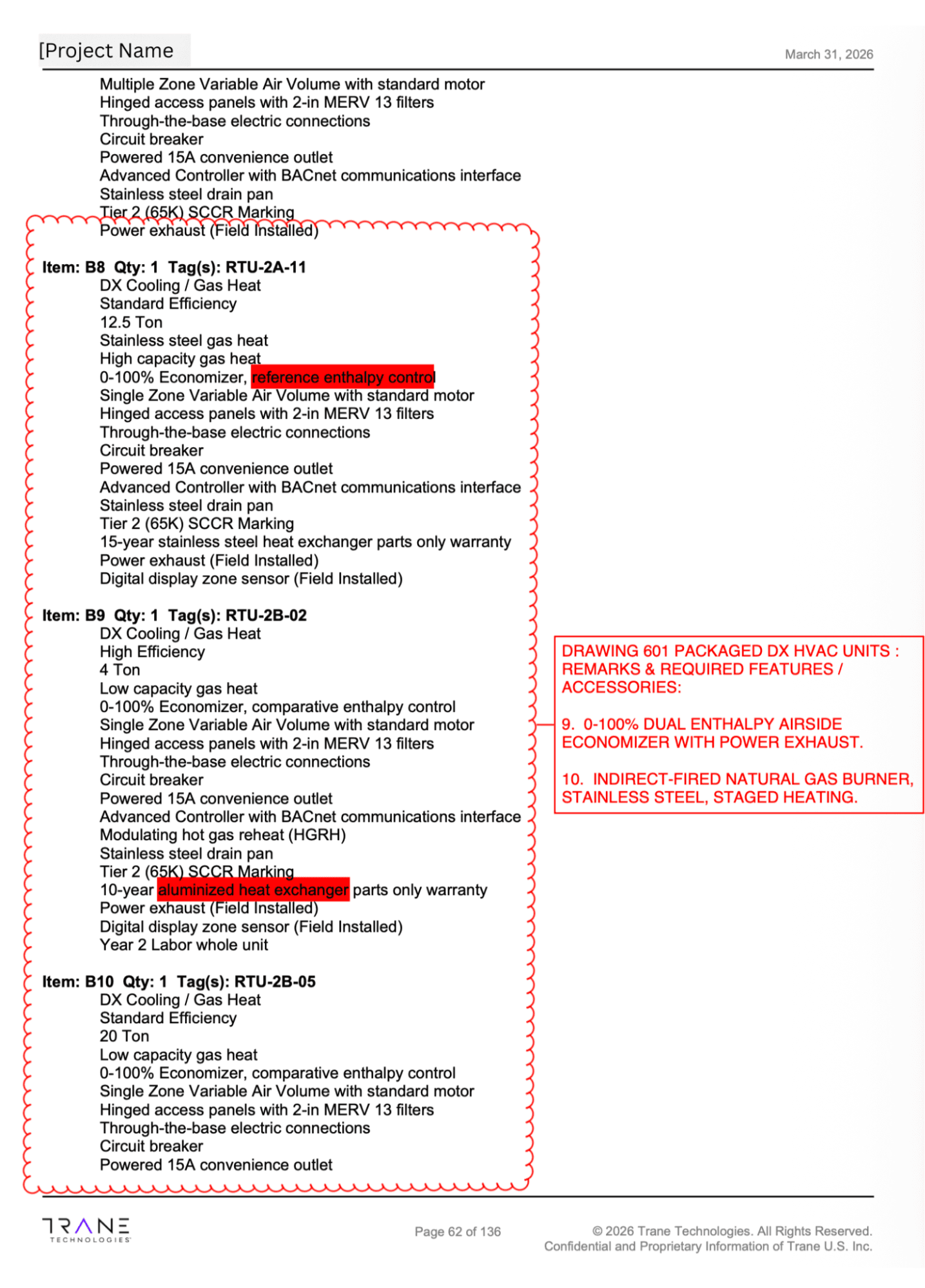
Caption: Product data page showing the annotated economizer finding, with the design requirement called out beside the submitted value.
When a general contractor forwards incomplete submittal documents to the architect and design team, the architect or engineer sends them back, restarting the approval process and adding about two weeks.
There's a clear pattern in why submittals get rejected, and most of it traces to the depth of the review process, not the form. BuildSync's survey of more than 6,000 construction professionals put the average cost of a single rejected submittal at $805 once you account for labor, coordination, and the approval delays that ripple across the schedule.
When asked about the #1 reason complete-looking submittals get kicked back, Tom Port, the co-founder of BuildSync, says:
I've seen countless submittals that looked perfectly complete on the surface but still came back rejected.
The issue is almost never the paperwork, it's the technical compliance hidden inside it. When you're manually reviewing hundreds of pages under deadline pressure, it's incredibly easy to miss a single requirement that ultimately sends the whole package back for resubmission.
How to turn this example into a reusable submittal package template
The fastest way to make this repeatable is to lock the structure into a submittal package template you reuse on each job. Keep the same backbone each time: a transmittal cover, the compliance matrix, certifications, and closeout items.
Then pre-populate the characteristics list for each equipment type, since a rooftop unit and a lighting fixture demand different checks. A good submittal review template gives specialty contractors a consistent way to create a submittal that's easy for a reviewer or the design team to trust.
A word of caution: a single universal template helps when preparing submittals for straightforward items and tends to fall short on complex MEP equipment, which is where most rejections happen. A template structures the entire process, but it can't ensure compliance on its own.
Want to see what a reviewed package looks like end-to-end? Book a demo.
When asked about why static templates aren't enough for complex MEP packages, Tom Port, the co-founder of BuildSync, says:
Templates solve an organization problem, not a verification problem.
The challenge isn't assembling the package, it's proving every technical characteristic complies with the specs. That's the point where static templates reach their limit and detailed review becomes the real bottleneck.
When a template isn't enough on complex construction projects
A template can't read dozens of pages of cut sheets and verify each characteristic against the contract requirements. On complex construction projects, that gap is where rejections cluster.
This is where AI-powered submittal review software changes the math on the submittal process. BuildSync performs deep technical analysis, extracting every technical characteristic and checking each against the plans and specs, then returning a marked-up submittal and a compliance report the team can send to subs, vendors, or the design team.
Every finding links to the source page in both the submittal and the specs, so reviewers can trust but verify. Not every team builds this capability in-house, though. Some subcontractors outsource submittal package preparation to a third-party firm instead, trading control over the process for a different cost structure.
That same extraction engine can also run in reverse: instead of checking a finished package, AI can generate a submittal package by starting with the specifications and matching product data to each requirement before the package is submitted. On the rooftop unit package above, that meant two clear fails and 14 flagged unknowns surfaced automatically, instead of found (or missed) somewhere across a submittal running well past 100 pages. It's the kind of quality control that helps general contractors and specialty contractors get more submittals approved, and it confirms the correct materials reach the site.
The results show up in the work. Monteith Construction cut review time by roughly 70% on a healthcare renovation, and on a school project reviewed a 530-page submittal that flagged spec references its project engineer would not have caught.
Across BuildSync customers, that depth moves construction teams from a 35% rejection rate toward 5%, while returning 70 to 80% of the hours manual review used to eat. Fewer submittals come back, the design team review goes faster, and the project owner sees a cleaner path to project completion and a more successful project.
When asked about the #1 habit that keeps teams out of resubmission loops, Tom Port says:
The teams that consistently get submittals approved don't assume a product meets the spec because it looks right, they prove it.
They treat every technical requirement as something that needs to be verified, not guessed. That habit alone prevents countless resubmissions and keeps projects moving.
Try BuildSync free on your most complex submittal and compare it to your manual review.
Frequently asked questions
What's the difference between a submittal and a transmittal in construction?
A submittal is the documentation proving a product meets the project requirements, while a transmittal is the cover form that records what's being sent, to whom, and when. The transmittal routes the package; the submittal is the content inside it. Mixing the two up creates tracking and approval confusion that stalls the construction submittal process.
Why are submittals important in construction management?
What does a construction submittal package example look like for HVAC?
How long does it take to create a submittal package?
Related reads for you
Discover more articles that align with your interests and keep exploring.


