Construction Technology & Innovation
/
Aug 3, 2026
Outsourcing Submittal Packages: Is It Worth It for Subs?
What it costs to outsource construction submittal packages, what you give up in control, and how in-house AI generation compares for speed and accuracy.


It's the week before a long-lead order has to go out, and the submittal package still isn't built. The cut sheets are scattered across three vendor emails, the spec section runs 80 pages, and the crew that assembles this paperwork is the same crew running the job. Somewhere in that crunch, a lot of mechanical and electrical subs start asking whether they should outsource construction submittal package work to a third-party firm and buy back their time.
It's a fair question, and the honest answer isn't a slogan. Outsourcing can help. It can also cost more than the invoice suggests and hand off things a sub may not want to give away. This article walks through what outsourcing actually costs, what control gets traded for convenience, and a third path most subs never weigh.
Why the construction industry keeps outsourcing submittal package prep
Subcontractors outsource because assembling construction submittals is slow, detailed, and rarely the thing they were hired to build. On most construction projects, building one package means working through the same checklist:
Review the project specifications and flag the required submittals.
Chase down product data sheets and material samples from vendors.
Pull the manufacturer's literature and installation instructions for each item.
Draft or collect shop drawings that detail installation methods before installation begins.
The submittal process eats hours of back-office work per package, stacked on top of estimating, buyout, and field coordination.
The construction industry also has a staffing problem. Many specialty contractors don't have a dedicated person for managing submittals, so the task of preparing submittals lands on project managers or a project engineer who is already stretched. Handing that grind to an outside firm looks like an easy win: fewer late nights, faster turnaround, and someone else handling document management on the project submittals.
When asked about the hidden costs of outsourcing submittal preparation, beyond what's listed on the invoice, Tom Port, the co-founder of BuildSync, says:
We've seen this quite often with customers, the invoice only tells you what you're paying the outsourcing company, and while there certainly is a place for this type of service, it doesn't tell you about the back-and-forth, the delays waiting in someone else's queue, or the cost when a package comes back rejected. At the end of the day, your name is still on that submittal, so you own the outcome whether you built it or not.
What it really costs to outsource construction submittal package prep
Outsourcing a construction submittal package rarely costs just the quoted fee. Most firms price per package or per hour, so the cost climbs with every project and every revision cycle. A package that comes back needing corrections gets re-billed, and the clock keeps running while the submittal waits in someone else's queue, which is how outsourcing quietly creates its own project delays.
Then there's the cost of a rejection. BuildSync's survey of more than 6,000 construction professionals put the average cost of a single rejected submittal at $805 once you count rework, delay, and coordination. Outsourcing doesn't make that number disappear. If the outside team misreads a spec, the sub still owns the rejected package, the project schedule hit, and the rework that follows across the project timeline.
For high-volume shops, those per-package fees add up to real money over a year of construction projects. For a shop with only a few submittals a quarter, the math can still work. The point is to price the whole relationship, not the first invoice.
What subs give up when they hand off construction submittals
Outsourcing construction submittals trades control for convenience, and that trade carries a few hidden line items:
Spec knowledge: When an outside firm interprets the specs and decides which correct materials satisfy the project requirements, that expertise leaves the building, and so does the quality control that comes with it. Managing submittals in-house keeps that spec fluency on the team.
Confidentiality: Handing over plans, construction documents, and vendor pricing means those project documents live on someone else's system.
Speed of iteration: Every clarification that would normally move fast through the RFI process now travels through an intermediary instead of getting answered across the project at the next desk.
What the general contractor and design team still check
None of the outsourcing changes who's accountable. The general contractor still runs an internal review before forwarding the package, and the architects and engineers still check for conformance with the project design and design intent before final approval.
Submittals prove compliance with project requirements, and a submittal shows what the contractor intends to install, so under standard contract requirements, responsibility for submittal accuracy stays with the contractor, not the architect and not the firm that got paid.
If it's rejected, the approval process starts over and drags the entire process back to the beginning, and a polished package with someone else's interpretation baked in still has the sub's name on it when it reaches the GC's submittal review process.
When asked how outsourcing submittal preparation can affect a subcontractor's credibility with architects and project teams, Tom Port, the co-founder of BuildSync, says:
People don't remember the ten submittals that sailed through. They remember the one that came back with basic mistakes. Every package you submit says something about how your company works, and that's why I'd rather keep the understanding of the spec in-house than hand it off to someone who doesn't have to defend the result.
Is outsourcing worth it across your construction projects?
Outsourcing is worth it when the volume is high, the work is unpredictable, and there's no in-house capacity to build packages consistently across construction projects. It's a weaker fit when submittals are steady, repeatable, and submittal management is central to how a sub protects its margin. The decision to outsource construction submittal package work usually comes down to three questions:
Volume and spikes: Is managing submittals overwhelming the project team during buyout, or is it a manageable trickle?
Repeatability: Does the same equipment and the same spec sections show up job after job, where a reusable submittal process would pay off?
Capacity and cost: Is there a cheaper way to get the same speed without giving up control of the project? Before deciding, it helps to run the numbers on submittal costs.
That last question is where most subs stop too early, because they assume the only alternative to outsourcing is doing it all by hand.
A third path: generating construction submittal packages in-house with AI
There's a third option between manual assembly and full outsourcing: AI-powered submittal package generation that builds the package in-house in a fraction of the time. Instead of shipping the job out, the software reads the project specifications, extracts every requirement, and cross-checks the technical data from the manufacturer data and product data sheets to assemble a complete submittal package the sub reviews and sends, even on complex construction projects.
For what that finished package actually contains section by section, whichever route you choose to build it, this walks through a real one.
For the mechanics of how AI reads the spec and assembles the package before it ever reaches the sub for review, this walks through each step of the process.
How in-house generation changes the tradeoff
Speed comes from automation, not from a queue in another time zone.
Control stays in-house, because the team makes the final call and keeps the spec knowledge.
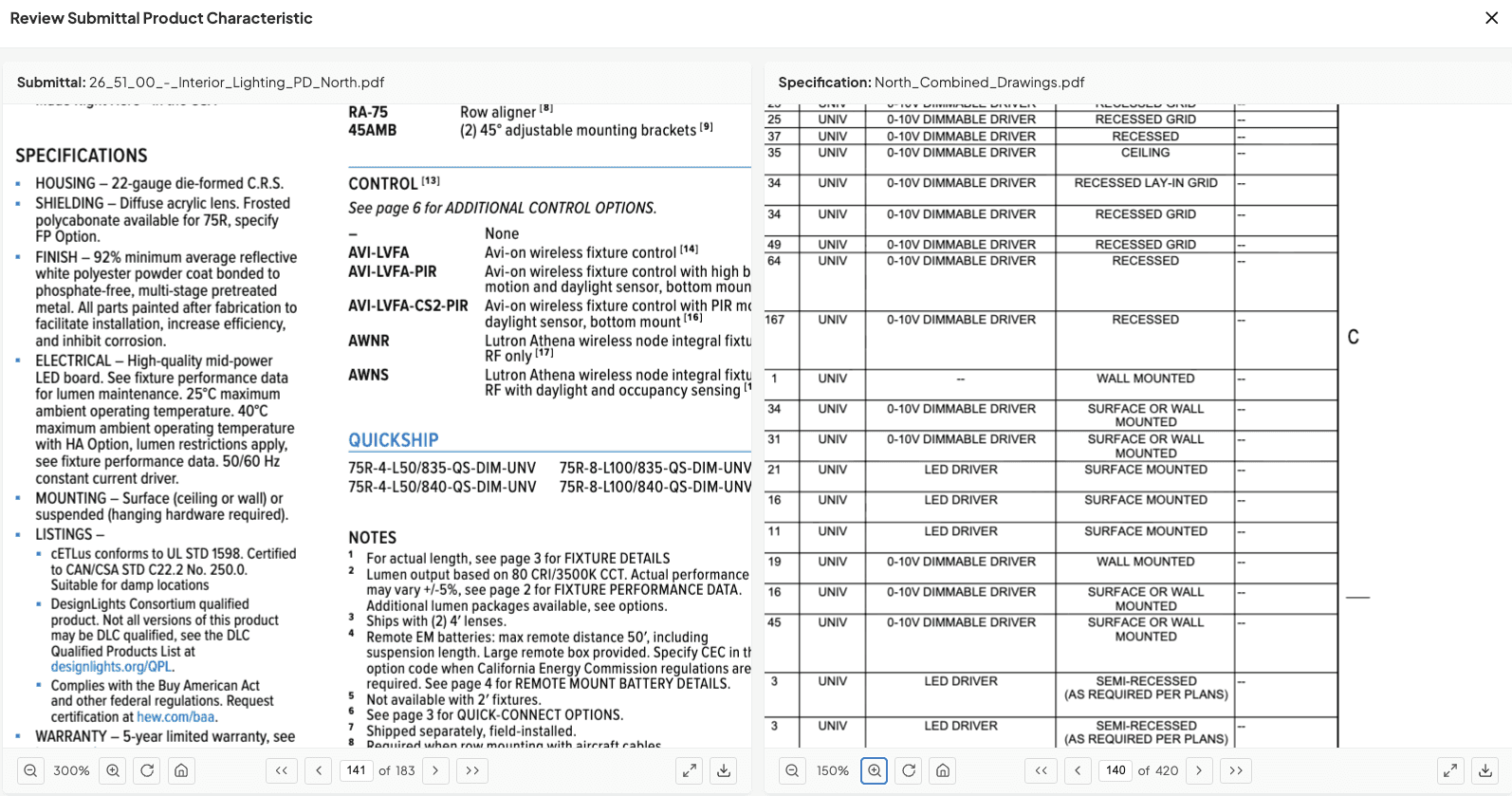
Accuracy comes from the deep submittal review that checks every technical characteristic against the spec to ensure compliance, the kind of pass a rushed manual attempt or an off-site assembler can miss.
On a fast-tracked hospital renovation, Monteith Construction was clearing complex MEP submittals under critical-path pressure and cut review time by 70%, the kind of workload where manual assembly and off-site handoffs both break down.
Can you trust an AI-generated submittal package?
Yes, but only because the work is checkable. AI skepticism here is reasonable, and the answer isn't to take a vendor's word for it. BuildSync shows the source for every requirement it pulls, so a project engineer can trust but verify before anything is kept moving through the construction process.
It generates product-data packages, not custom shop drawings, and it keeps a human in the loop rather than replacing the reviewer. The stakes are highest on HVAC equipment and other complex gear, where the actual submittals can carry dozens of technical characteristics.
When asked how outsourcing submittal preparation differs from using BuildSync's AI once accuracy becomes the priority, Tom Port, the co-founder of BuildSync, says:
The biggest difference is that BuildSync doesn't ask you to trust it; it gives you everything you need to verify it.
Every requirement is linked back to the spec; our interface is built to ensure that every recommendation can be checked, and your team still makes the final decision. That's very different from getting a completed package back and wondering how someone arrived at those conclusions.
Try BuildSync free on your next package.
How the three approaches compare for construction teams
The right choice depends on what a sub values most: cost predictability, control, or speed. On a project, the table below lines up the three ways construction teams handle submittal management.
Factor | Manual in-house | Outsource to a firm | In-house AI generation |
Cost model | Staff hours | Per package or hourly, plus revisions | Software cost, flat per project |
Turnaround | Slow, competes with field work | Depends on vendor queue | Hours, on your schedule |
Control | Full | Limited | Full |
Spec knowledge | Stays in-house | Leaves with the vendor | Stays in-house |
Accuracy | Varies by reviewer | Varies by vendor | Every requirement checked against spec |
Scales with volume | Poorly | At rising cost | Yes |
For many mechanical and electrical subs, in-house submittal management captures most of the time savings of outsourcing while keeping the control and the accuracy that protect the relationship with the general contractor and the architect.
Subs weighing that tradeoff usually end up reviewing the rest of their tech stack at the same time, and this roundup of AI tools for construction workflows is a reasonable place to start.
Deciding what's actually worth it
The choice to outsource construction submittal package prep can buy back time, and for some subs on some construction projects it's the right move. The decision deserves the full picture, though: the per-package cost that scales, the control and spec knowledge handed off, and the accountability that never leaves the sub's desk.
Weigh that against generating construction submittals in-house, where subs keep the speed without giving up the parts that matter to the project owner, the project stakeholders, and the reputation that wins the next project.
Book a demo or contact BuildSync today.
Common questions about outsourcing submittal packages
Who is responsible if the design team review rejects the package?
The cost lands on the sub, not the outsourcing firm. Most outsourcing agreements don't carry the liability for a rejected package, so the sub absorbs the resubmittal fee, the schedule slip, and any re-billing from the firm to correct its own miss. Read the contract's indemnity and revision terms before assuming an outside partner shares that risk.
How do you vet a construction submittal outsourcing company?
How do you outsource MEP submittal package creation?
What is the standard turnaround time for outsourced construction submittals?
Related reads for you
Discover more articles that align with your interests and keep exploring.


