Construction Technology & Innovation
/
Jun 10, 2026
Construction Submittal Management: What Most Teams Miss
Most teams have submittal management figured out. The part that's still broken is review. Here's why compliance gets missed and what to do about it.


Walk into almost any general contractor's office today and the submittal process looks under control. There's a submittal log that updates in real time, a submittal schedule tied to the build, and a centralized system showing exactly where every package sits in the approval process. At the foundation of each is a master list of every required submittal, built from the project specifications during pre-construction.
Construction submittal management, as a discipline, has matured. Teams see status at a glance, route documents to the right responsible parties, and keep a clear audit trail across multiple projects.
And yet the rejections keep coming. Roughly a third of construction submittals still bounce back from the design team, even on jobs with spotless tracking. That gap, between knowing where a submittal sits and knowing whether it actually complies, is the part most teams miss.
What today's submittal process already gets right
The last decade transformed how the construction industry handles documents. Submittal management software put the entire submittal workflow in one place. Project teams that once chased paper transmittals now manage submittals through a centralized platform, with automated workflows that route each item to the right reviewer and surface approval delays before they turn into project delays.
This is real progress. Project management software and construction submittal software handle the logistics of the submittal process well, and submittal tracking gives project managers visibility they never had. A clear audit trail protects everyone when questions surface later in the project lifecycle.
For the administrative side of submittal management, the problem is largely solved. A modern project manager can open a dashboard and answer almost any question about where a document sits. Tracking submittal statuses across dozens of contractors' submit cycles is no longer the bottleneck it once was.
The trouble is that none of this touches the actual content of what's being submitted. A submittal can move through a flawless submittal workflow, hit every milestone on time, and still be wrong.
The limits of tracking submittal statuses
Tracking and reviewing are two different jobs, and most teams have only automated the first one:
The tracking layer handles | The review layer still requires judgment |
Where each submittal sits | Whether the product data matches the specs |
Who has the ball and what's overdue | Whether every technical characteristic complies |
Routing to the right reviewer | Catching a wrong refrigerant, rating, or coating |
A clear audit trail | The compliance call a status field can't make |
Tracking submittal statuses tells you a package arrived, who reviewed it, and when it moved forward. It says nothing about whether what's inside actually complies. On a live job, this distinction separates an approved submittal from a six-figure mistake on the project.
Consider a typical mechanical submittal. The submittal documents might run 60 or 70 pages: cut sheets, performance criteria, installation instructions, and engineering calculations for a single piece of equipment. A submittal tracking system records that the package was received and routed. Confirming that every value meets the contract documents is a separate act of judgment that no status field captures, and the various types of construction submittals each carry their own technical requirements.
This is where the review process quietly breaks down. Project documentation keeps improving while the review and approval process stays manual, page by page, characteristic by characteristic.
Junior engineers may not yet know which technical data points matter most. Senior staff rarely have the hours. So reviews get rushed, skimmed, or stamped "comply" down the margin without a true line-by-line check against the detailed plans.
Speed can come from a better sequence instead, and the steps behind faster submittal reviews start with pulling requirements from the spec before the package is ever opened.
Why construction submittals still fail the approval process
The reason construction submittals keep getting rejected is rarely poor tracking. It's that the approval process depends on a manual review the schedule never really allows time for. The submittal process compresses at exactly the moment it matters most: the project startup phase, when RFIs, schedule-of-values approvals, and hundreds of project submittals all land at once.
In that crunch, the initial review by the general contractor often becomes a quick scan rather than a deep comparison. A spec might call for a specific light transmittance value, a particular manufacturer, or corrosion-resistant coil coatings for a coastal site. If the submittal misses any of these and the reviewer is moving fast, the failure sails through to the design team. Weeks later it comes back rejected, and the cycle restarts.
Each rejection can add 2 or more weeks to construction projects. A BuildSync survey of more than 6,000 construction professionals puts the true cost of a rejected submittal at $805 on average, once you account for resubmittal labor, delays, and schedule pressure.
The deeper issue is that poor information is expensive across the board. Research from FMI ties billions in annual construction rework to inaccurate, incomplete, or inconsistent project data. A submittal that clears review without a real compliance check becomes exactly that: bad data carried downstream into procurement and installation.
Tom Port, the co-founder of BuildSync, says:
Construction solved document management before it solved document understanding. We built great systems for moving submittals from one person to another, but not for determining whether the content actually complied with the specs. The result is that most teams know exactly where a submittal is at any moment, but they still don't know whether it's right until an engineer spends hours reviewing it.
What deep review of technical data looks like on real construction projects
Closing the gap means treating review as a discipline distinct from tracking. Instead of asking "where is this submittal," the question becomes "does every technical data point match the project specifications and the design intent in the contract documents."
That's a different kind of work, and it's where AI-powered submittal review has started to change how construction teams operate.
A deep technical analysis works in three steps:
Break the submittal down to the product level, separating a package into the individual products it contains.
Extract every technical characteristic for each product: dimensions, ratings, materials, certifications, refrigerant types, coatings, and warranties.
Compare each characteristic against the plans and specs to ensure compliance, then assign a status.
Not every team has the capacity to perform that level of analysis in-house. Some subcontractors instead outsource submittal package preparation to a third party, trading control over the process for a per-package cost.
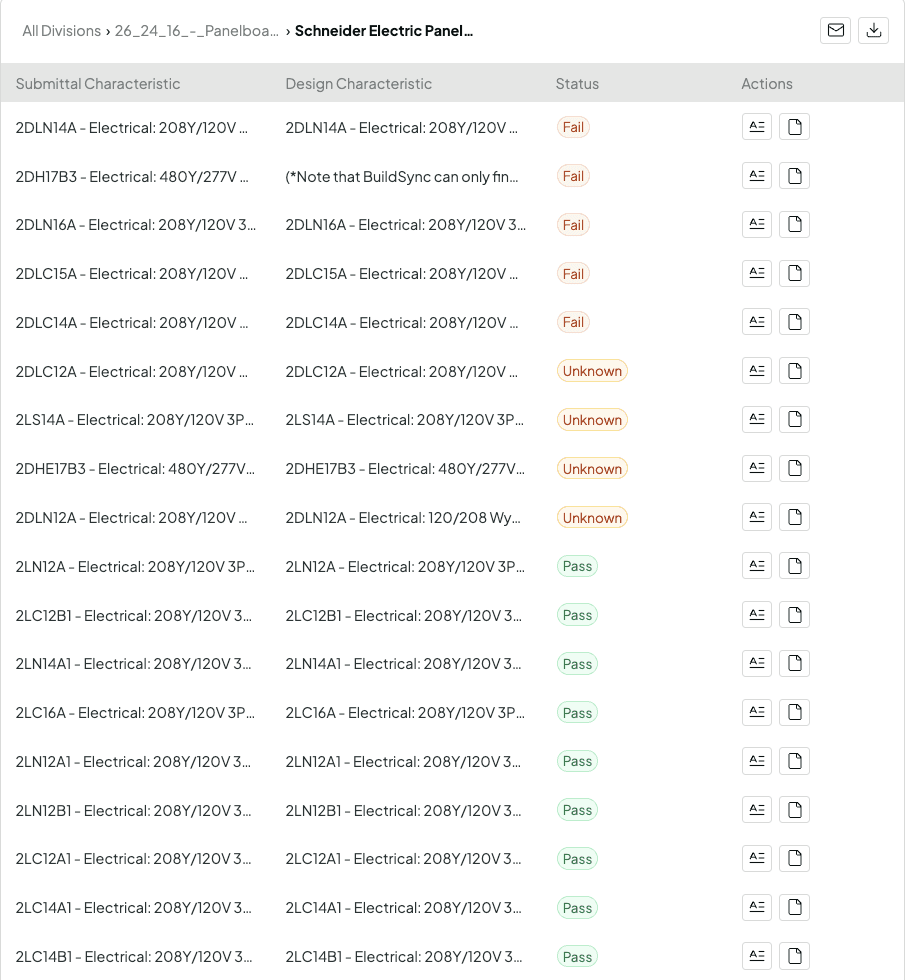
Each characteristic gets one of three statuses:
Status | What it means | What it signals for your team |
Pass | The characteristic meets the plans and specs | No action needed |
Fail | The characteristic does not meet the plans and specs | Follow up with the sub or vendor before it reaches the design team |
Unknown | The information needed to decide isn't in the submittal or the specs | A reviewer applies contextual knowledge or writes an RFI |
That last category matters. Good construction submittal software doesn't pretend to replace judgment. It surfaces exactly where human judgment is required and gets the reviewer to the source faster.
For every characteristic, a reviewer can open the original submittal page and the relevant spec page side by side and verify the finding in seconds rather than combing through hundreds of project documents by hand. Teams that want a repeatable standard often pair this with a construction submittal review template so everyone checks the same things every time.
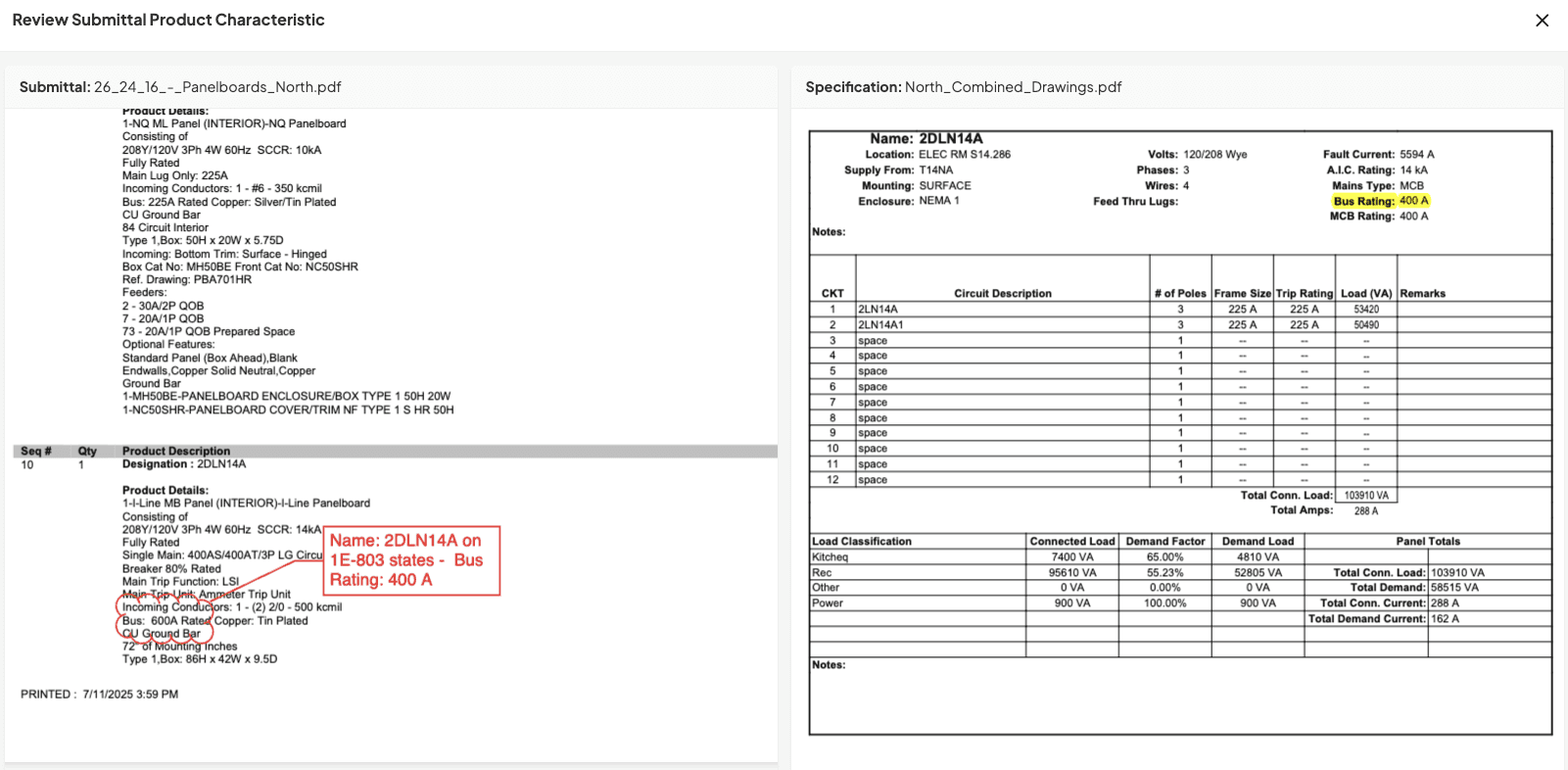
Done this way, submittal software stops being a filing cabinet and becomes a second set of expert eyes. It helps newer engineers learn what to check against design intent, and it gives senior staff back the hours manual review used to consume, up to 70 to 80% of the time otherwise spent reviewing submittals by hand.
When asked about the most missed thing in the submittal review process, Tom Port says:
What surprises people is the sheer number of things they weren't checking consistently. Not because they were doing a bad job, but because the process was never designed for characteristic-level verification at scale. A reviewer might catch the major issues, but there can be hundreds of individual requirements buried across specifications, drawings, and product data. When teams see every characteristic broken out as Pass, Fail, or Unknown, they realize they've never really had complete visibility into compliance before.
When your submittal software needs to do more than track
Most construction submittal software was built to move documents, not to read them. That works until the review itself becomes the bottleneck, which on busy construction projects it almost always does. When tracking is solid but rejections and review hours still hurt the project, the missing layer is deep technical analysis.
This is the gap BuildSync was built to close. The platform runs AI-powered submittal review on construction submittals, extracting technical characteristics and checking each against the plans and specs, then returning a marked-up submittal and a compliance report a team can send straight to subs, vendors, or the design team.
For a general contractor already standardized on Procore, it functions as a zero-friction integration, operating within the existing submittal workflow rather than requiring an additional login.
Skepticism about AI reviewing technical documents is fair. That skepticism often extends further, into whether it's quietly reshaping what junior engineers actually learn by doing the comparison work for them. The stakes are real, and a wrong call costs money. That's why the model is built around trust but verify, and why teams run a pilot on their own hardest submittals before committing.
Monteith Construction, for instance, reviewed a 530-page submittal and cut review time by roughly 70% after adopting the platform, with a project engineer noting it flagged specs he wouldn't have thought to cross-reference on his own.
The teams that consistently pass submittal review the first time aren't tracking harder. They've added a real compliance check to the construction submittal process.
Tom Port says:
In the first 120 days, teams usually realize that review can be managed the same way they manage safety, quality, or scheduling. Once you can see every compliance decision and every exception, review becomes a discipline instead of an individual effort. The result is fewer surprises, more consistent reviews, and a lot more confidence that what's being submitted actually matches the design intent.
The tracking is solved. The review isn't.
Construction submittal management has come a long way, and the tracking is genuinely solved. The next real gain for most construction teams won't come from a better log. It will come from a deeper review that catches non-compliant submittals before they ever reach the design team.
Ready to move from tracking submittals to truly reviewing them? Request a demo, or contact BuildSync to run a free trial on your most complex submittals.
Frequently asked questions about construction submittals and review
What's the difference between shop drawings and product data submittals?
Shop drawings are custom documents the contractor or fabricator prepares to show how a specific element will be built, such as fabrication drawings for structural steel or ductwork. Product data submittals are the manufacturer's standard literature: cut sheets, performance criteria, and installation instructions for off-the-shelf equipment. Per the AIA's A201 general conditions, both demonstrate how the contractor intends to conform to the design intent, but shop drawings are project-specific while product data is not.
What are submittal requirements for structural steel vs electrical components?
What's the role of the architect in the submittal review and approval process?
Related reads for you
Discover more articles that align with your interests and keep exploring.


