Construction Technology & Innovation
/
Jun 18, 2026
Transmittal vs Submittal: What's the Difference?
Transmittals and submittals are not the same thing. Here's what each one is, when to use them, and why mixing them up causes problems on commercial projects.


A submittal can move through the system flawlessly on paper. It gets logged, a transmittal records the handoff, and everyone signs off and moves on to the next fire. Then three weeks later it comes back rejected and takes the schedule with it, because the paper trail tracked where the document went without ever checking whether the contents were right.
Ask ten people on a commercial construction project to explain transmittal vs submittal and you'll get a few confident answers, a few vague ones, and at least one person who uses the two words interchangeably. The terms travel together so often that the line between them blurs. That blur is where the trouble starts, because a transmittal and a submittal do completely different jobs, and only one of them carries technical risk.
This article breaks down what each document actually is, how the two move through the project together, and why treating them as the same thing quietly costs teams time, money, and goodwill with their design partners.
What is a submittal in a construction project?
A submittal is the technical content a contractor provides to prove that the materials, products, and equipment they plan to install match what the project specifications require. It's the substance under review. The design team reads it, checks it against plans and specs, and decides whether the proposed product conforms to the design intent.
On any construction project, submittals are the mechanism that confirms what gets built lines up with what was specified. According to the Engineers Joint Contract Documents Committee, the terms "shop drawing" and "submittal" aren't even synonyms, which is a useful reminder that submittals cover a wider range of documents than most people assume.
Shop drawings, product data, and samples
The most common types of submittals fall into three buckets.
Shop drawings are specially prepared drawings, diagrams, and schedules that show how a contractor intends to fabricate and install a portion of the work.
Product data covers the manufacturer's catalog cuts, performance charts, and technical sheets that describe materials or equipment.
Samples are physical examples of a material or finish, submitted so the design team can judge appearance and quality.
Beyond those three, submittals also include mockups, test reports, certificates, and warranty documentation. If you want the full picture of what crosses a PM's desk, the breakdown of types of construction submittals covers each one and what to review for.
What is a transmittal in the flow of project documents?
A transmittal is the cover document that records the handoff of project documents from one party to another. It's the paperwork that says what was sent, who sent it, who received it, when, and why. The transmittal captures the exchange itself. It doesn't make any judgment about the contents.
The AIA G810 Transmittal Letter describes the job well: it provides an orderly flow of information between the parties involved in design and construction, and it serves as a written record reminding the sender to tell the recipient exactly what's being sent and why.
A transmittal typically carries the project name, recipient information, a date, and a document list of everything enclosed. Transmittals record the movement of files. They're the formal record that something changed hands.
That distinction is the whole point, so it's worth slowing down on it.
Transmittal vs submittal: the difference that actually matters
A submittal is the contents. A transmittal is the envelope.
The submittal carries the technical information that has to be reviewed and approved. The transmittal carries proof that the package moved from one party to the next. One creates risk that has to be checked. The other creates a paper trail that has to be tracked.
Aspect | Submittal | Transmittal |
Purpose | Demonstrate that proposed products meet specifications | Record that documents were exchanged between parties |
What it contains | Shop drawings, product data, samples, test reports | A cover sheet, document list, sender, recipient, date |
Who acts on it | Design team reviews for compliance | Document controller logs it for the record |
What it proves | Whether the work conforms to design intent | That a transfer happened, and when |
Risk it carries | High: a missed detail gets rejected or built wrong | Low: it's a record, not a judgment |
How transmittals and submittals work together in construction project management
In day-to-day project management, the two documents run in sequence.
A subcontractor prepares a submittal. A transmittal routes it to the general contractor. The GC reviews it for coordination and compliance, then a transmittal forwards it to the architect or engineer. The design team responds, and a transmittal carries that response back down the chain.
The submittal is the thing being judged. The transmittal is the record of every step that judgment traveled through.
Where the document controller fits
On larger teams, a document controller owns the transmittal side. They log every transmittal, maintain the submittal log, confirm receipt, and keep the routing clean so nothing gets lost between parties. None of that logging matters much if the submittal register was incomplete to begin with, since a document controller can only route the items identified as required in the first place. It's essential work, and it keeps the project auditable.
The catch is that document control answers "where is this and who has it," not "does this comply." Those are two different questions, and the second one is where projects get burned.
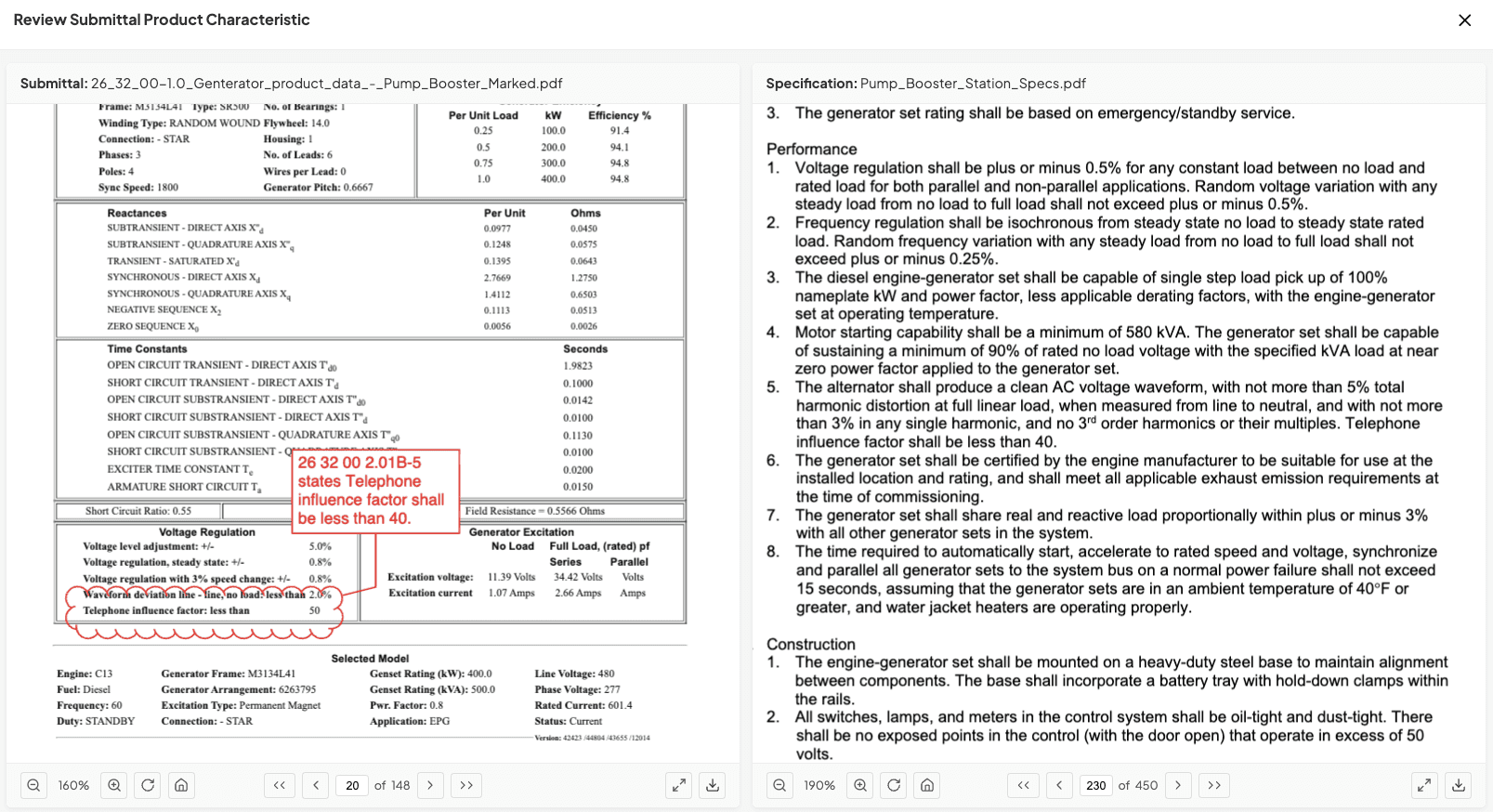
For GCs running submittals through Procore, BuildSync slots into that same flow as an actor in the workflow. The ball-in-court comes to BuildSync, the review happens in the background, and the results return to Procore without anyone changing how they already work.
Managing transmittals as the project scales
On a small job, tracking a handful of transmittals by hand is manageable. On a $100M project with thousands of documents moving between dozens of subcontractors, the submittal log becomes a full-time concern. Construction transmittals pile up fast, and a single missed or misfiled record can stall a procurement decision for days.
From paper to digital transmittals
Most teams have moved from paper to digital transmittals for exactly this reason. Digital transmittals timestamp every exchange, keep the document list attached to the record, and make managing transmittals across multiple projects far less error-prone. The tools handle the bookkeeping so the team can focus on the work the bookkeeping is supposed to protect.
Keeping up with change orders and resubmittals
Volume isn't the only pressure. Change orders, spec revisions, and resubmittals keep the document set in motion long after the first submittal is logged. Every revision generates a new transmittal and, often, a new round of review.
A digital log keeps the version history straight. What it can't do is tell you whether the revised submittal actually fixed the technical issue that got it kicked back in the first place.
When tracking construction transmittals isn't enough
Tracking construction transmittals tells you a document moved and when it moved. It can't tell you whether the contents comply. That's the gap, and it's the gap that drives rejection rates from a manageable number into a schedule problem.
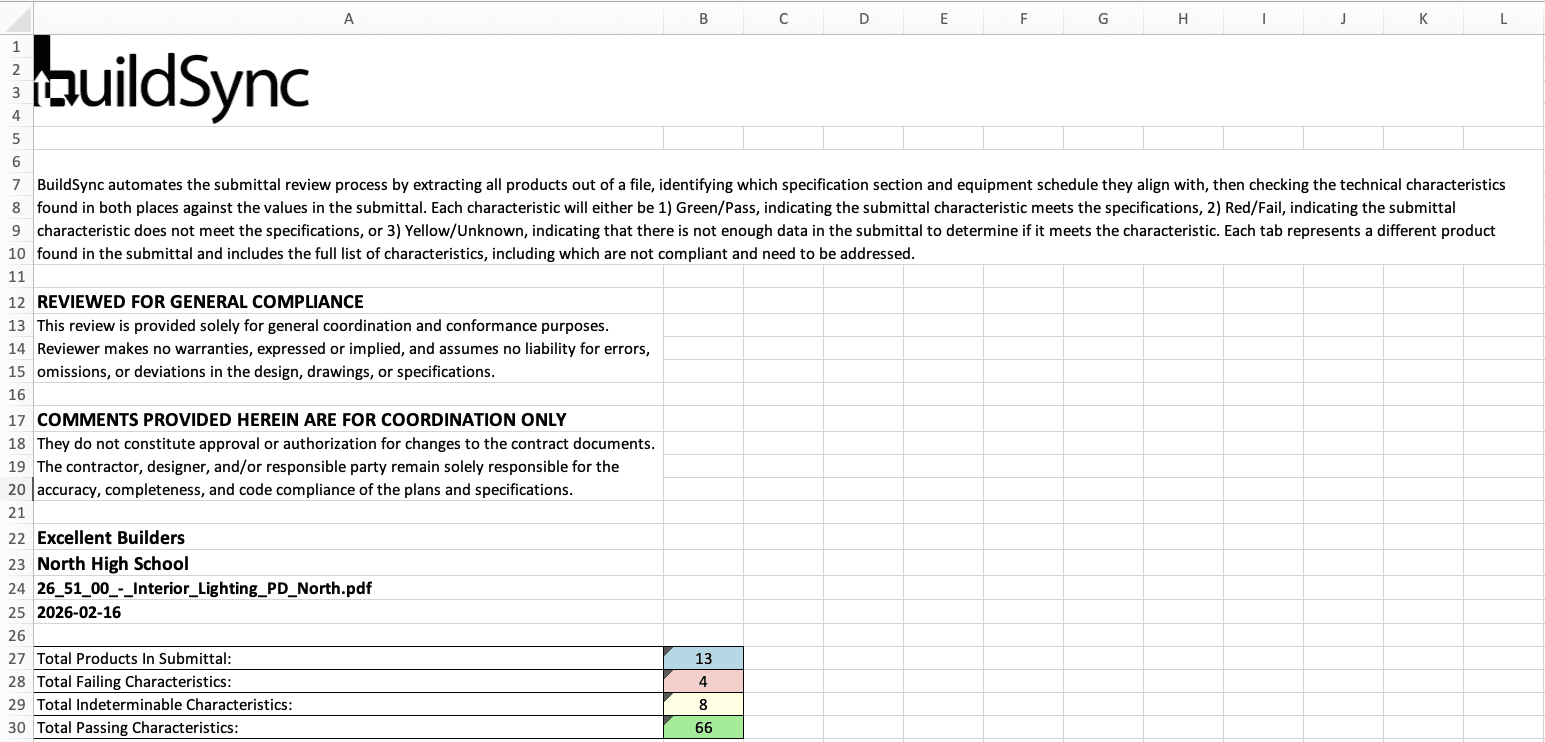
This is where deep technical analysis matters more than document control. BuildSync reads the submittal, breaks it down to the individual products, and extracts every technical characteristic, then checks each one against the plans and specifications. Dimensions, ratings, materials, coatings, warranties, and more get compared line by line, and each gets flagged as pass, fail, or unknown with the reason attached.
AI handling technical review earns a fair amount of skepticism in this industry, which is reasonable given the stakes. That's why BuildSync shows its work: for every characteristic, you can open the original submittal page and the spec page side by side and verify it yourself. Trust, but verify.
The teams that adopt this see the difference in their numbers. At Monteith Construction, project engineer Jacob Delargy used BuildSync to review a 530-page submittal against multiple specs he wouldn't have thought to cross-reference manually, and PM Daniel Recktenwald reported submittal reviews running roughly 70% faster than before.
The transmittal log still tracks the paper trail. BuildSync handles the part the paper trail can't: confirming the contents are right before they ever reach the design team. For teams trying to pass submittal review the first time, that's the step that moves the needle from a 35% rejection rate toward 5%.
Want to catch non-compliant submittals before they reach your design team? Try BuildSync free on a few of your most complex submittals, or contact the team.
Frequently asked questions
What's the difference between a transmittal, a submittal, and an RFI?
A submittal is the technical content under review, a transmittal is the cover document recording that the content was sent, and an RFI (request for information) is a formal question asking the design team to clarify or resolve something in the contract documents. Submittals prove compliance, transmittals prove transfer, and RFIs request answers. All three move through the project, but each one does a distinct job.
What's the difference between an engineering submittal and a construction submittal?
Why are submittals required in project management?
Related reads for you
Discover more articles that align with your interests and keep exploring.


