Construction Technology & Innovation
/
Jul 31, 2026
Plumbing Submittal Package: What to Gather Before You Submit
A practical look at assembling a plumbing submittal package: fixture cut sheets, flow and pressure data, certifications, and the gaps that trigger rejection.


A plumbing submittal looks simple from the outside: a stack of manufacturer cut sheets, a few certifications, and a cover sheet routing everything to the design team. Then the submittal comes back rejected because one fixture on the schedule had no matching data sheet, and the project slips two weeks.
That scenario plays out on commercial construction projects every week. Assembling a typical plumbing submittal package is less about collecting paper and more about proving, line by line, that every fixture, valve, and water heater meets the project specifications before the submittal reaches an engineer.
Here is what to gather, and what quietly slows the whole submittal process down.
What does a plumbing submittal have to prove?
The plumbing submittal exists to prove code compliance and design intent. Construction submittal packages are proof, not a formality. Every submittal in the set answers one question for the reviewer: does this proposed product match what the project specifications and the plumbing drawings call for?
The design team checks whether the fixtures, water heaters, valves, and plumbing systems you plan to install carry the right flow rates, materials, and third party certifications. When the submittal supports that answer cleanly, it moves. When the submittal leaves a gap, the submittal process stalls and the review cycle starts over.
Project specifications are the reference point for the entire project. The spec section for each product names which characteristics matter, and the fixture schedule names which specific model belongs at each location. A submittal that ignores the Division 22 plumbing specifications or the schedule is a guess, and guesses drive the 35% construction industry rejection rate.
A complete plumbing submittal package usually gathers:
A cover sheet or transmittal identifying the project, spec section, and fixture tags
Product data sheets and cut sheets for every fixture, valve, and water heater, with the specific model marked
Required certifications (backflow/ASSE, NSF/ANSI 61 lead-free, ASME A112)
Manufacturer installation instructions and warranty information
Shop drawings only where custom fabrication is involved
Product data and shop drawings: what belongs in the submittal
Most items in the submittal package are product data submittals: manufacturer cut sheets, product data sheets, and installation instructions for off-the-shelf fixtures and equipment.
Shop drawings are the exception, and knowing which belongs where keeps the package clean. Per the AIA A201 general conditions, both are proper documentation demonstrating the engineer's design intent, but they serve different purposes.
Product data submittals | Shop drawings | |
What it is | Manufacturer cut sheets, product data sheets, and installation instructions for off-the-shelf products | Project-specific drawings a fabricator prepares to show how a component will be built |
Project-specific? | No. Catalog documents reused across construction projects | Yes. Prepared for one project |
Typical plumbing example | Faucets, valves, water heaters, floor drains, backflow preventers | Fabricated pipe rack, shop-built manifold, custom carrier assembly |
When to include | Nearly every plumbing item | Only where custom fabrication is involved |
Many plumbing scopes lean on catalog data and add shop drawings only where custom fabrication is involved, which matters for clean project execution.
Build the plumbing submittal against the fixture schedule
The fastest way to assemble a defensible submittal package is to work from the fixture schedule, tag by tag, rather than from the pile of manufacturer cut sheets. The schedule (P-1, P-2, WH-1, and so on) is the source of truth for the project requirements.
Every tag needs one thing: marked data sheets showing the specific product meets the requirements for that location. When the contractor assembles the submittal product by product instead, it is easy to end up with duplicate sheets for fixtures that were value-engineered out and none for the floor drain the spec requires.
Working tag by tag surfaces the gaps early, while there is still time to fix them before construction begins. A fixture on the schedule with no matching cut sheet is a rejection waiting to happen. A cut sheet with no highlighting is worse, because the reviewer has to hunt for the flow rate and pressure rating and may return the submittal rather than guess.
When asked about the difference between a plumbing submittal that sails through review from one that bounces, Tom Port, the co-founder of BuildSync, says:
The difference isn't usually whether the documents are there; it's whether the reviewer can verify compliance in minutes instead of hunting for it.
A plumbing submittal that clearly maps every fixture tag to a marked-up, compliant product data sheet builds confidence. One that forces the engineer to guess almost always comes back for revision.
Which submittal package sections does a plumbing reviewer check?
Beyond cover letters and the transmittal, a reviewer works through the submittal in a predictable order. Four categories drive most plumbing submittal decisions.
Flow rates, pressure ratings, and water supply data
Reviewers check flow rates and pressure ratings first, because these values determine whether a fixture performs as designed and meets code compliance. A lavatory faucet submittal flagged at 2.2 GPM when the spec requires a 1.5 GPM model is an immediate fail.
The EPA WaterSense program publishes the fixture flow-rate thresholds that many commercial specs now reference, so the requirement is rarely ambiguous. Water supply fixtures, flush valves, and any pressure-dependent device need the rated values shown on the spec sheet, not buried in a catalog.
Materials, pipe sizes, and plumbing systems
Material composition matters as much as performance for anything touching the water supply. The design team verifies pipe material, pipe sizes, and valve type against the plumbing systems on the drawings. For complex plumbing systems, the reviewer also confirms joint methods and pressure class on the larger piping systems.
Lead-free requirements under NSF/ANSI 61 are a frequent checkpoint, and a valve body that fails that standard fails the submittal regardless of how well it performs.
Required certifications and third party certifications
Certifications are where plumbing submittals quietly fall apart. Backflow preventers, mixing valves, and cross-connection devices carry required certifications the design team looks for by standard number. ASSE International lists the product certifications, backflow prevention and thermostatic mixing among them, that the Uniform Plumbing Code and International
Plumbing Code reference directly, so a missing ASSE listing reads as non-compliance. Manufacturer certifications and third party certifications belong in the submittal as documented technical data, not implied.
Water heaters, efficiency ratings, and warranty information
Water heaters generate more unknowns than almost any other plumbing item, because their submittals combine capacity, efficiency ratings, warranty terms, and gas or electrical characteristics on a single data sheet.
The spec often requires a specific recovery rate and a ten-year warranty, so a water heater submittal showing a one-year warranty is a compliance failure with real cost downstream. Include the full product specifications, the warranty information, and the manufacturer installation instructions so the reviewer is not left guessing.
Coordinating plumbing installations with other building systems
Plumbing installations rarely stand alone, and a good review process catches coordination issues a document-only check misses. Water heaters share mechanical rooms with HVAC systems, recirculation pumps carry electrical characteristics the electrical submittals have to match, and in healthcare facilities, medical gas and specialty plumbing systems raise the bar further.
When a submittal package ignores how the proposed product interacts with mechanical equipment and other building systems, coordination issues surface in the field instead of on paper, where commissioning agents and the general contractor absorb the cost across the project team. A short coordination note in the submittal signals a thorough review to the design team.
Why plumbing submittals stall in the review process
Most plumbing submittal rejections trace back to avoidable gaps in the submittal process, and knowing them shortens the review cycle. Five triggers account for the bulk of what gets kicked back in plumbing scopes:
Rejection trigger | What it looks like | Catch it before submitting |
Fixture with no cut sheet | A scheduled tag (P-1, WH-1) has no matching data sheet in the package | Work the fixture schedule tag by tag, so every tag gets one marked sheet |
Flow or pressure mismatch | A faucet at 2.2 GPM where the spec requires a 1.5 GPM model, or a pressure rating under spec | Check flow rates and pressure ratings against the schedule first |
Unmarked "or equal" substitution | A substitute offered with no side-by-side against the specified product line | Show the substitute meets each specification requirement |
Short warranty | A one-year warranty where the spec requires ten years | Confirm warranty terms on the data sheet before submitting |
Missing certification | No backflow or ASSE listing on a device that requires one | Verify required certifications and third party certifications by standard number |
Each gap forces a revise-and-resubmit, and each submittal cycle adds two or more weeks to the project schedule. Preventable rejections are a project management problem as much as a technical one.
BuildSync research across construction professionals puts the direct cost of a single rejected submittal near $805, before the schedule impact is counted. On a project with hundreds of submittals, costly delays add up fast across construction projects, which is why a disciplined self-check before submission protects the entire project.
Mark every submittal line pass, fail, or unknown before it leaves your desk
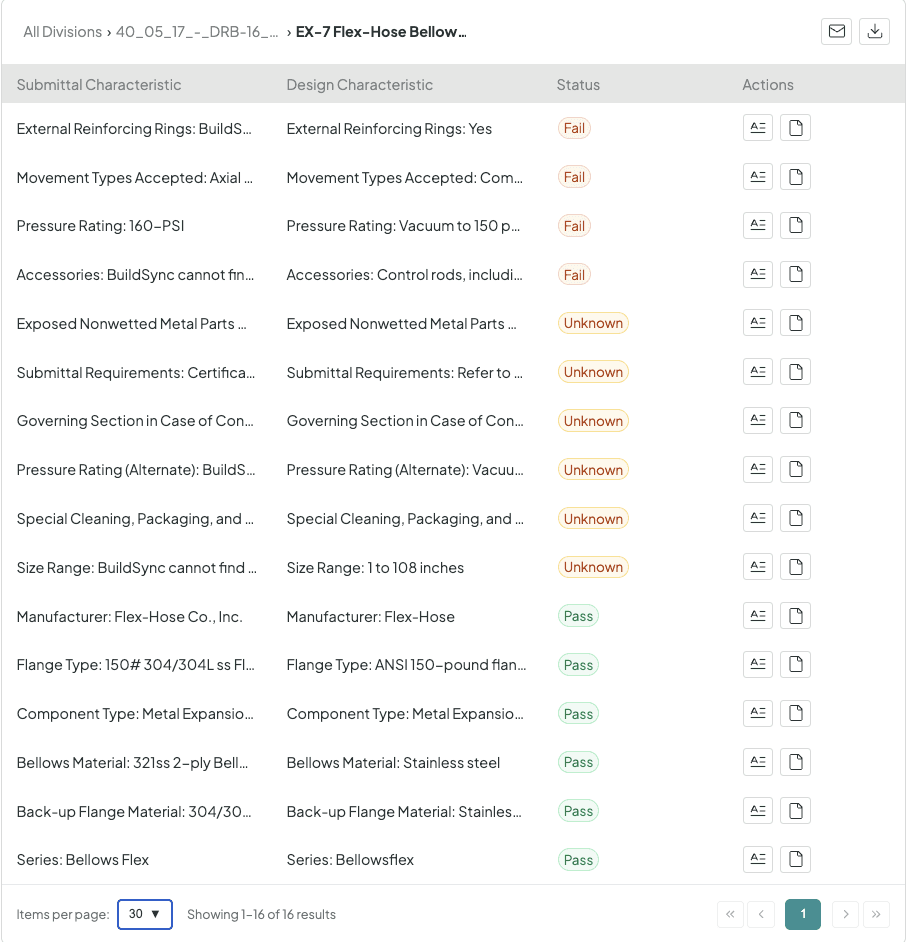
Treat the assembled submittal package the way a reviewer will: mark every line item pass, fail, or unknown before the submittal leaves your desk. A pass meets the specification requirements. A fail clearly does not, and it is the easiest to fix while the submittal is still in your hands.
An unknown is the dangerous category, because that is an ambiguity the reviewer cannot resolve: a cut sheet that says "coating provided" where the spec requires a specific corrosion-resistant material, or a value that is not printed on the data sheet.
Unknowns are what turn a submittal into a rejection, and most of them are questions a plumbing sub could answer in five minutes by calling the manufacturer or checking the product literature. Specialty contractors who self-check this way rarely see a bounce, and a complete plumbing submittal carries zero unknowns before submission.
Tom Port says:
The biggest ambiguity one is an 'unknown' that could have been answered with a five-minute call to the manufacturer.
A cut sheet might say 'available with lead-free construction' or 'optional coating,' but never confirms what's actually being supplied. Rather than verify it before submitting, contractors leave it to the reviewer to figure out, and that's when the submittal comes back.
When a manual review of product data reaches its limit
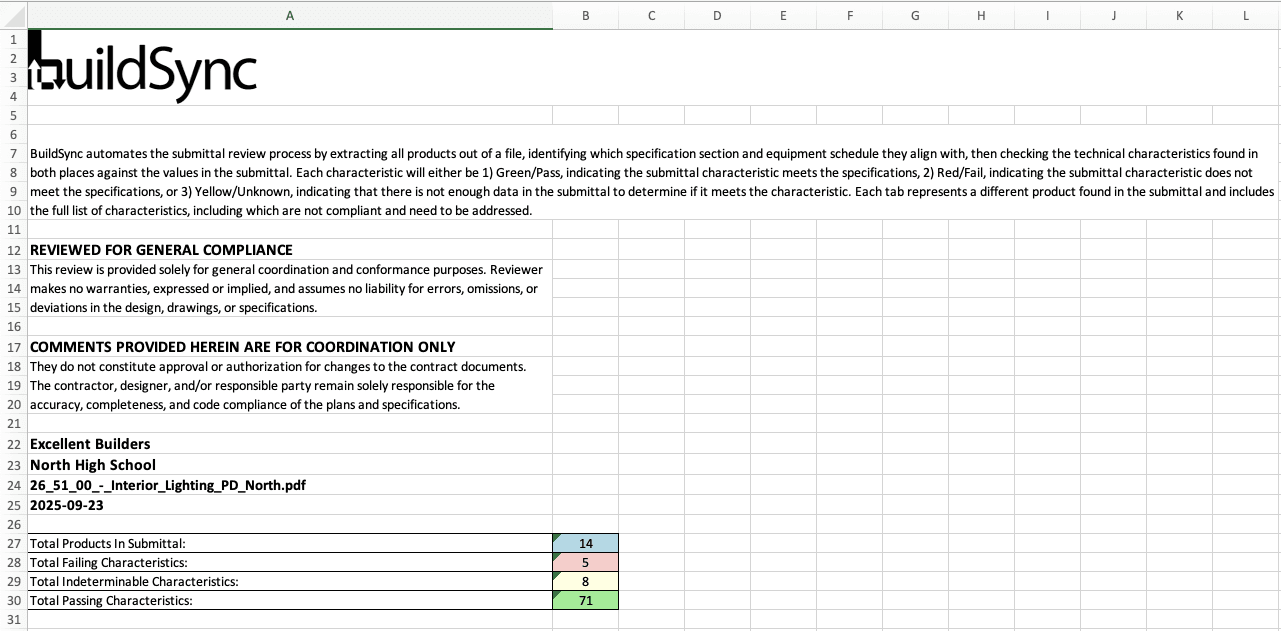
A tag-by-tag self-check works well until the submittal volume climbs. On a large commercial construction project, a plumbing scope can run to dozens of fixtures across multiple spec sections, and a manual review of that much documentation is where a tired project engineer misses one efficiency rating on page 47. This is where AI-powered plumbing submittal review software earns its place. BuildSync extracts the technical characteristics from each submittal and checks them against the project specifications one by one, then flags every fail and unknown before the submittal package reaches the general contractor or design team. For what a submittal package looks like across trades, not just plumbing, this walks through a real package section by section.
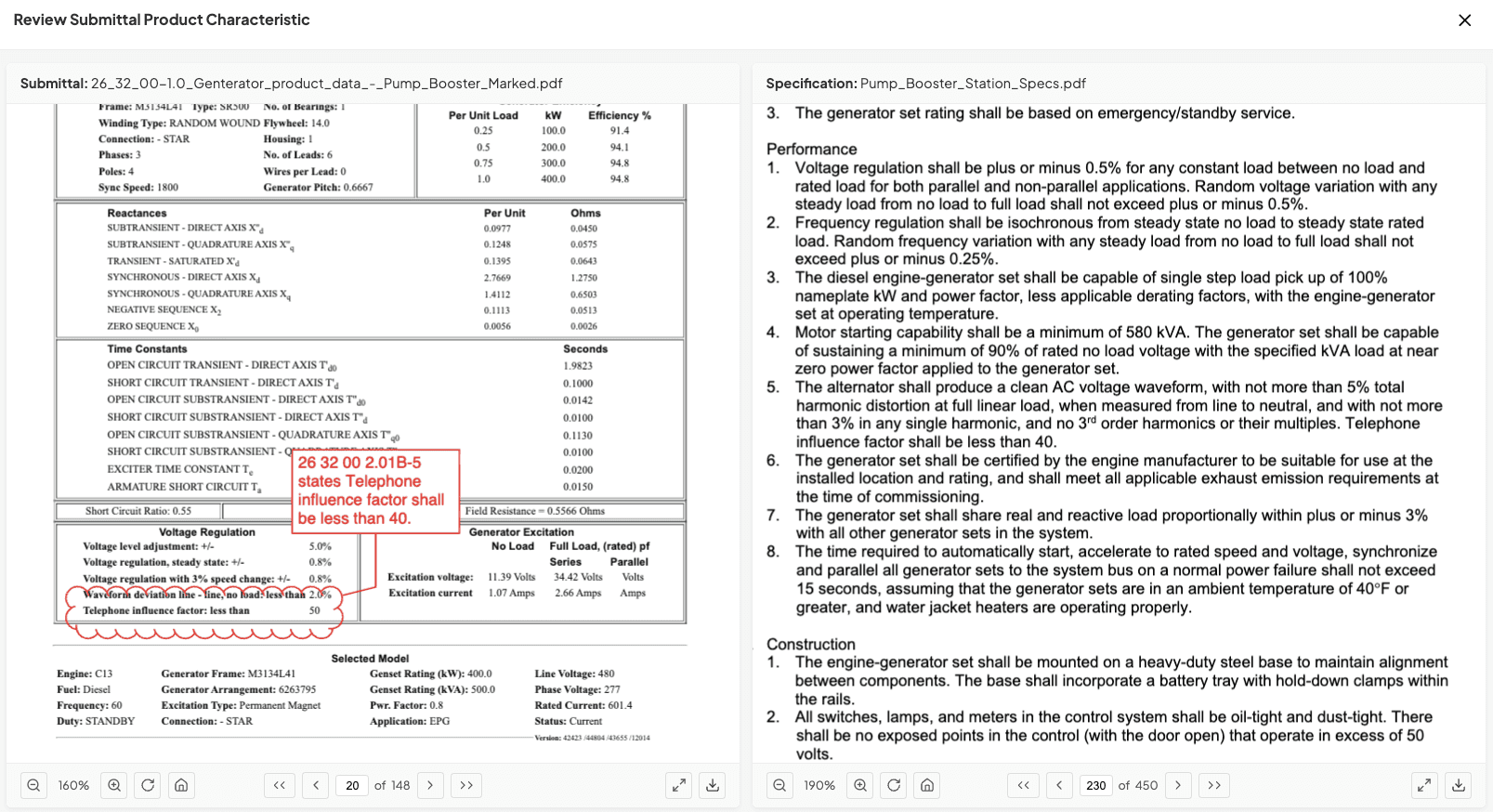
Skepticism about AI reading technical documentation is fair, and the stakes on a construction project are real. BuildSync is built around trust but verify: for each characteristic, the reviewer clicks through to the original source documents, the submittal on one side and the spec on the other, and confirms the call.
The software does not replace the project engineer's judgment. It removes the manual hunt so the judgment on each submittal happens faster, which changes how project managers and construction teams handle the early-project submittal crush. Good project management starts there. Monteith Construction, running submittal-heavy work on healthcare facilities, cut review time by roughly 70% this way, with a project engineer noting the tool flagged specs he would not have thought to reference.
Try BuildSync free on your most complex plumbing submittals.
Get the submittal right before it leaves your desk
A clean plumbing submittal protects the project schedule and the working relationship with the design team and the project owner. Strong submittal package review is a discipline, and better project management on any construction project starts with catching submittal gaps before a reviewer does. It keeps every submittal moving and protects the entire process.
Plumbing submittal FAQs
Who assembles and reviews a plumbing submittal?
The plumbing subcontractor assembles the submittal, and it's reviewed in two stages: the GC's PM or PE checks it for completeness, then the design team runs the technical compliance review against the specs. The sub gathers marked cut sheets and certifications for every fixture on the schedule and confirms each specific model matches spec before it goes up the chain. Catching gaps at the sub and GC stages is what keeps a submittal from bouncing back weeks later.
When should a plumbing submittal be submitted?
Can plumbing submittals be reviewed through Procore?
Related reads for you
Discover more articles that align with your interests and keep exploring.


